Exploring the Genetic Legacy of the Anglo-Saxon Migration: Formation of the Early Medieval English Gene Pool

– 4 min read


 Joscha Gretzinger
Early Medieval England is brought to life through the study of ancient DNA, which illuminates the genetic makeup and migration patterns of its peoples. This genomic work has transformed our understanding of the Anglo-Saxon migrations, offering new insight into early medieval social structure and cross-continental interaction.
Read more about post-Roman Britain
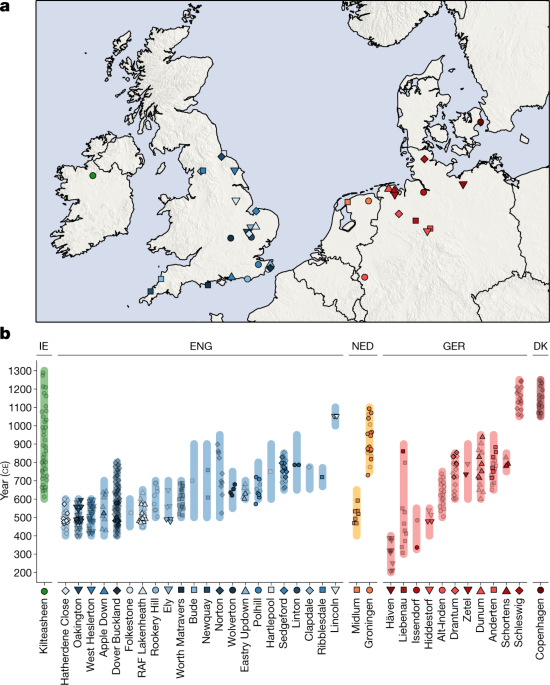
Unearthed in the early 1980s, Apple Down offers a compelling example of diversity in burial customs, with both cremation and inhumation practices. The cemetery contains 185 burials with varying orientations, north-south and east-west, suggesting different coexisting groups or communities in early medieval Sussex. DNA analysis linked individuals to Continental Northern European (CNE) and Western British Isles (WBI) ancestry.
First excavated in the 1950s, Dover Buckland comprises over 500 inhumation graves and has become a landmark site for understanding Anglo-Saxon migration. The site is notable for its:
This significant site contains over 200 graves revealing complex burial organization that suggests social stratification. The cemetery features:
Known since the 19th century, this site's grave goods include imported Frankish and Byzantine artifacts, indicating extensive trade networks. DNA results align these individuals closely with contemporaneous populations in continental Europe.
Posited as a crucial center in medieval Kent, Eastry Updown is rich in jewelry and imported artifacts, including a Byzantine buckle, amethyst beads, and Frankish items. These finds reveal connections well beyond the Isles and deepen our understanding of Anglo-Saxon material culture and external influence.
Within a military airbase, this site preserves discrete burial grounds and varied grave configurations that hint at a complex social structure. The discovery of an early grave of an adult female, ostensibly Danish, broadens our perspective on Anglo-Saxon immigration. Isotopic analyses indicating an early Scandinavian female enrich our understanding of movement across the North Sea, while the burials more generally underscore the familial legacies established through migration and integration.
The excavation at Lincoln Castle paints a picture of a community closely tied to religious and possibly royal duties, as suggested by a church or chapel amidst the burial sites. The graves, dating to just before the Norman Conquest, point to individuals of both local and foreign origin, based on isotope evidence.
This accidental discovery of human remains offers a glimpse into a large pre-Conquest cemetery. The burial grounds and scattered bones revive lost voices from between the 7th and 10th centuries.
While initially thought to be Neolithic, Fox Holes Cave surprised researchers with early medieval remains dating to 655-774 CE. The unexpected chronology urges a reassessment of continuity between periods and reveals layers of human history long concealed beneath Yorkshire's cliffs.
This site illustrates a deeply mixed genetic landscape, reflecting broader movements across the North Sea. Differences in burial customs suggest a nuanced coexistence of native traditions and newly introduced continental influences.
Explore another early medieval England DNA study
The genetic analyses reveal a pattern of convergence and divergence across medieval England:
Research on sex-biased ancestry from uniparental markers reveals:
While Scandinavian ancestry during the Viking Age looms large in the historical imagination, the evidence suggests a more complicated picture:
These findings invite us to reconsider early medieval England:
The examination of kings and commoners alike shows us not just who they were, but the worlds they inhabited and the many paths that led to what would become England.
See DNA after the Norman Conquest
Upload your DNA to MyTrueAncestry to see whether you match this family or related ancient DNA samples, and explore how your own ancestry connects to the peoples of early medieval Britain and continental Europe.






Comments