The House of Wyatt
– 3 min read


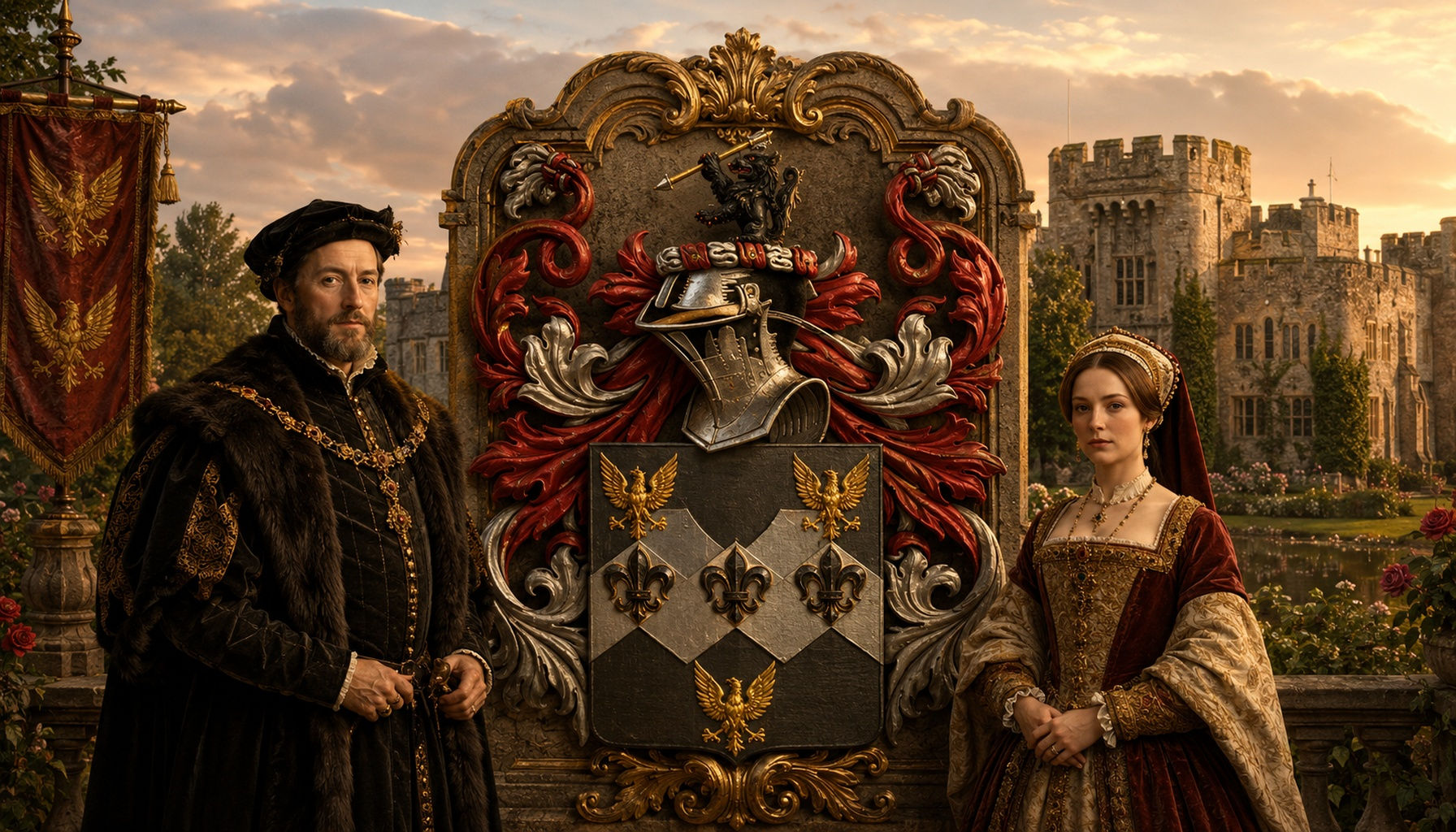
The House of Wyatt was an English gentry family whose story was built not only on land and inheritance, but on service, talent, education, and public reputation. Associated above all with Kent and with the Tudor world, the Wyatts are remembered through court service, poetry, architecture, and civic life. Their primary family haplogroup is tagged here as I1a2a1a1d, a paternal line with deep roots in northern Europe and a long presence in the wider North Sea and continental world that helped shape medieval England.
In historical terms, the Wyatts fit a very English pattern: a family rising and enduring through usefulness to crown and country, polished by learning and culture, and preserved in memory by named individuals rather than by princely rank alone. That is why the family still feels vivid. Sir Henry Wyatt (1460-1537) stands near the foundation of the house's later fame, a trusted royal servant whose fortunes rose under the early Tudors. From that base came later figures such as Sir Thomas Wyatt, courtier and poet, whose name carried the family into the literary history of England. Wyatt prestige was therefore not merely inherited; it was made, remade, and displayed through office, intellect, and public standing.
Read more about the House of Cecil
The great location anchor of Wyatt heritage is Allington Castle in Kent, near Maidstone, set beside the River Medway. The site has medieval origins and was first established as a fortified manor in the 13th century, later becoming a genuine castle complex with curtain walls, towers, and a gatehouse. It passed through important hands over the centuries, and after damage and decline in later periods it became closely associated with the Wyatt family, especially in the Tudor age. Under the Wyatts, Allington was not just a defensive relic but a residence that proclaimed status, loyalty, and cultivated identity. It is one of those places where English history feels properly layered: medieval masonry, Tudor memory, later restoration, and the unmistakable atmosphere of a family seat that tied local standing to national life. The castle still survives and is known as a historic site that can be visited on limited open days and special events, so it remains a tangible point of connection for anyone interested in Wyatt heritage.
From a DNA perspective, the Wyatt-tagged paternal line I1a2a1a1d belongs to a wider northern European haplogroup cluster with a striking archaeological footprint. Related or linked ancient samples assigned within this branch or its close neighborhood include Imperial Roman Serbia at Svilos Krusevlje (R6693), Merovingian Bavaria at Altheim in Germany (Alh_117, Alh_132, Alh_150), Medieval Vasterhus in Sweden (mbv291), the Gothic-associated Maslomecz Wielbark sample from Poland (PL065), Medieval Sint-Truiden in Belgium (ST0006), Thuringii-linked Obermoellern in Germany (OBM005), Migration Period Grodek nad Bugiem in Poland (GRK018), and a strong Scandinavian run through Denmark and Sweden including Southern Sjaelland Praesto Endegaarde (CGG107416), Asnaes (CGG107442), Gedebjerg (CGG107447), Kalundborg Simonsborg (CGG106721), Stenlille (CGG107502), Jerslev Ubby (CGG107505), Vester Egesborg Vordingborg (CGG107507), Regnemark (CGG107427), Juellinge (CGG106773), Viking Age Gorla in Stockholm (gor164), Oland Island (VK443), Salme II on Saaremaa (VK492), Post Viking Age Hedeby (SWG015), Medieval Hungary at Himod Kaposztas (KBS28), Migration Period Scitarjevo in Croatia (R3660), and even an Early Bronze Age signal in Viken, Norway (CGG105645_CGG105646) and Iron Age Maglarp in Sweden (CGG105932_CGG105933). These do not prove direct descent from any named Wyatt ancestor, of course, but they do place the haplogroup in a broad historical world that connects Roman frontiers, Migration Period communities, Viking Age Scandinavia, and the medieval North Sea zone from which much of England's paternal landscape was formed.
Explore Anglo-Saxon migration DNA
If the House of Wyatt speaks to your own family story, whether through English roots, Kentish history, gentry traditions, or the haplogroup I1a2a1a1d, you can take the next step by uploading your DNA to MyTrueAncestry and seeing whether you match the family or any of these related ancient DNA samples. It is a wonderfully direct way to connect surname history, archaeology, and genetics.


Comments