The House of Wentworth
– 3 min read


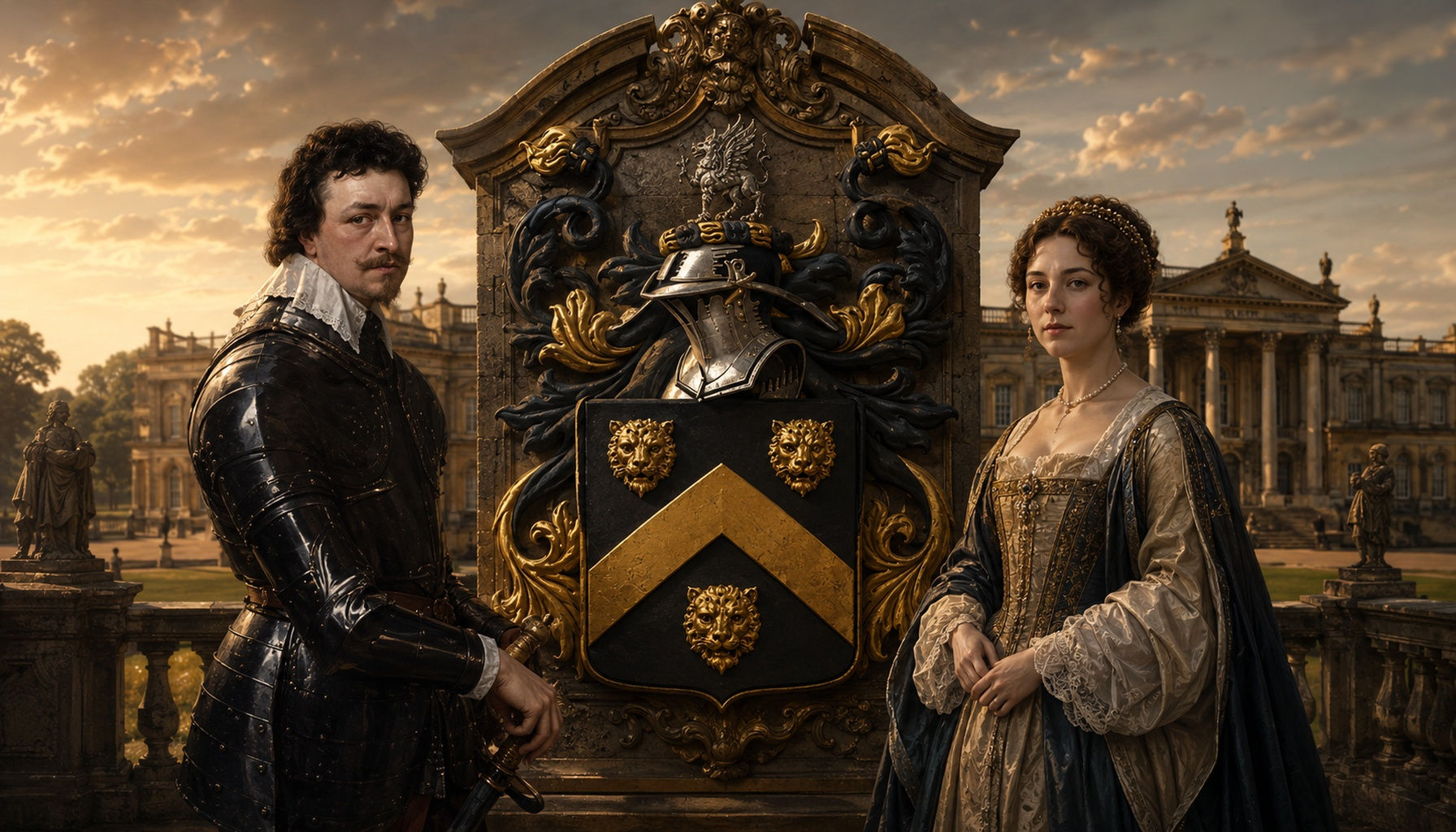
The House of Wentworth was one of the great landed and political families of England, rooted above all in Yorkshire and long associated with public office, estate power, and aristocratic memory. Their story is a very English one: a family rising through landholding, strategic marriage, court service, parliamentary influence, and a careful cultivation of status across generations. In haplogroup terms, the primary family line here is linked with I2a1b1a2a1a1, a paternal branch with a deep and wide ancient footprint across parts of Europe and the Mediterranean.
The family took its name from Wentworth in the West Riding of Yorkshire, and that matters. This was not simply a surname picked for decoration, but a place-name identity anchored in a real landscape of manors, local influence, and county society. From that Yorkshire base, the Wentworths developed into a house that could operate both locally and nationally: sheriffs, MPs, courtiers, peers, and political heavyweights. Among the best known are Thomas Wentworth, 1st Earl of Strafford (1593-1641), the formidable minister of Charles I; William Wentworth, 2nd Earl of Strafford (1626-1695), who carried the family name through the Restoration world; and Charles Watson-Wentworth, 2nd Marquess of Rockingham (1730-1782), twice Prime Minister and one of the central figures of 18th-century British politics.
If the family needs one architectural anchor, it is Wentworth Woodhouse in South Yorkshire, one of the grandest stately houses in Britain and a place that almost seems to argue with the viewer about the scale of aristocratic ambition. The house is especially famous for its vast facade, its development across different periods, and the way it embodies the wealth and political standing of the Wentworth and later Fitzwilliam connections. It sits within an extensive estate landscape and became not just a residence but a statement of rank, patronage, and continuity. Like many great houses, it tells several stories at once: family prestige, changing taste, inheritance, politics, and the economics of land. Happily, it is not just a name in a genealogy chart. Wentworth Woodhouse is open to visitors today, so the family's historical setting can still be experienced in person rather than merely imagined from portraits and pedigrees.
Read more about the House of Cavendish
For those interested in deeper paternal ancestry, I2a1b1a2a1a1 is not a "Wentworth-only" signature, nor does it prove direct descent from any ancient individual. What it does offer is a set of linked ancient reference points that show how old and geographically varied this branch is. Related or linked samples include Neolithic Romania at Giurgiu Pietrele Magura Gorgana (PIE060 and PIE061), a Hellenic individual from Carthaginian-era Mozia in western Sicily (I7648), an Early Bronze Age individual from Izmir in Aegean Anatolia (I5737), an Ancient Dorian from Halikarnassos on the Aegean coast (I3311), a Bronze Age sample from Klakar in Bosnia-Herzegovina (I19561), Roman-period and Late Roman samples from Croatia, Bulgaria, and Hungary such as OSIJ004, I40571, and RKF242, a Migration Period sample from Rakoczifalva Szolnok in Hungary (RKF261), a Late Medieval sample from Bardhoc in Albania (I14686), and even a Viking Age sample from Skara Varnhem in Sweden (VK427). In other words, the haplogroup linked with the Wentworth paternal line belongs to a much older European story that stretches across millennia of farmers, soldiers, townsmen, and mobile communities.
Explore Roman and Early Medieval Britain DNA
If you are exploring Wentworth heritage, the most interesting question is not just whether the name appears in your family tree, but how your own DNA might connect with the wider historical world around it. Upload your DNA to MyTrueAncestry to see whether you match the House of Wentworth, its haplogroup I2a1b1a2a1a1, or related ancient DNA samples from across Europe and the Mediterranean.
Comments