The House of Gervais

– 3 min read


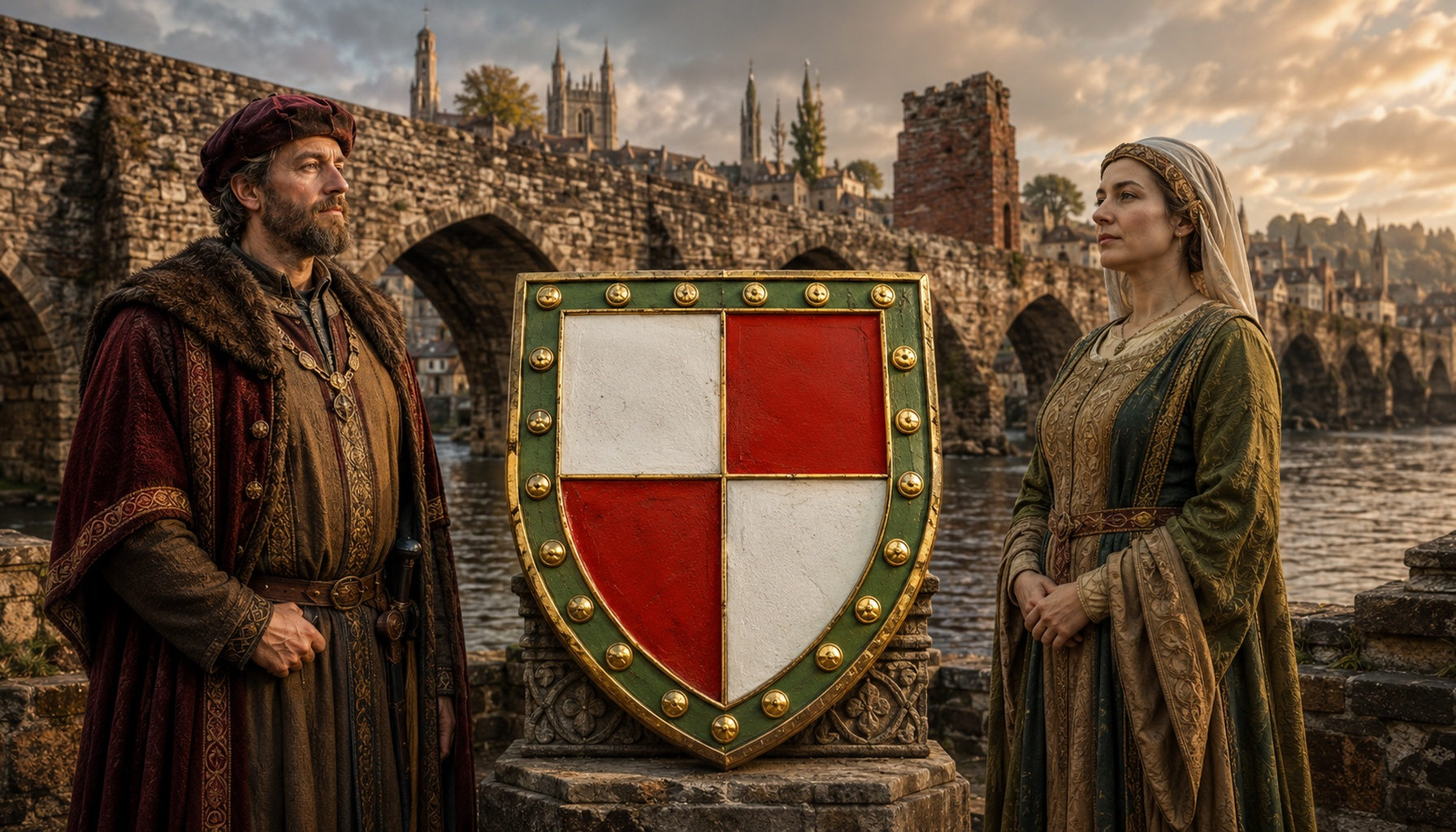
The House of Gervais belongs to the broad world of French-origin family houses: families rooted in place, remembered through surname continuity, public service, marriage alliances, and the long afterlife of reputation. In that sense, Gervais is not simply a name but a pattern of historical identity, one shaped by regional belonging and by the habit, so common in medieval and early modern France, of carrying family memory forward through records, office, land, heraldic association, and migration. The primary haplogroup linked here is R1b1a1b1a1a2c1a4b2, a branch within the wider western European paternal landscape, and it offers a genetic tag for exploring deep-time connections alongside the documentary story.
The surname itself sits in a rich historical setting stretching between France and England, where names often travelled with clerics, merchants, soldiers, and settlers. That helps explain why figures associated with the name appear in different forms across centuries, including Gervase of Canterbury in 1188, John Gervais in 1268, and much later Leonard Jarvis, 1781 to 1854, whose surname spelling reflects the very normal evolution of family names over time. The House of Gervais is best understood not as a single unbroken courtly line we can prove in every generation, but as a durable French family-house tradition: local roots, remembered name, changing branches, and continuity through shifting historical worlds.
A particularly evocative anchor for the Gervais story is Canterbury Cathedral, bound up with the memory of Gervase of Canterbury, the monk and chronicler active in the late 12th century. Canterbury Cathedral in Kent is one of the great monuments of medieval Europe: the seat of the Archbishop of Canterbury, part of a UNESCO World Heritage Site, and famous above all for the murder of Thomas Becket in 1170, which turned it into one of the most important pilgrimage destinations in Christendom. Architecturally it is a grand layering of centuries, with early Christian origins, major Romanesque rebuilding after the Norman Conquest, and striking Gothic work that followed the fire of 1174. It is exactly the sort of place where family memory, ecclesiastical service, and written history meet under one roof. Better still, it can still be visited today, which gives this family story a very real stone-and-mortar setting rather than a merely abstract genealogical backdrop.
Read more about the House of de Warenne
From the ancient-DNA angle, the haplogroup R1b1a1b1a1a2c1a4b2 is linked to a wide spread of related samples across Britain and the near continent, reminding us that surnames are recent, but paternal lineages are much older. Among the related or linked samples are several Celtic Durotriges burials from Duropolis at Winterborne Kingston in England, including WBK12, WBK20, WBK29, WBK41, WBK05, WBK30, WBK43, WBK06, WBK08, WBK18, and WBK191, as well as medieval and later individuals such as Cambridge St Johns Hospital ATP_PSN_192, Clopton Cambridgeshire ATP_PSN_1268, and post-Roman Worth Matravers I11580. The same broader lineage also appears in places as varied as Imperial Roman Zadar in Croatia I26776, Bronze Age Orkney KD061, Bronze Age Calabria GMO015, Early Medieval Belgium ST2025, medieval Sint-Truiden ST1308, Gallic France CGG023699, Alt-Inden IND013 in Germany, medieval Ireland KIL020, Late Roman Austria R10656, Late Roman Portugal R10488, Danebury I17264, Worlebury I11991, Battlesbury Bowl I21309, East Lothian I2693, Applecross I3568, Trumpington Meadows I3256, Amesbury Down I2417, Upavon I4950, Bedfordshire I7576 and I7577, Boatbridge Quarry I5473, Trumpington I7640, Hinxton HI2, the Early Bronze Age Thames sample I5377, and Rathlin2B from Copper Age Ireland. These are not evidence of direct descent from any one ancient individual to the House of Gervais, but they do place the family's tagged paternal line within a deep and fascinating archaeological network stretching from Bronze Age Britain to Roman and medieval western Europe.
Explore Roman and Early Medieval Britain DNA
If the House of Gervais speaks to your own family story, the next step is to test it against both history and archaeology. Upload your DNA to MyTrueAncestry to see whether you match the House of Gervais, the haplogroup R1b1a1b1a1a2c1a4b2, or any of the related ancient samples linked to this wider lineage across Britain, France, and Europe.


Comments