The Gascoigne Family
– 3 min read


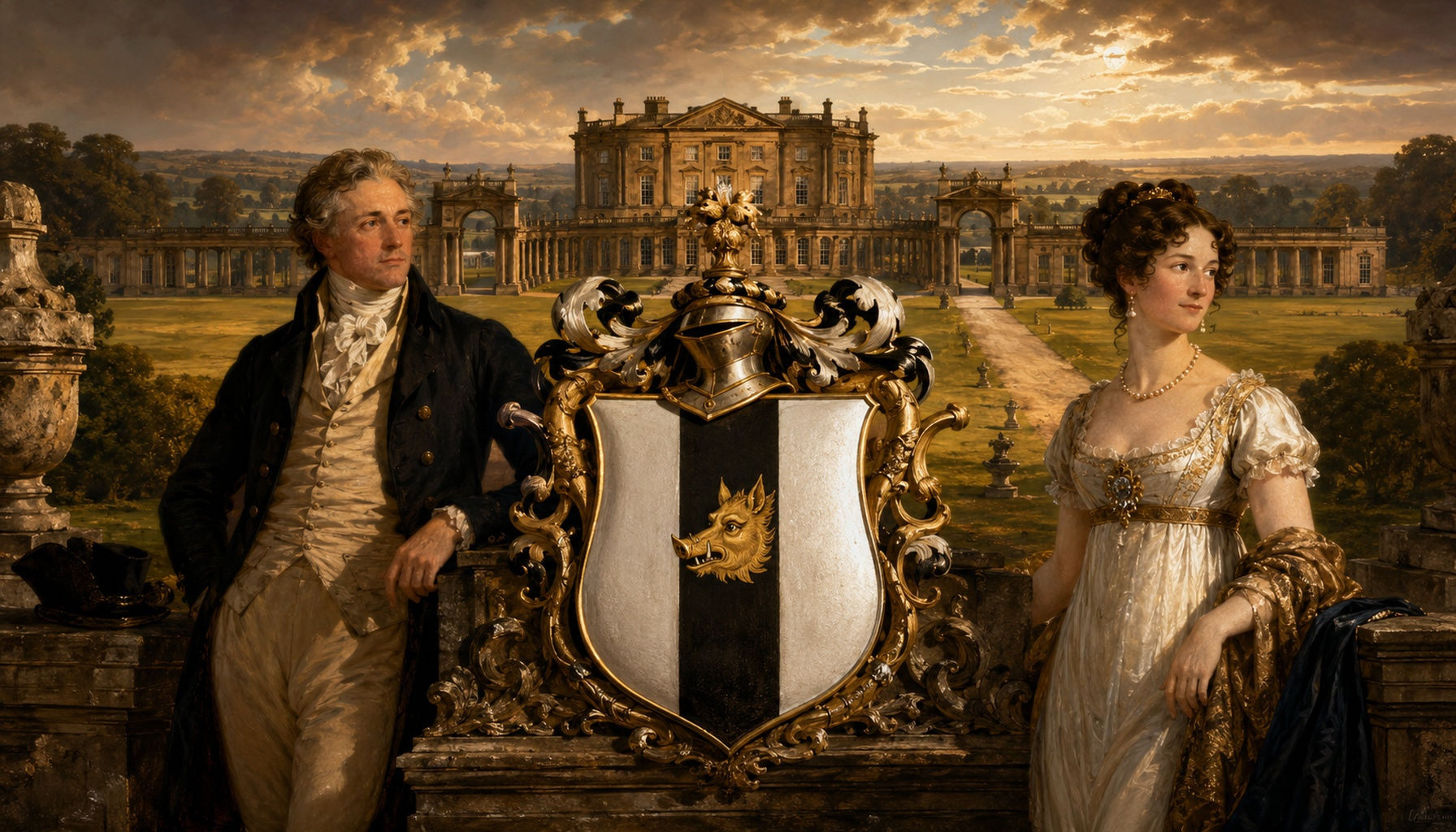
The Gascoigne family, remembered as House Gascoigne, was one of those long-standing English landed families whose story is really the story of how local power worked in medieval and early modern England. They emerged from the world of manor, county office, legal service, marriage strategy, and estate continuity: not kings, not quite magnates, but exactly the kind of gentry house that helped hold the machinery of English society together. Their roots are associated above all with Yorkshire and later with Oxfordshire, and their primary linked Y-DNA haplogroup here is R1b1a1b1a1a2c1a4b4a1a1, a branch within the very widespread western European R1b line.
What makes the Gascoignes interesting is that they fit a recognisable English pattern while still producing individuals of real historical weight. Land was the foundation, of course, but land by itself was never enough. Families like this had to translate acreage into influence: through service to crown and county, through advantageous marriages, through heraldic identity, and through the careful passing on of property from one generation to the next. Among the best-known members are William Gascoigne (1350-1419), the distinguished judge and Chief Justice of the King's Bench, often treated as a model of late medieval judicial authority, and Thomas Gascoigne (1404-1458), the learned Yorkshire theologian and chronicler whose writings offer an unusually sharp window into the anxieties and politics of fifteenth-century England.
Read more about House of Lowther
A key later anchor for the family story is Kiddington Hall in Oxfordshire, near Woodstock, a country house set within landscaped parkland that speaks perfectly to the world of the English landed elite. The present hall is largely an eighteenth-century house, rebuilt around 1770 for the Dashwood family and associated with the architect Sir William Chambers, though the estate itself is much older and sits in a landscape layered with earlier occupation and aristocratic reuse. In other words, Kiddington is not just a pretty house in a park; it is a textbook example of how old landholding families and their successors reshaped inherited estates to project taste, authority, and permanence. The Hall is a Grade I listed building, with notable parkland and estate features, and while it is a private house rather than a fully open museum property, the estate and its setting are still very much part of the visible historic landscape and can be appreciated from the area if visiting locally.
Explore the House of Cavendish
From a DNA perspective, the Gascoigne line is tagged here with haplogroup R1b1a1b1a1a2c1a4b4a1a1. That does not let us claim direct descent from ancient or medieval excavated individuals, and we should be careful about that. What it does do is place the family within a broader paternal network linked to a range of ancient samples across Britain and Europe. Related or linked examples include several Celtic Durotriges individuals from Duropolis at Winterborne Kingston in Dorset, such as WBK12, WBK20, WBK29, WBK41, WBK05, WBK30, WBK43, WBK06, WBK08, WBK18 and WBK191; the medieval sample ATP_PSN_192 from St Johns Hospital, Cambridge; Post Roman Worth Matravers, Dorset sample I11580; Iron Age samples from Worlebury in Somerset and Battlesbury Bowl in England; Bronze Age individuals from Trumpington Meadows, Amesbury Down, Bedfordshire, Westray in Orkney, and Upavon in Wiltshire; and further linked finds from Belgium, Germany, Austria, Portugal, Croatia, France, Calabria, and even Rathlin in Copper Age Ireland. Taken together, these are not "Gascoignes before the Gascoignes" but a deep archaeological backdrop for the kind of western European paternal ancestry from which an English gentry house like this ultimately emerged.
Read Ancient DNA in Post-Roman Britain
If the Gascoigne family story rings a bell for your own ancestry, the next step is to test it against both history and archaeology. Upload your DNA to MyTrueAncestry and see whether you match the Gascoigne family group or related ancient DNA samples linked to haplogroup R1b1a1b1a1a2c1a4b4a1a1 and the wider world of Iron Age, Roman, and medieval Britain.
Comments