The Embracing Man of Pompeii
– 5 min read
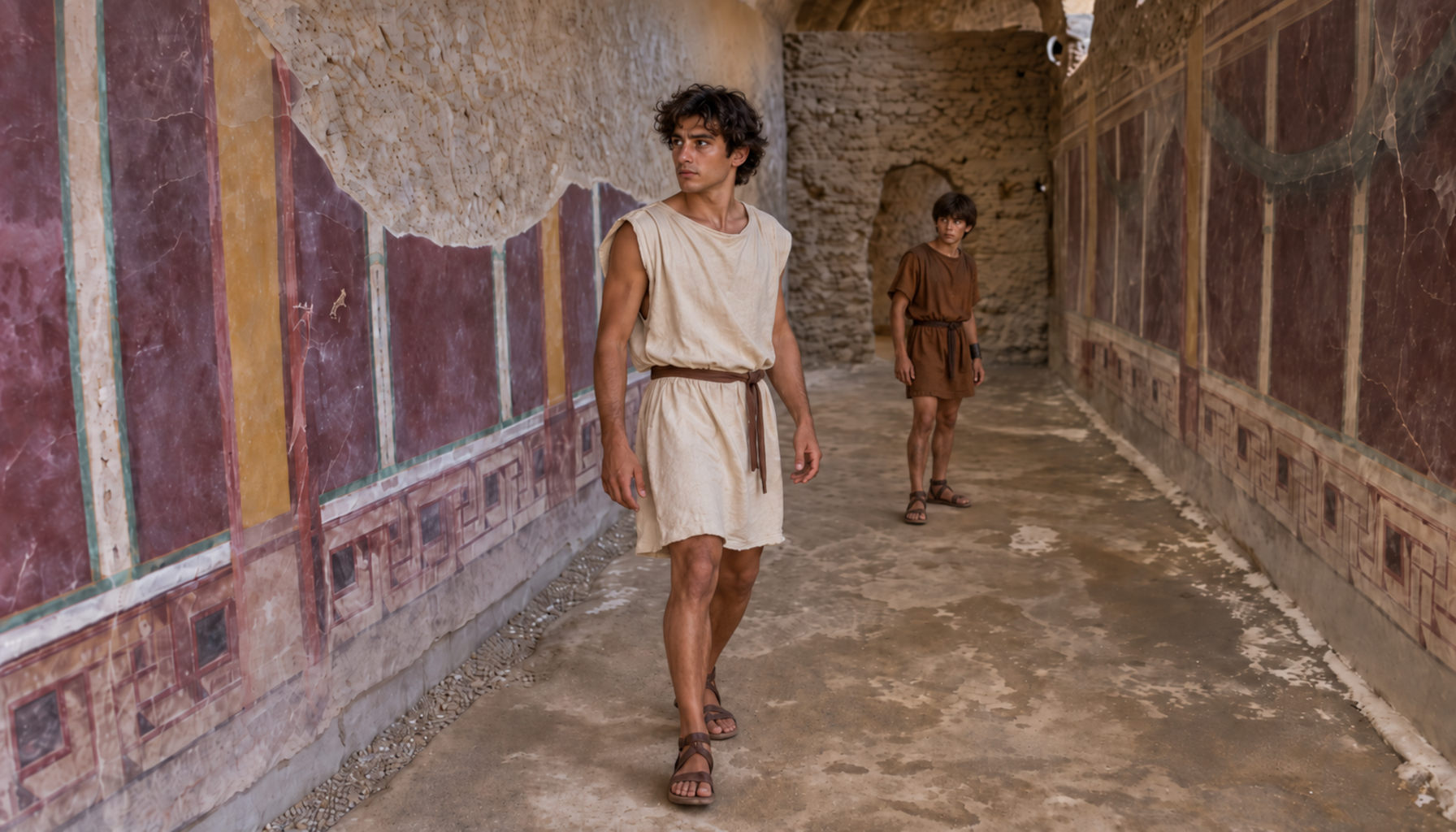
The so-called Embracing Man of Pompeii is one of those ancient people who have long been known by a pose rather than a name. He is the young adult Roman represented by sample I3690, traditionally identified as Cast 22 from the House of the Cryptoporticus at Pompeii, and he died in the eruption of Mount Vesuvius in 79 AD. Found beside another victim, Cast 21, his body position seemed to generations of viewers to capture an embrace in the last moments before death.
That image did a great deal of work in the public imagination. For years, people proposed that the pair might be sisters, or perhaps a mother and daughter, as if closeness in death must automatically reflect family ties. Ancient DNA, however, has given this famous Pompeian victim a rather sharper historical outline. It showed that I3690 was genetically male and that the two individuals were not maternally related. That does not tell us exactly who they were to one another, but it does remind us that Roman cities were full of relationships more varied than tidy family labels allow.
The Embracing Man lived in a world that was thoroughly Roman but never culturally narrow. Pompeii in the first century AD was a prosperous Campanian town under the early emperors, rebuilt and reshaped after the earthquake of 62 AD, and tied into imperial trade networks that ran across the Mediterranean. Its inhabitants spoke Latin, used Roman law, visited baths and temples, and moved through houses decorated with the confidence of a wealthy urban society. Yet Roman Pompeii was also a place of mobility: merchants, freedpeople, migrants, slaves, and families from different regions of the empire could all be part of its streetscape.
That wider background matters here because the genetic evidence suggests that I3690 had ancestry with affinities toward the eastern Mediterranean. In other words, he stands as a vivid individual example of something historians have increasingly suspected and archaeologists have often glimpsed: Roman Italy, and especially towns plugged into commerce, was not a sealed biological or cultural box. His story is historically important not because DNA suddenly gives him a neat identity, but because it strips away an old sentimental assumption and places him back into the cosmopolitan human reality of the Roman world.
The biological sample is described as Roman Pompeii Vesuvius Victim House of the Cryptoporticus, dated to about 79 AD. The association with this individual is strong in archaeological terms: sample I3690 corresponds to the victim long known as Cast 22 from the House of the Cryptoporticus. What we have here is not a named historical person in the way we might identify an emperor or an inscription-bearing official, but a securely associated archaeological individual from a famous Pompeian context.
The House of the Cryptoporticus was one of the residences overwhelmed during the Vesuvian disaster. The casts made from voids left in the volcanic deposits preserved the positions of the dead with extraordinary emotional force. In this case, Cast 22 lay beside Cast 21 in a configuration that seemed intimate enough to encourage generations of storytelling. But the scientific work behind the recent study, including ancient DNA analysis discussed in Current Biology, allows us to separate what is actually supported from what is merely evocative. The remains preserve a real human tragedy; they do not, by themselves, reveal the exact social bond between the two victims.
The Embracing Man’s Y-DNA haplogroup was J2b2a1, while his mtDNA haplogroup was N1b1a1. These are two different kinds of lineage markers. Y-DNA traces the direct paternal line, passed from father to son, while mitochondrial DNA traces the direct maternal line, passed from mothers to all their children. They are useful pieces of the puzzle, but only pieces.
His Y-DNA lineage, J2b2a1, belongs to a broader set of paternal lineages with a long history around the Mediterranean and neighboring regions. That does not make it an ethnic badge, still less a proof of nationality. It simply places his direct father’s father’s father line within one branch of human paternal history. The mtDNA lineage N1b1a1 does the same for one narrow maternal line. Neither haplogroup tells us his language, legal status, occupation, or personal identity, and neither can by itself explain the social relationship between Cast 22 and Cast 21.
What makes the DNA historically powerful is not just the haplogroups, but the wider genomic result. The study found that I3690 was genetically male and that the pair were not maternally related. That matters because it overturns a deeply rooted interpretation based largely on visual impression. It also showed ancestry links pointing toward the eastern Mediterranean, which fits a growing body of evidence that Roman communities could include people with varied origins and family histories.
There are also broader ancient-DNA echoes for the paternal lineage J2b2a1. Related samples with that lineage appear across a strikingly wide chronological and geographic range, including Medieval Sicily Segesta Muslim Grave (SGBN5), Medieval England Cambridge St Johns Hospital (ATP_PSN_264 and ATP_PSN_113), Late Imperial Roman Serbia Timacum Kuline Ravna Village (I15547), Goth Maslomecz (PCA0113), several post-Roman and Late Roman individuals from Pannonia such as SZL077, GYS031, GYS025, HMU036, SZL004, and KMU008, as well as older examples from Carthaginian-era Motya in Sicily (I4798), Bronze Age Croatia, Mycenaean Greece, Iron Age Croatia, Illyrian Albania, and Phoenician Kerkouane. The point is not that these people formed one tribe or one people. Quite the reverse: this paternal branch turns up in very different cultural settings, which is exactly the sort of pattern one expects in a Mediterranean world shaped by long-distance mobility, trade, warfare, and intermarriage.
The maternal lineage N1b1a1 is more modestly attested in the material supplied here, with the key linked ancient sample being Roman Pompeii Vesuvius Victim House of the Cryptoporticus (I3690) itself. That limitation is worth stating plainly. Sometimes ancient DNA gives us many comparanda; sometimes it gives us only a narrow anchor point. In this case, N1b1a1 helps define one direct maternal line for this individual, but the historically important conclusions come more from the combination of sex determination, kinship exclusion, and broader ancestry signals than from the maternal haplogroup alone.
The Embracing Man of Pompeii is a fine example of what ancient DNA can and cannot do. It can correct a mistaken assumption, reveal biological sex, test for certain family relationships, and place a person within wider patterns of ancestry and mobility. It cannot tell us the name he used, whether Cast 21 was his friend, companion, relative by marriage, servant, or simply another frightened person trapped in the same room. In that sense, the science makes the story both clearer and more human. It removes an easy fiction and leaves us with a more interesting Roman reality: a young man in a diverse imperial city, caught forever in a gesture we can see but never fully explain.
Discover eastern Mediterranean ancestry in Roman Italy
If this Pompeian life and death has sparked your curiosity, MyTrueAncestry lets you compare your DNA with ancient populations and archaeological samples from the Roman world and far beyond. It is a way to explore genetic connections to the kinds of lineages and populations that shaped places like Pompeii, without claiming direct descent from any one ancient individual.

Comments