The Craftsman of Pompeii
– 5 min read
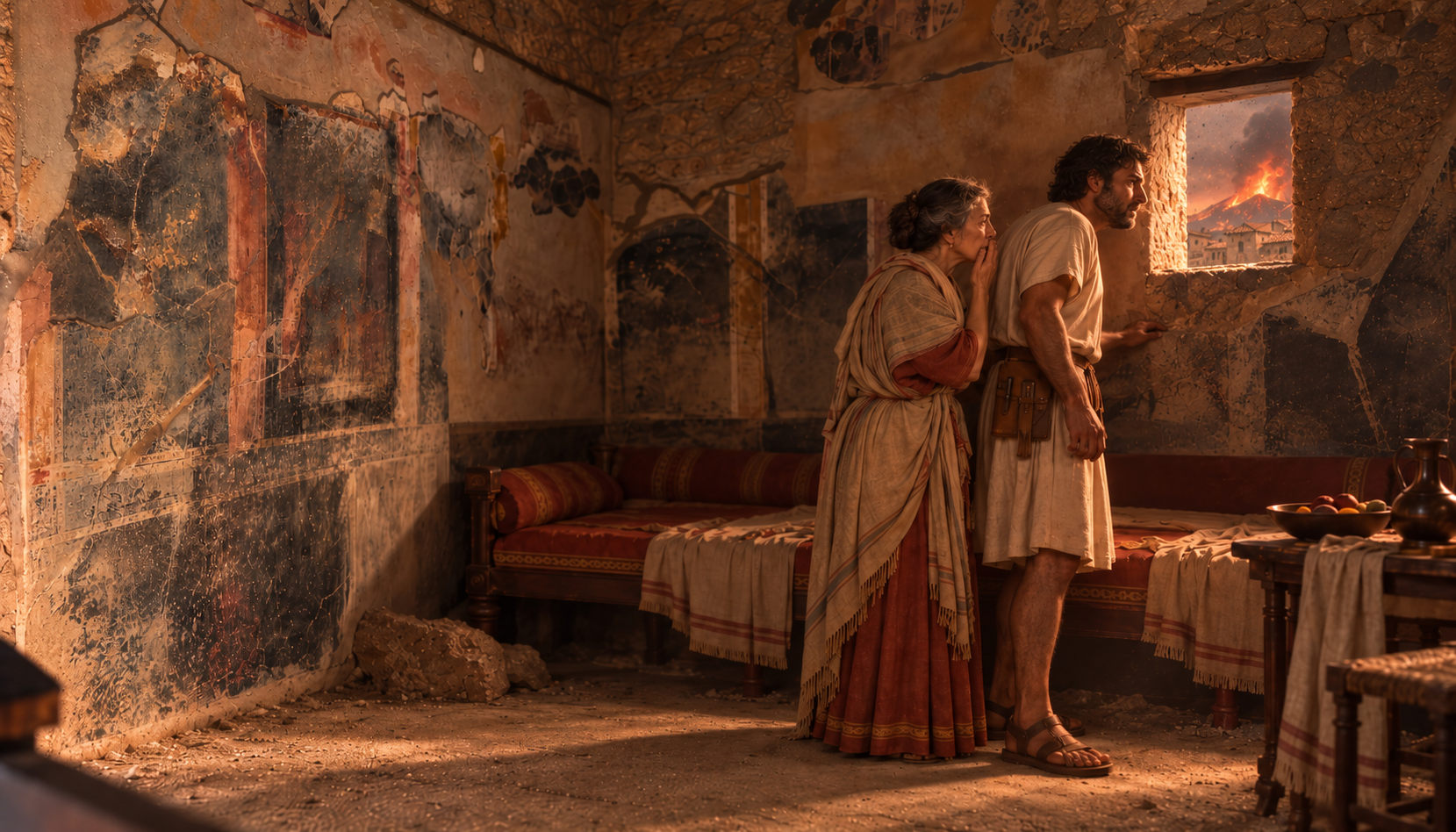
The man often called the Craftsman of Pompeii was not an emperor, a general, or a famous author. He was something more revealing in its own way: an ordinary Roman townsman, about 35 to 40 years old, caught in one of history’s most famous disasters. He died in 79 AD in the Casa del Fabbro, the House of the Craftsman, at Pompeii, when Mount Vesuvius destroyed the city in a sequence of ashfall, heat, and lethal surges.
That very ordinariness is the point. Pompeii is so often treated as a stage set for catastrophe that it is easy to forget it was a living Roman town under the Flavian emperors, in the age of Vespasian and Titus, buzzing with trade, workshops, dining rooms, shrines, gossip, and repairs after the earthquake of 62 AD. The Craftsman of Pompeii matters because his skeleton, his house, and now his genome bring us unusually close to one individual life within that Roman world.
The individual represented by sample f1R was found in what was probably the dining room of the Casa del Fabbro, together with an older woman. His body lay partly against a Roman dining couch when the volcanic surge overwhelmed the building. It is a grim scene, but an intimate one too: not a battlefield, not a formal tomb, just a domestic interior suddenly turned into a place of death.
The house itself is what gives him his modern nickname. Archaeologists found an unusual collection of iron woodworking tools, along with furniture remains, decorative bone elements, and other materials associated with skilled carpentry. That does not amount to a signed business card, and we should be careful: he is not securely identified by name, and the link between this man and a cabinetmaker’s trade is a strong archaeological suggestion rather than a certainty. Even so, the setting makes it plausible that an occupant of the house practiced specialized woodworking or fine furniture making. If so, he belonged to that vast class of Roman skilled workers whose labor filled homes with doors, chests, couches, fittings, and ornament, but whose names almost never survive.
His skeleton adds another sobering detail. Researchers observed destructive lesions of the spine consistent with tuberculosis. In life this may have caused serious pain and physical limitation. So behind the neat label “Craftsman of Pompeii” there may have been a man working through chronic illness in a town still recovering from earlier disaster, only to be killed by the eruption that ended Pompeii altogether.
Explore Pompeii’s ancient genomes
The biological sample is described as Roman Pompeii Vesuvius Victim Casa del Fabbro, dated to approximately 79 AD. The remains come from the eruption victims discovered inside the Casa del Fabbro at Pompeii. In this case we are dealing not with a securely named historical person, but with a probable identification of a particular victim as the adult male found in that house and designated genetically as sample f1R.
That distinction matters. We can say with confidence that this was a real man who died in the eruption, and that his remains were excavated in a specific domestic context. We cannot say what his personal name was, nor can we prove from the evidence alone that he himself was the woodworker rather than another member of the household. The archaeological context, however, is unusually rich, and it is exactly this combination of skeleton, room, artifacts, and disaster horizon that makes him such a powerful case study.
He is also scientifically important for another reason: his remains yielded the first essentially complete ancient human genome recovered from a Pompeii victim. That is a major technical achievement, because environments affected by heat, contamination, and difficult preservation do not always produce usable ancient DNA. The study published in Scientific Reports showed that Pompeii’s victims can, in some cases, preserve genomic information detailed enough to illuminate ancestry as well as pathology and archaeological context.
The Craftsman of Pompeii’s Y-DNA haplogroup, tracing his direct paternal line from father to father, was reported as A1b1b2b. His mtDNA haplogroup, tracing his direct maternal line from mother to mother, was HV0a. These are lineage markers, not ethnic labels. They tell us about one narrow paternal line and one narrow maternal line within his family tree, not the entirety of his ancestry, identity, language, or social status.
The Y-DNA result is especially striking because A1b1b2b is a deep and uncommon paternal lineage in ancient Eurasian discussions, and its appearance in a Roman Pompeian individual is a reminder of how complex the population history of the Roman world could be. Rome and Roman Italy were connected to wider Mediterranean and extra-Mediterranean networks through slavery, trade, military movement, migration, and generations of family mixing. A haplogroup alone cannot tell us when or how this lineage entered his paternal ancestry, but it does show that even in a seemingly local Pompeian household, the deeper genetic story may be unexpectedly wide-ranging.
A short ancient-DNA comparison helps place that paternal lineage in context. A1b1b2b-linked individuals have been reported from a remarkably scattered set of times and places, including the same Pompeii sample f1R, Neolithic Croatia at Starcevo Vinkovci-Nama, Iron Age and Scythian-period Ukraine, post-Roman Pannonia in Hungary, Merovingian Germany, medieval Sweden, Iron Age Ibiza, medieval Belgium, Iron Age Denmark, Viking Age Norway, Carthaginian-linked Tunisia, and even far older or geographically distant finds such as Ballito Bay in South Africa. That does not mean these people formed one coherent population, still less that they were close relatives in any ordinary sense. It means only that this paternal branch, or branches assigned within it, appears across a long and complicated human record. For the Pompeian craftsman, the value of the comparison is not to pin an identity label on him, but to underline that Roman Italy sat within a world of deep mobility and layered ancestry.
His maternal lineage, HV0a, is much less dramatically discussed in the published material here, and among the supplied related ancient samples the clear example is the Pompeii individual f1R himself. That limits what can responsibly be said. HV0a marks his direct maternal line, but by itself it cannot identify his mother’s recent place of origin, let alone his household’s ethnicity or social role. Still, it is part of the great usefulness of ancient DNA that both paternal and maternal lines can now be recorded for a man whose life would otherwise be known only from bones and the objects left in a ruined room.
Read about DNA from Roman Italy
The genome of the Craftsman of Pompeii is historically interesting not because it “solves” his identity, but because it restores biological depth to a specific victim of Vesuvius. It confirms that Pompeii’s dead can be studied not just as plaster-cast symbols of catastrophe, but as individuals with traceable ancestry and health histories. Combined with the spinal lesions suggestive of tuberculosis, the DNA work turns him into a particularly vivid example of bioarchaeology meeting urban Roman history.
What it cannot do is far more modest than popular imagination sometimes hopes. His haplogroups do not prove he was ethnically one thing or another; they do not identify his profession with certainty; and they do not make modern people with similar lineages his direct descendants. What they do provide is a carefully delimited genetic snapshot of one Pompeian man, embedded in the bustling, mixed, and often surprising human landscape of Roman Italy.
Discover wider Roman-era ancestry
At MyTrueAncestry, you can compare your DNA with ancient populations and archaeological samples from worlds like Roman Italy, Pompeii, and the wider Mediterranean. It is a way to explore genetic connections to the past and see how your own story may intersect with the deep human history revealed by archaeology and ancient DNA.


Comments