Spanish Habsburg
– 4 min read


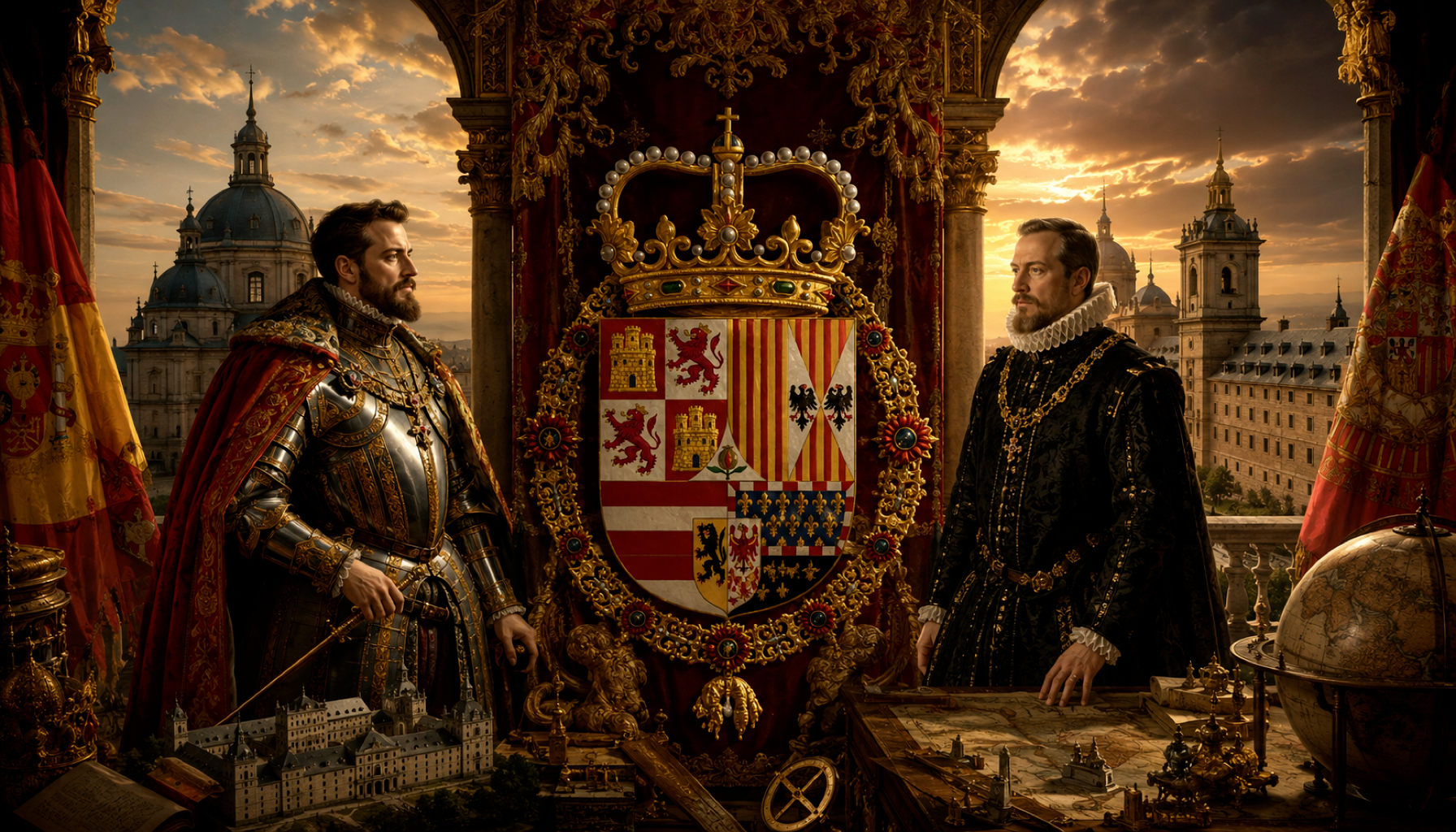
The Spanish Habsburgs were the Spanish branch of the House of Habsburg, the dynasty that came to rule one of the largest and most ambitious composite monarchies in early modern history. Their rise rested not simply on conquest, but on that classic dynastic recipe of inheritance, marriage, piety, paperwork, and war. From the sixteenth into the seventeenth century they governed Castile, Aragon, the Low Countries, large parts of Italy, Spain's American dominions, and far-flung possessions tied into a Catholic global monarchy. In haplogroup tagging terms, the primary family haplogroup linked here is G2a2b2a1a1b.
The family itself came originally from the Habsburg lands of the Upper Rhine and Alpine world, with roots in what is now Switzerland and southwestern Germany before expanding into Austria and then across Europe through marriage politics of almost theatrical effectiveness. The Spanish line emerged when Habsburg inheritance fused with the crowns of Spain, especially through Joanna of Castile and Philip the Handsome, bringing together Iberian kingdoms with Burgundian and Austrian dynastic interests. This is why the Spanish Habsburg story feels so vast: it is never just about Spain, but about an interconnected imperial system stretching from Madrid to Milan, Brussels, Naples, Mexico City, Lima, and beyond. Among its best-known rulers were Charles I of Spain, who was also Holy Roman Emperor Charles V, Philip II, architect of an intensely Catholic and administrative monarchy, and Philip IV, remembered for both political strain and the extraordinary court culture of the age of Velazquez.
What made the Spanish Habsburgs distinctive was their ability to turn family politics into world politics. They stood for Catholic monarchy in an age of Reformation and confessional conflict, and they built an empire held together by councils, viceroys, scribes, silver fleets, and military obligation as much as by royal image. Their reign saw the Spanish monarchy battling France, confronting England, fighting the Dutch Revolt, and facing the Ottoman world across the Mediterranean. Yet this was not merely a story of armies and decline, as older textbook summaries sometimes make it. It was also the age of court ritual, saints and relics, painters and architects, legal reform, colonial administration, and a constant attempt to make a scattered inheritance function as a single political organism. The Spanish Habsburgs are, in that sense, the great example of the dynastic empire model: power built from bloodlines, religion, ceremony, and institutions.
No place captures the Spanish Habsburg imagination better than El Escorial, in the town of San Lorenzo de El Escorial northwest of Madrid, on the slopes of the Sierra de Guadarrama. Commissioned by Philip II in the sixteenth century, it was designed as a royal monastery, palace, basilica, library, school, pantheon, and political symbol all at once, which is a very Habsburg combination of devotion and statecraft. The complex is famous for its severe, monumental geometry and its association with the cult of Catholic kingship: this was not a pleasure palace in the lighter Italian sense, but a statement in stone about monarchy, order, faith, memory, and empire. It also became the burial place of many Spanish monarchs, giving it a dynastic gravity quite apart from its architecture. El Escorial still stands and can be visited today, and for anyone interested in the Spanish Habsburgs it is one of those rare places where ideology, family, religion, and politics feel physically present in the building itself.
For readers interested in deeper genetic context, the haplogroup tag G2a2b2a1a1b has appeared in a wide spread of ancient and historic samples across Europe and the Mediterranean. These are not evidence of direct descent from the Spanish Habsburg family, but they are useful related or linked points showing the long time depth and geographic range of this paternal line. Examples include Elite Celtic Germany Eberdingen-Hochdorf Biegel (HOC003, HOC003b), Copper Age Alpine Italy South Tyrol Ora/Auer (3058_13_115_1), Dark Ages Italy South Tyrol Malles Burgusio Santo Stefano (2427), Late Copper Age Baden Budakalasz Luppa Csarda Hungary (I2366), Bronze Age Spain Camino del Molino Murcia Caravaca (CDM002), Soldier of Napoleon Grande Armee Mass Grave Vilnius Latvia (YYY085B), Late Imperial Roman Croatia Hvar Radosevic Palace (I33890), Migration Period Germany Deersheim Saxony-Anhalt (DRH034), Thuringii German Obermoellern (OBM011), Imperial Roman Croatia Karlovac Pannonia Savia (BBC004), Copper and Bronze Age Alpine Italy Nogarole (NOG201, NOG301, NOG302), Trento Romagnano (ROM301, ROM308, ROM309), Trento Paludei di Volanoo (PAL01), Carthaginian Kerkouane Tunisia Pantelleria (I24208), Ancient Greek Himera Sicily (I7219, I17432), Post Viking Era Denmark St Clemen Zealand (KPN011), Germanic and Gallic contexts in France and Alsace including R11552, BUCH48-1, ERS83-2, WET429, and R11560, Migration Era Hassleben Thuringia (R11872), Iron Age Slovenia and Hungary (I23974, I18526), Kulubnarti Makurian Nubia (I6334, I6337), Iron Age and early medieval Italy including CAM002, VEN012, TAQ006, Early Bronze Age Budakalasz-Luppa Csarda (I2367), Viking Age Skara Varnhem Sweden (VK39), several Neolithic France samples such as GRG035, HBS002, GRG027, GRG021, GRG052, GRG043, GRG003, Late Neolithic Brienzersee Switzerland (SX11), Central Roman Mausoleo Augusto (R30), and Anatolian Roman ANAS (R70). In other words, this is a lineage with a very long archaeological shadow, stretching from prehistoric farming communities to Celtic, Roman, Germanic, Mediterranean, and medieval settings.
If the Spanish Habsburg story makes you wonder what dynasties, migrations, and ancient populations may sit behind your own DNA, upload your results to MyTrueAncestry and explore the historical matches for yourself.
Comments