Princess of Hassleben
– 4 min read


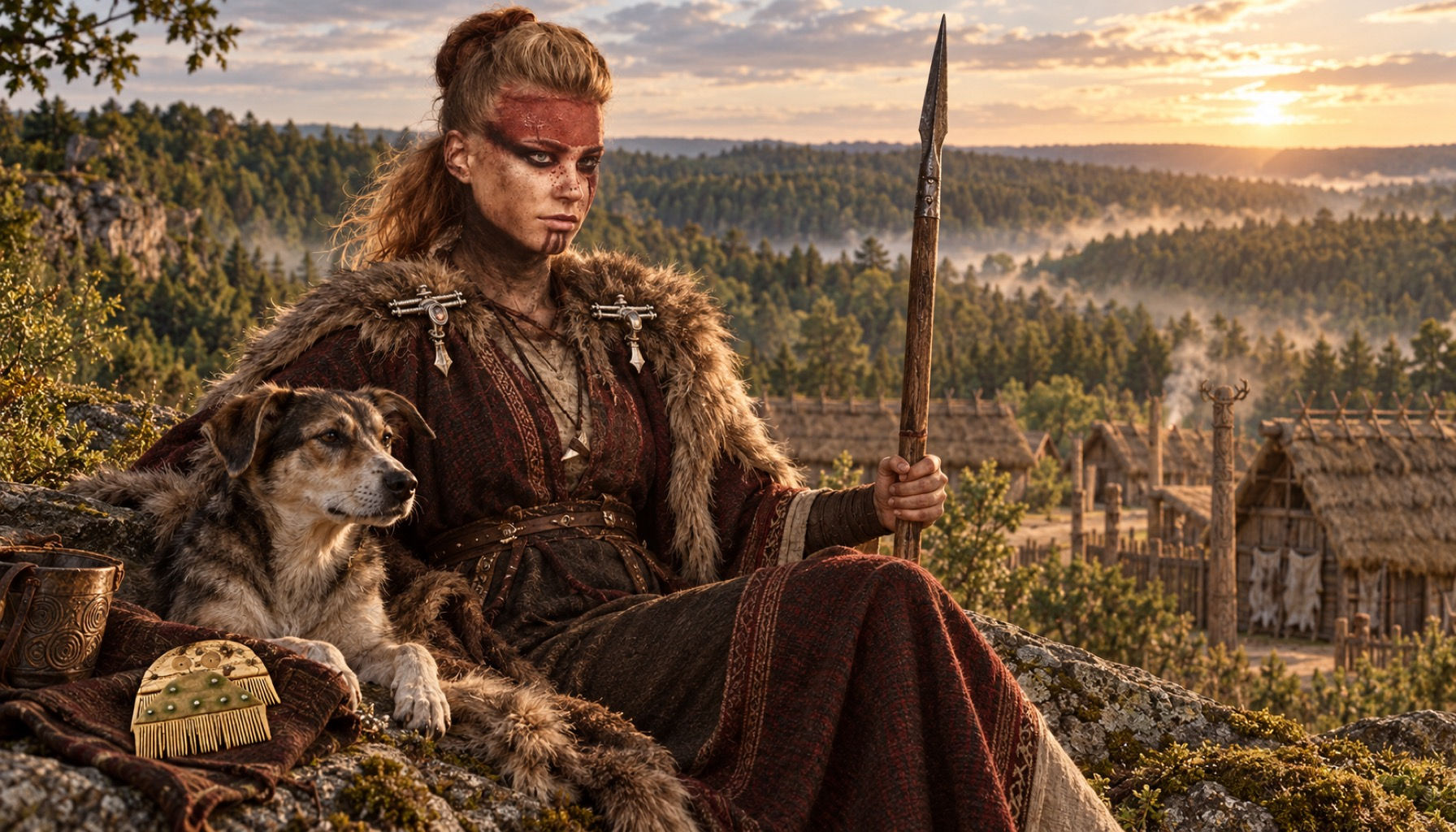
The woman conventionally known as the Princess of Hassleben was buried in Thuringia in one of the most spectacular elite graves of the Germanic world in what archaeologists call the Roman Iron Age. She lived beyond the formal frontiers of the Roman Empire, yet her burial makes plain that the frontier was never a hard wall. It was a zone of negotiation, gift exchange, military service, fashion, and ambition.
At Hassleben, wealth arrived not as an abstract idea but as objects: Roman coins, imported ceramics, jewelry, brooches, and other prestige goods placed in graves of remarkable richness. The so-called princess stands out because her burial captures a historical moment when leading families in central Germany could participate in Roman-connected networks while still expressing unmistakably local identities in dress, status display, and funerary custom.
We do not know her personal name, and “Princess of Hassleben” is a modern archaeological label rather than a documented title. Still, the phrase survives because it conveys something real about the burial’s extraordinary rank. Thuringia in Late Antiquity sat in a world transformed by the weakening western Roman state, shifting military alliances, and the rise of powerful regional elites north of the imperial border. Men from such communities could serve Rome, trade with Rome, raid Rome, or imitate Roman forms of prestige; women in elite households were no less important to that political theatre. Their dress, ornaments, and burial assemblages were public statements about family power, far-reaching contacts, and inherited standing.
The Hassleben cemetery is famous not only for luxury imports but also for evidence of skilled craftsmanship and early Germanic writing in the wider region. That matters because it reminds us that these were not passive consumers of Roman goods. They were communities selecting, adapting, and reinterpreting material from the empire for their own purposes. The burial traditionally associated with the Princess of Hassleben belongs to this complicated frontier world: neither Roman nor isolated from Rome, but part of a connected landscape stretching across central Europe.
Explore the Roman-Germanic Frontier
The ancient DNA sample is described as Thuringian Princess Hassleben Germany, with an approximate date of 450 AD. That date places the individual in the turbulent centuries after the high Roman Empire, when older imperial structures still mattered, but political authority in many frontier regions was increasingly shaped by local warrior aristocracies and their households.
In terms of identification, this is not a securely named historical individual in the way a king in an inscribed tomb might be. It is better understood as a strong archaeological identification: the remains are associated with the exceptionally rich female burial traditionally called the Princess of Hassleben because of the grave’s elite character, not because a personal name survives. The supplied material does not specify which skeletal element produced the DNA, so it is best not to invent details. What can be said is that the biological sample is tied to one of the most celebrated high-status female burials from Hassleben and therefore lets us study the woman herself, not only the glamorous objects buried around her.
That distinction is crucial. Archaeology can show rank, display, and connections; DNA can add biological information about lineage and population affinities. But the skeleton is not a shortcut to biography. It does not tell us what language she spoke, what political choices her family made, or whether she herself had ever seen Roman territory. Those questions still belong to the slower, subtler work of archaeology and history.
Read Post-Roman Central Europe DNA
The reported mitochondrial DNA haplogroup for the Princess of Hassleben is H1t. Mitochondrial DNA, or mtDNA, traces the direct maternal line: mother to child, through an unbroken chain of mothers. Her Y-DNA haplogroup is not available, which is entirely expected because Y-DNA traces the direct paternal line and is present only in genetic males. Since this burial is that of a woman, no Y-chromosome lineage can be reported for her.
Haplogroup H and its branches are widely found in ancient and modern Europe, and H1t is one maternal lineage within that broader family. Still, the important point is not to turn H1t into a tribal badge. A mitochondrial haplogroup does not prove that someone was “Roman,” “Germanic,” “Thuringian,” or anything else in a cultural sense. It simply places this woman within a long maternal lineage that had its own deep history long before the politics of Late Antiquity.
The ancient-DNA angle becomes more interesting when the Hassleben sample is considered alongside other H1t-linked individuals. The directly relevant linked sample is Thuringian Princess Hassleben Germany (R11877), which anchors this maternal lineage in the very individual discussed here. More distantly, H1t-linked samples from very different times and places, such as Late Medieval England All Saints (ATP_PSN_728), Bronze Age Spain North-East Iberia Barcelona Paris Street (I0826), Iron Age Cambridgeshire England (I19046), Iron Age Catalan (I12640), and Iberian / Ilergetes Tribe (I3322), show how a maternal lineage can appear across wide stretches of European history without implying close kinship. Shared mtDNA means a shared maternal ancestry somewhere in the deep past, not a recent family tree connecting an Iron Age woman in Germany to every later H1t carrier.
The reference study at https://www.biorxiv.org/content/10.1101/2022.05.15.491973v1.full is part of the broader archaeogenetic effort to place such individuals into population history rather than treating elite graves as isolated curiosities. The real contribution of ancient DNA here is not a dramatic revelation of identity, but a quieter and more valuable thing: it helps integrate a famous burial into the biological history of Europe’s post-Roman populations.
For the Princess of Hassleben, DNA adds human texture to a burial long defined by riches. It reminds us that beneath the imported vessels and glittering ornaments was a real woman with a maternal ancestry that can be traced as one thread in Europe’s much older genetic tapestry. At the same time, the data has limits. It cannot by itself tell us her social role, ethnic self-understanding, or political allegiance. What it can do is strengthen the sense that the world beyond Rome’s frontier was populated by communities with deep local roots, broad connections, and no simple boundary between “inside” and “outside” the empire.
MyTrueAncestry lets you compare your DNA with ancient populations and archaeological samples from worlds like that of Hassleben, where Roman influence, Germanic elite culture, and long-distance mobility met. You may discover genetic connections to ancient European lineages and populations associated with Late Antiquity and the post-Roman frontier.
Comments