Pompeii Man of the Villa of the Mysteries
– 5 min read


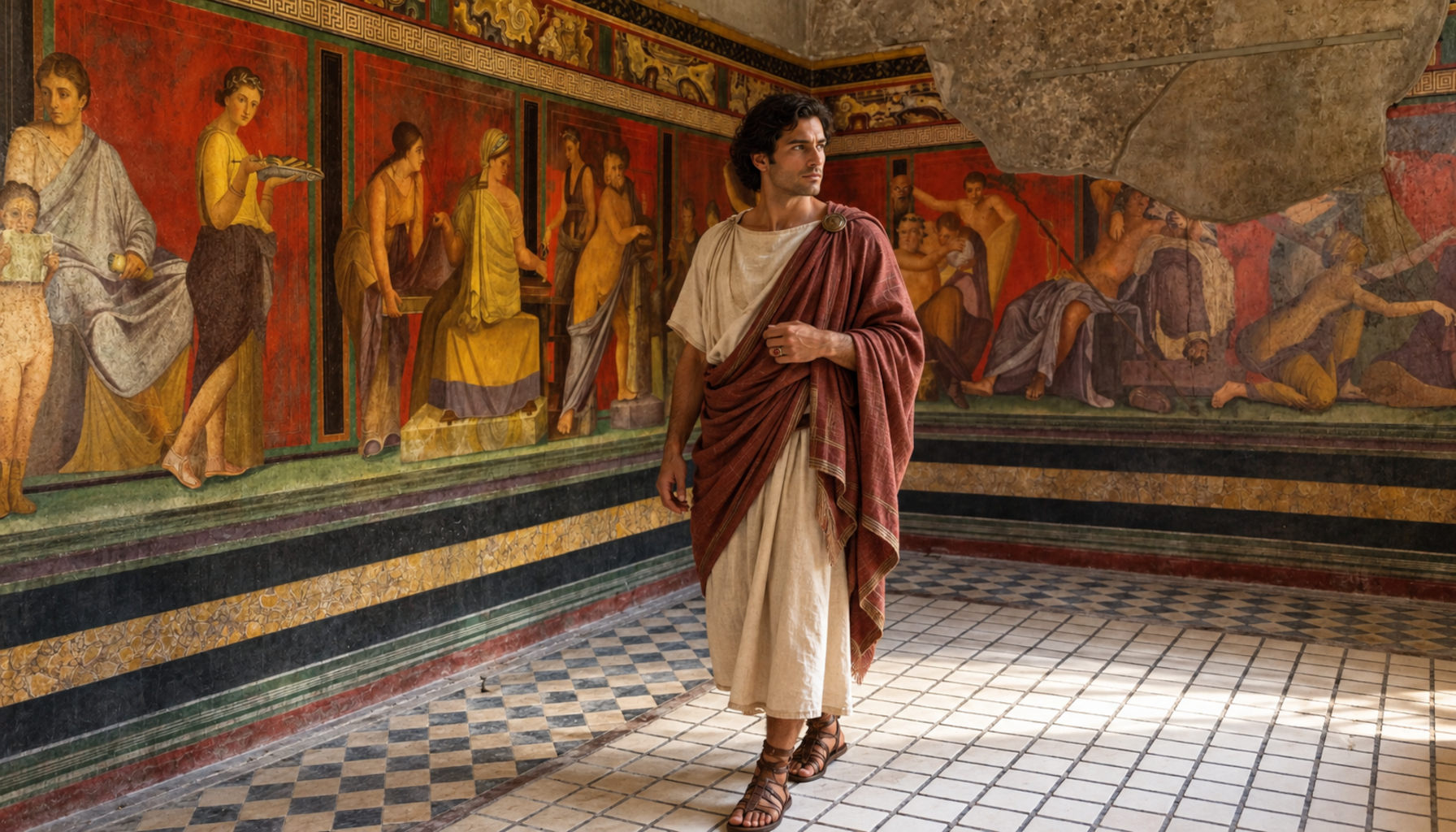
In the last hours of Pompeii, as Mount Vesuvius overwhelmed the city in AD 79, one man died near one of the most famous houses in the Roman world: the Villa of the Mysteries. He is known to us today through archaeology and ancient DNA as the Pompeii Man of the Villa of the Mysteries, represented genetically by sample I3682. He was found lying on top of volcanic ash, still wearing an engraved iron-and-carnelian ring on his left hand, a small and rather moving detail that makes him feel less like an anonymous disaster victim and more like a person interrupted mid-life.
That villa beside which he died was no ordinary building. The Villa of the Mysteries, just outside Pompeii’s walls, was a luxurious suburban estate famed for its great painted cycle of Dionysian imagery, among the most celebrated frescoes to survive from the Roman world. To die in its vicinity was to die on the edge of a wealthy and highly Romanized landscape of country houses, agricultural estates, enslaved labor, household management, trade, and display. The man’s remains matter because they place an individual human life back into that setting, and because his DNA adds another layer to the picture of Pompeii as a cosmopolitan city of empire rather than a sealed, purely local community.
We do not know this man’s personal name, family, or exact occupation, and it is important not to pretend otherwise. Archaeologists have suggested that he may have been a custodian or caretaker connected with the villa, a sensible possibility given where he was found, though it cannot be proven. What we can say is that he lived in the reign of the Flavian emperors, in the generation after Nero and not long after the Roman civil wars of AD 69. Pompeii in this period was part of a vast imperial system that tied Campania to Rome, the wider Italian peninsula, the eastern Mediterranean, North Africa, Gaul, and beyond. Goods, people, languages, cults, and family histories moved constantly through that world. The man by the villa stands as a very Roman sort of individual: local in death, but not necessarily local in ancestry.
Explore Pompeii's Genomic Story
The biological sample associated with this individual is described as Roman Pompeii Vesuvius Victim Villa of the Mysteries, dated to approximately 79 AD. In other words, this is not a later intrusive burial or a medieval skeleton found nearby, but one of the people killed in the eruption itself. The identification is secure only in the limited sense that the sampled remains belong to a male victim found near the Villa of the Mysteries; it is not the case that we know his name or can tie him to a specific historical document.
That distinction matters. He is not a named senator, magistrate, or literary figure. He is instead a well-contextualized archaeological individual: a real victim of the Vesuvian disaster whose body position, location, and surviving ring give him unusual individuality. The ring is especially striking, because objects worn on the body often help anchor a skeleton to the final moment of life. In Pompeii, where so many victims are remembered collectively, such details sharpen the human outline.
The recent research context, including the study published in Current Biology, has helped bring this victim into focus genetically. The broader significance of that work is not that it produces melodrama, but that it lets us test an old historical truth: Roman Italy was full of mobility. Pompeii, despite its famous preservation, was not a fossilized little town but a place linked to the sea, commerce, slavery, migration, and empire-wide movement.
The man’s Y-DNA haplogroup was E1b1b1b1b1a. Y-DNA traces the direct paternal line: father to son to son across many generations. His mtDNA haplogroup was H. Mitochondrial DNA is inherited through the direct maternal line, from mother to child, though only daughters pass it on further. These are lineages, not ethnic labels. They do not tell us that he belonged to a single “tribe” or neatly defined people, and they certainly do not reveal his profession, language, or legal status.
What they do offer is a narrow but useful view into two strands of his ancestry. The broader Y-chromosome lineage E1b1b is historically widespread around the Mediterranean and adjacent regions, including parts of southern Europe, the Balkans, Anatolia, and the Near East. His mitochondrial haplogroup H is also common in ancient and modern western Eurasian populations. On their own, these two markers are only small fragments of the whole story, but when read alongside genome-wide data they fit a picture of mixed eastern Mediterranean and European ancestry. That is historically interesting because it matches what we know from inscriptions, trade, slavery, military movement, and urban life across the Roman Empire.
Ancient-DNA comparisons also show that his paternal lineage, E1b1b1b1b1a, turns up in a remarkably wide historical spread of samples. Among the most directly relevant are the Pompeian victim from the House of the Golden Bracelet (I3691) and Roman-era individuals from places such as Duxford and Knobbs Farm in England, showing that this paternal branch could appear in very different provincial settings under Roman rule. Further back in time, related lineages are documented in Neolithic Anatolia at Çatalhöyük, in the Natufian-associated sample from Raqefet Cave in the ancient Levant, and in a range of later Mediterranean and Balkan contexts. That does not make these people close relatives of the man from Pompeii; the shared paternal ancestor may lie far back in prehistory. But it does underline a larger point: the lineage belonged to a deep and mobile human story that long predated Rome and continued through it.
His maternal lineage, mtDNA H, is less individually distinctive because it is so broadly distributed across ancient western Eurasia, but that too is worth noting. In this case, the H result confirms that his direct maternal line sits within one of the major mitochondrial lineages long present across Europe and the Mediterranean. As ever, that does not define his identity; it simply marks one maternal thread in a much larger ancestral tapestry.
The real value of this man’s DNA is not that it solves his biography, because it does not. It cannot tell us his name, whether he was freeborn or enslaved, whether he prayed to Dionysus, Jupiter, Isis, or no god in particular, or whether he truly served as the villa’s caretaker. What it can do is place him more securely in the human landscape of imperial Campania: a world in which ancestry was often mixed, movement was common, and the population of Roman towns could draw on roots from across the Mediterranean.
That is why he matters. Pompeii is often treated as a freeze-frame of Roman daily life, and in some ways it is. But this victim reminds us that the city’s inhabitants were not static figures in frescoes. They were people shaped by generations of migration, marriage, labor, and imperial entanglement. His ring, his place of death, and his genome together make him one of the most recognizable individuals yet recovered from the eruption.
At MyTrueAncestry, you can compare your DNA with ancient populations and archaeological samples from the Roman world and far beyond. It is a way to explore whether your genetic profile shows connections to the kinds of lineages and populations found in places like Pompeii, without claiming direct descent from any one individual.

Comments