Philip Calvert
– 5 min read


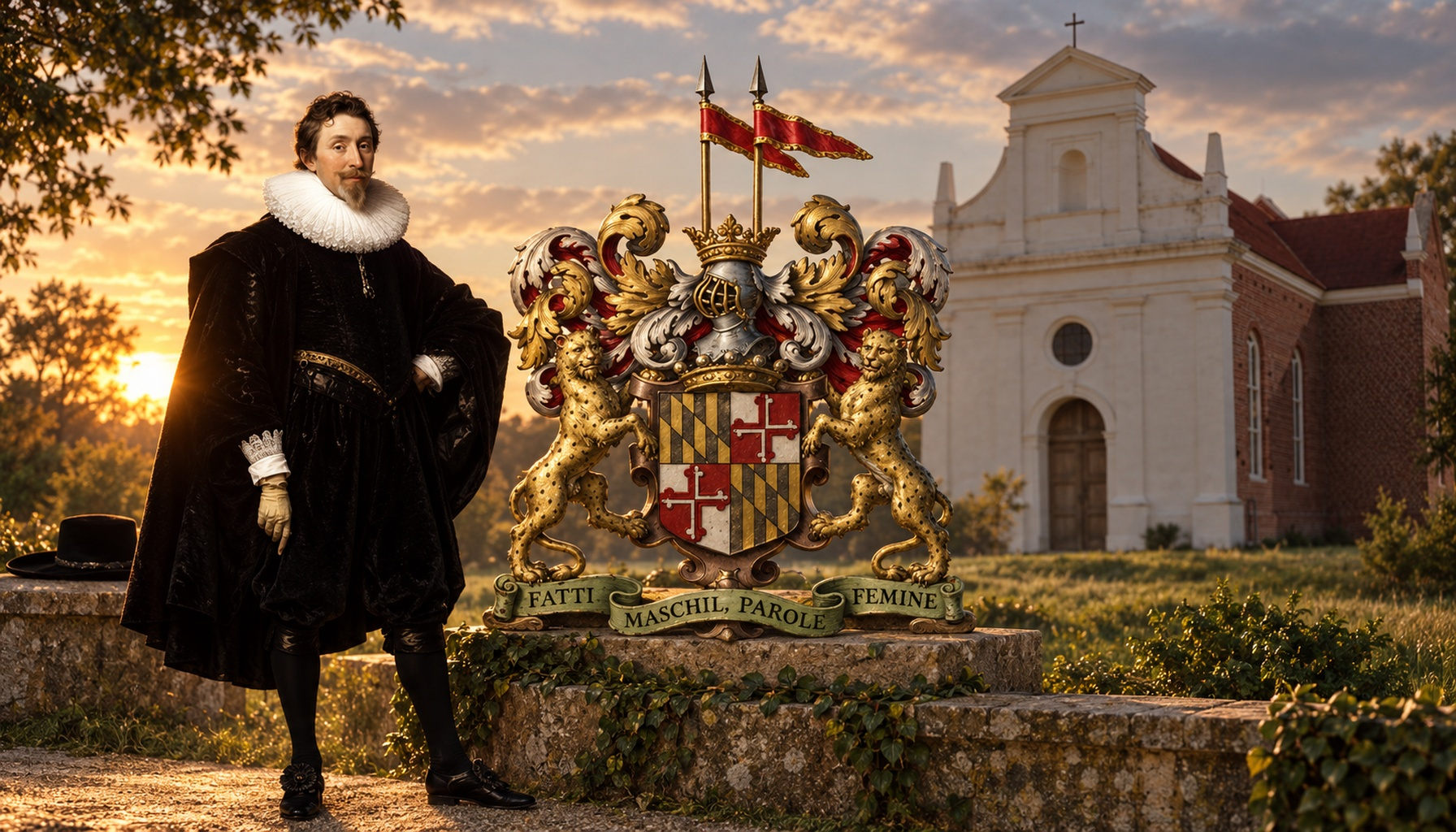
Philip Calvert was one of the most important men in early Maryland, though he is less famous today than the family name behind the colony itself. A younger son of George Calvert, the first Lord Baltimore, Philip belonged to the prominent English Catholic Calvert family whose ambitions, loyalties, and experiments in colonial government helped shape seventeenth-century North America. Born into a world of Stuart monarchy, confessional tension, and Atlantic expansion, he crossed to Maryland and became a central figure in its political life.
What makes Philip Calvert especially interesting now is that he is not known only from charters, offices, and family papers. Archaeologists at St. Mary's City uncovered his remains in the early Brick Chapel, buried in an exceptionally rare lead coffin beside the coffin of his first wife, Anne Wolseley Calvert, and that of an unidentified infant. Centuries later, DNA analysis showed that the infant was Philip's biological son. It is a splendidly revealing collision of archive, grave, and genome.
The Calverts were not merely a family with colonial investments; they were architects of Maryland's existence. Philip's father, George Calvert, first Lord Baltimore, secured the royal backing that led to the founding of the proprietary colony, and Philip's brother Cecilius Calvert, the second Lord Baltimore, became its proprietor. Philip, the youngest son, entered this enterprise not as a decorative relative but as a working statesman in the colony. He served as governor and later as chancellor of Maryland, holding authority in a place that was still improvising how power, religion, landholding, and law would work on the edge of English empire.
This mattered because Maryland was no ordinary plantation outpost. It was founded in part as a haven for English Catholics in a kingdom where Catholic loyalty was perpetually suspect. The colony had to survive not only practical hardships but also the political aftershocks of the English Civil Wars, the Commonwealth, and the Restoration. Men like Philip Calvert were therefore balancing local colonial disputes with the larger tempests of Stuart politics. His career belongs to that wider story of how fragile seventeenth-century colonies were, and how much depended on a small group of literate, well-connected, and politically adaptable officials.
Explore another American DNA case
The biological sample associated with Philip Calvert is listed as Philip Calvert Coffin Maryland, dated approximately to 1682 AD. The archaeological context is unusually strong. His remains were excavated from the site of the early Brick Chapel at St. Mary's City, Maryland's first colonial capital. This was not an anonymous rural grave but a high-status chapel burial, and the use of a lead coffin marks the interment as exceptionally elite for colonial North America.
In historical terms, Philip Calvert's identification is best treated as securely established within the supplied context: the burial setting, the associated chapel site, and the longstanding historical interpretation tie the coffin to him. The infant buried nearby was initially a mystery. According to reporting in the supplied Washington Post article, modern DNA testing demonstrated that the child was Philip's biological son, resolving a question that had persisted since excavation. That does not tell us the whole life story of the infant, still less every detail of the family drama, but it does give the burial group a deeply personal dimension that documents alone had not settled.
Anne Wolseley Calvert's presence beside him is equally important. Archaeology often strips the great and good of their paperwork and titles, leaving us with bodies, coffins, and burial choices. Here, however, the graves restore a family unit. They remind us that colonial government was not an abstract machine. It was built by households, marriages, children, inheritance strategies, and the stark realities of mortality in the seventeenth-century Atlantic world.
Discover St. Mary's City's genetic legacy
Philip Calvert's Y-DNA haplogroup is reported as R1b1a1b1a1a2c1a1a1a1a1, while his mitochondrial DNA haplogroup is T2b4c. These are two different kinds of lineage markers. Y-DNA follows the direct paternal line, passing from father to son, so Philip's Y-haplogroup reflects one narrow branch of his male-line ancestry. mtDNA follows the direct maternal line, passed from mothers to their children, so his T2b4c lineage reflects a different, equally narrow maternal thread.
That distinction matters. Haplogroups do not describe the whole ancestry of a person, and they certainly do not define nationality, religion, or political identity. Philip Calvert was English and Catholic because of family, culture, law, and history, not because a haplogroup can label him as such. What these lineages do provide is a way of tracing very long-term paternal and maternal genetic branches through time. Broadly speaking, R1b lineages are widespread in western Eurasia and common in many ancient and modern European contexts, while T2 is an old and widespread maternal lineage found across parts of Europe and the Near East in both ancient and later populations.
The historically valuable point here is not that Philip's lineages are somehow unique, but that they come from a named colonial statesman whose remains can be studied in a tightly documented archaeological context. Even more useful, DNA from the burial group helped establish a first-degree biological relationship between Philip and the infant buried nearby. In other words, the genetics illuminate kinship within a known family rather than merely assigning broad ancestry labels.
Among reported ancient and historical samples linked on the Y-DNA side to the same long R1b1a1b1a1a2c1a1a1a1a1 branch are Philip Calvert Coffin Maryland (2099) itself and Son of Philip Calvert Lead Coffin Maryland (I2097), which is especially relevant because it sits in the same burial story and strengthens the paternal-line picture inside one colonial family. More distant examples listed on related branches in ancient DNA datasets include individuals from Medieval Jutland in Denmark, Thuringii-period Germany, Carolingian Groningen, medieval Ireland, Merovingian North Rhine-Westphalia, Anglo-Saxon Norfolk, Bronze Age Derbyshire, and Pech-Maho in France. These parallels do not mean those people were close relatives of Philip Calvert. They simply show that his paternal lineage belongs to a deep and widely distributed West Eurasian branch that appears in many times and places.
On the maternal side, the supplied related example for T2b4c is Philip Calvert himself. That makes this a more limited comparison set here, but it still has value. It tells us that Philip's direct maternal line can be anchored to a specific excavated individual from seventeenth-century Maryland. As more ancient and historical samples become available, such lineages can sometimes help researchers compare maternal continuity or diversity across families and burial groups. In Philip's case, though, the strongest present value remains identification and contextualization rather than any sweeping claim about population history.
Philip Calvert's DNA is interesting because it helps with a very human historical question: who was buried with him, and how were they related? That is a modest question in one sense, but an important one. Colonial elites liked to arrange memory carefully, through chapels, coffins, and inscriptions. Archaeology breaks open that choreography; DNA lets us test parts of it. In Philip's case, genetics does not rewrite the history of Maryland, nor can it tell us everything about the Calverts' ancestry or identity. What it can do is add biological evidence to a well-documented life, confirming kinship where the written record left uncertainty.
Read about the rise of archaeogenetics
MyTrueAncestry lets you compare your DNA with ancient populations and archaeological samples from the worlds that shaped people like Philip Calvert, from medieval Europe to colonial-era burials in North America. It cannot prove direct descent from Philip Calvert, but it can help you explore whether your DNA shows connections to the broader lineages and populations linked to his historical world.
Comments