Ötzi the Iceman
– 5 min read


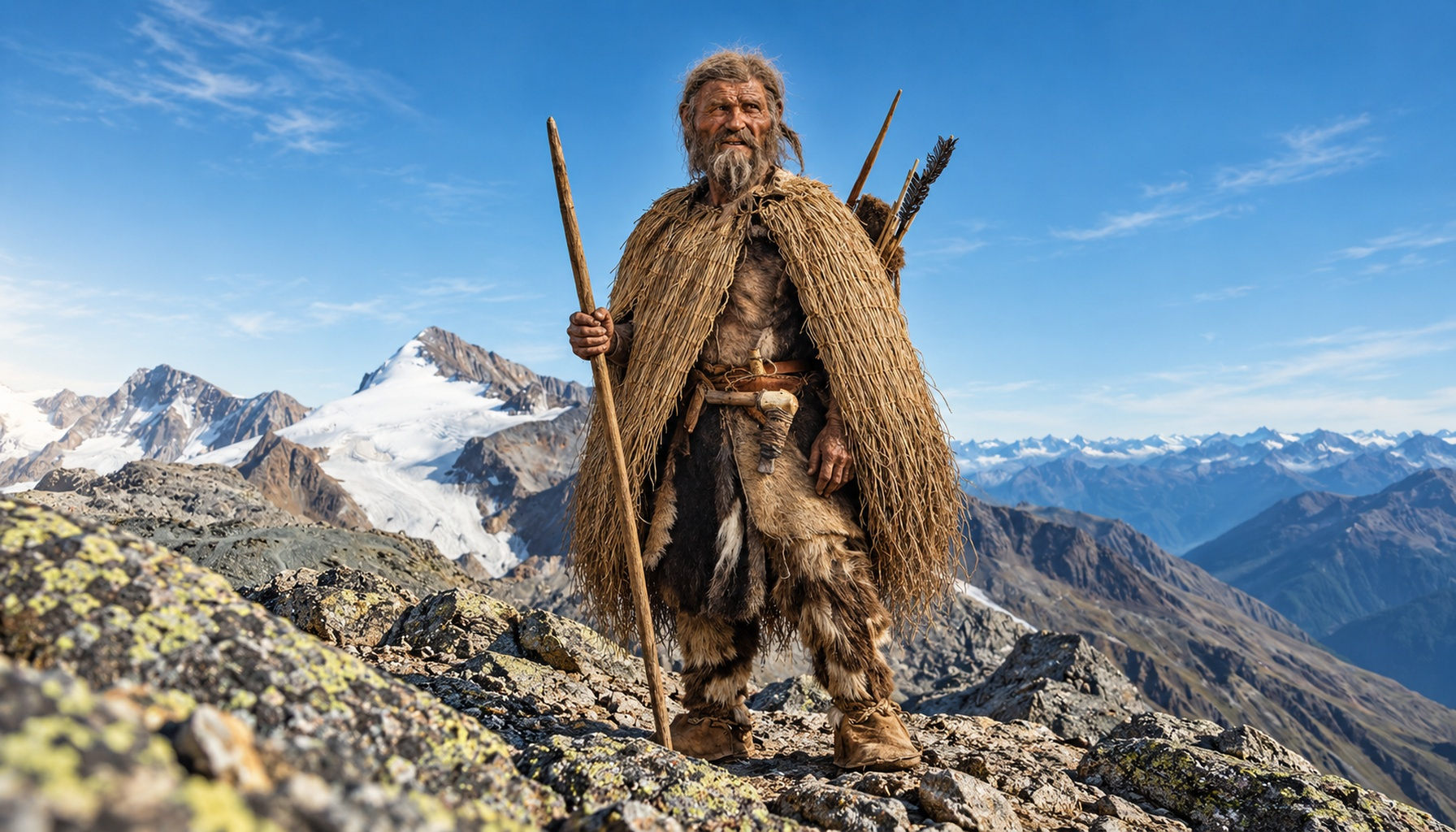
Ötzi the Iceman is one of those rare prehistoric people who feels almost uncomfortably close to us. He lived around 3300 BC in the Copper Age, in the Alpine world of high passes, seasonal movement, herding, hunting, and early metallurgy. When his naturally mummified body was discovered in 1991 in the Ötztal Alps near today’s Italian-Austrian border, archaeology suddenly acquired not just a skeleton or a grave, but a man complete with clothing, tools, weapons, and the small practical kit of everyday life.
That is why Ötzi matters so much. He is not merely famous because he is old, but because he is richly preserved. His body and equipment together offer an astonishingly detailed glimpse of late 4th-millennium BC Europe: what a man wore in the mountains, what he ate, how he travelled, what ailments he carried, and how violence could interrupt a life even in a seemingly remote landscape. He stands at a moment when farming communities had long been established across much of Europe, copper use was spreading, and local worlds were connected by exchange, movement, and occasional conflict.
Ötzi was not a king, general, or named ruler from written history; indeed, writing had not yet arrived in his world. But in another sense he is more informative than many famous monarchs. His tattoos, interpreted by some researchers as linked to therapeutic practices, hint at bodily knowledge and pain management. His gear included a copper axe, a bow, arrows, and carefully made clothing suited to Alpine conditions. Scientific study has reconstructed aspects of his diet, health, and mobility, while the injuries on his body point to a violent end. An arrow wound to the shoulder, together with additional trauma, strongly suggests that he died shortly after conflict and before his body became frozen high on the mountain pass.
His wider world was one of village farming and upland movement rather than states and empires. Yet it was no primitive backwater. The Copper Age Alps were part of a broader European transformation in which farming, stock-keeping, woodland management, and metalworking were reshaping landscapes and social relations. Ötzi’s axe alone tells us he belonged to a society that understood prestige materials and skilled craft. His death, meanwhile, is a reminder that prehistoric Europe was full of human drama: quarrels, rivalries, injuries, and hurried journeys through dangerous country.
The biological sample is the famous mummy known simply as Oetzi, dated to about 3300 BC. This is a securely identified archaeological individual in the straightforward sense that the preserved body itself is the object of study. There is no uncertainty about whether the DNA came from the man found in the ice; the remains, clothing, and equipment were recovered together, and the mummy is the very individual under discussion.
What makes the sample exceptional is context. Usually, prehistoric DNA comes from bone fragments or teeth detached from the rest of a life. Ötzi is different. Researchers have been able to examine not only his genome, but also his body as a whole, his injuries, his stomach contents, his tools, and the environment in which he died. In other words, the DNA is anchored to a person whose final hours and material world can be studied with unusual precision. That is archaeologically priceless.
Ötzi’s direct paternal line, traced through the Y chromosome, belongs to haplogroup G2a2a1a2a1a. His direct maternal line, traced through mitochondrial DNA, belongs to K1. These are two different kinds of lineage evidence: Y-DNA follows the father’s father’s father line, while mtDNA follows the mother’s mother’s mother line. Neither one sums up the whole of a person’s ancestry, but both are useful markers for tracking very long-term genetic history.
Ötzi’s Y-DNA lineage sits within a broader cluster often associated in ancient DNA studies with early farming populations in Europe and the Near East. That does not mean haplogroup G2a2a1a2a1a was an “ethnicity,” nor does it tell us his language, tribe, or personal identity. What it does suggest, in broad terms, is that his paternal line fits well within the genetic landscape of Europe’s Neolithic and Copper Age farming world. The reference context highlighted in coverage such as the Phys.org article on discoveries from Ötzi’s genetic history helped popularize exactly this point: his genome offered a remarkable window onto the ancestry of early European farmers and the population history of the Alps.
There are other ancient individuals carrying related G2a2a1a2a1a-linked lineages across a strikingly wide span of time and space, including Ötzi himself, the Iron Gates Mesolithic sample Padina Serbia I5238, Chalcolithic Romania Schela-Cladovei I4655, Early Bronze Age Czechia Praha-Jinonice Prague Unetice I11160, Early Medieval Croatia Velim-Velistak VEM048, Migration Period Crimea Suvlu-Khaye CGG017683, Hungarian Conqueror Period Homokmerhy-Szekes HMSZ-5, Minoan Period Crete Chania XAN027, Urartian Kingdom Teishebani Karmir Blur Armenia I3892, Danish Viking Medieval Denmark G57, Late Neolithic Oberbipp Switzerland samples MX187, MX212, MX210, MX211, MX209, and MX213, Late Neolithic Rapperswil Switzerland SX10, Sardinia Anghelu Ruju Bell Beaker I15942, and Bell Beaker Haunstetten Germany UNTA58_68Sk1. Such matches do not make these people close relatives of Ötzi. Rather, they show that branches of this paternal lineage appeared in many different communities over millennia, from the Balkans and Alps to the Aegean, Central Europe, and beyond.
On the maternal side, Ötzi’s mtDNA haplogroup K1 traces his direct mother-line ancestry. In the present context, the securely relevant K1-linked sample is Ötzi himself. That may sound obvious, but it is worth stressing: mtDNA is often less useful for making grand historical claims about one famous individual than popular writing assumes. It identifies a lineage, not a culture. In Ötzi’s case, K1 adds another strand to the picture of a Copper Age man whose ancestry belongs within the complex web of prehistoric European populations, but it does not by itself tell us where he was born, what language he spoke, or who killed him.
The real fascination of Ötzi’s DNA is not that it turns him into a genetic mascot, but that it helps place a vividly preserved individual inside the longer population history of prehistoric Europe. His genome can be compared with other ancient people to explore ancestry, mobility, and continuity in the Alpine region. Combined with archaeology, isotopes, and forensic study, it shows how one Copper Age life belonged to a bigger story: the spread and transformation of farming societies, the movement of people through mountain landscapes, and the very human realities of illness, work, conflict, and death.
At the same time, the limits matter. Haplogroups do not tell us Ötzi’s personality, language, or exact community identity, and sharing one of his lineages today would not prove descent from him. What DNA can do is something subtler and, in many ways, more interesting: it lets us situate this singular Alpine mummy within real ancient populations rather than mythic prehistory.
Discover Ötzi's microbial world
MyTrueAncestry allows you to compare your DNA with ancient populations and archaeological samples from the worlds discussed by historians and archaeologists. You can explore whether your genetic results show connections to ancient European lineages, Alpine populations, and other deep ancestral communities linked to the age in which Ötzi lived.
Comments