House of Grimaldi

– 3 min read


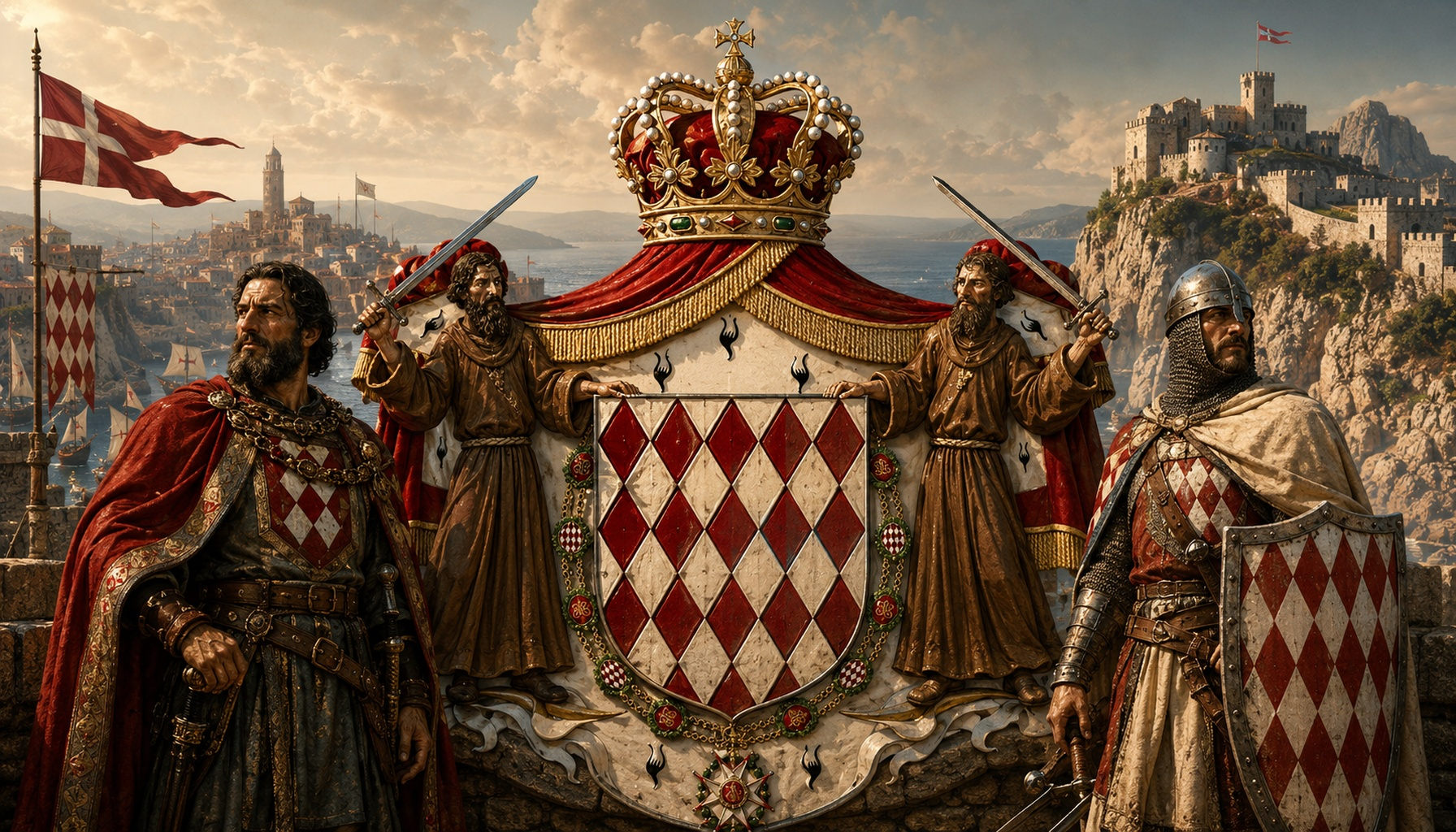
The House of Grimaldi was, and remains, the princely house of Monaco, a dynasty whose story begins not on the glittering Riviera of modern postcards but in the hard-edged political world of medieval Genoa. Their family background lies in the factional struggles of the Ligurian coast, where noble houses, merchant fortunes, naval power, and urban rivalry were all tangled together. Linked here with the haplogroup I1a1b1a1e2 as the primary family haplogroup, the Grimaldis fit a very Mediterranean pattern: a seaborne aristocratic family that turned maritime skill, political patience, and sheer stubborn continuity into lasting rule over a tiny but remarkably durable state.
What makes the Grimaldis so interesting is that they were never simply "local princes" in the narrow sense. They emerged from the Genoese noble sphere, but their rise depended on understanding a wider world of ports, fortresses, alliances, and dynastic calculation. Over centuries they held Monaco through conflicts with stronger neighbors, careful marriages, diplomatic agility, and an ability to adapt as Europe changed around them. Figures such as Jacques I, Prince of Monaco, Honore III, Honore IV, Florestan I, Charles III, Albert I, and Louis II each belonged to different phases of that survival story, from ancien regime court politics to the age of revolution, nationalism, modern statecraft, and public monarchy. The Grimaldi identity became inseparable from Monaco itself: its rock, its palace, its heraldry, and its ceremonials.
Explore the Royal House of Savoy
The great location anchor of the family is the Prince's Palace of Monaco, perched on the Rock of Monaco above the Mediterranean. That setting matters enormously. This was originally a Genoese fortress established in the late medieval period, and that martial beginning still shapes the place today. Over time it evolved from a defensive stronghold into a princely residence, but it never quite lost the feel of a seat won and kept by strategy. The palace combines layers of history: fortification, dynastic residence, ceremonial court, and political symbol of sovereignty. Its state apartments, courtyards, and commanding sea-facing position tell the story of a family that held onto rule by anchoring itself physically and symbolically to one of the most strategic promontories on the coast. In other words, the palace is not just where the Grimaldis lived; it is the stone expression of their legitimacy. And yes, it can still be visited, which makes it one of those rare dynastic sites where the medieval fortress, early modern court culture, and living monarchy all meet in one place.
Read more about House Lusignan
From a DNA perspective, the haplogroup tag linked here is I1a1b1a1e2. That does not mean we can claim direct descent from ancient individuals carrying related branches, and we should be careful about that. What we can say is that related or linked ancient samples help sketch the deeper paternal landscape behind this lineage. Among those are mbs072 from Medieval Sigtuna in Sweden, PCA0480 from Iron Age Pommerania at Gdansk in the Wielbark context, CGG100442 from Medieval Jutland at Vor Frue Kirkegard in Aalborg, CGG107518 from Viking Age Denmark at Hundstrup Mose, VK295 from Viking Age Hessum on Funen, VK296 from Early Viking Age Hundstrup on Sealand, VK320 from Viking Age Langeland Bogovej, VK379 from Vendel Age Oland, VK223 from Viking Age Gnezdovo in Russia, VK473 from Viking Age Gotland at Kopparsvik, VK176 and VK165 from the Viking St. Brice Massacre at Oxford, VK549, VK553, VK511, and VK509 from the Vendel and Viking-era Salme burials on Saaremaa, and R1286 from the Late Medieval Cancelleria Basilica. Taken together, these linked samples point to a broader northern and Baltic-world history for this haplogroup branch, showing how a lineage associated with a Mediterranean princely house can still connect, at the level of deep paternal prehistory, to a much wider European story.
If the House of Grimaldi catches your imagination, the next step is wonderfully simple: upload your DNA to MyTrueAncestry and see whether you match the House of Grimaldi or any of the related ancient DNA samples linked to haplogroup I1a1b1a1e2. It is a fascinating way to connect family history, archaeology, and the long human story behind dynasties, fortresses, and survival across the centuries.




Comments