Haplogroup U8b1a2a

– 4 min read


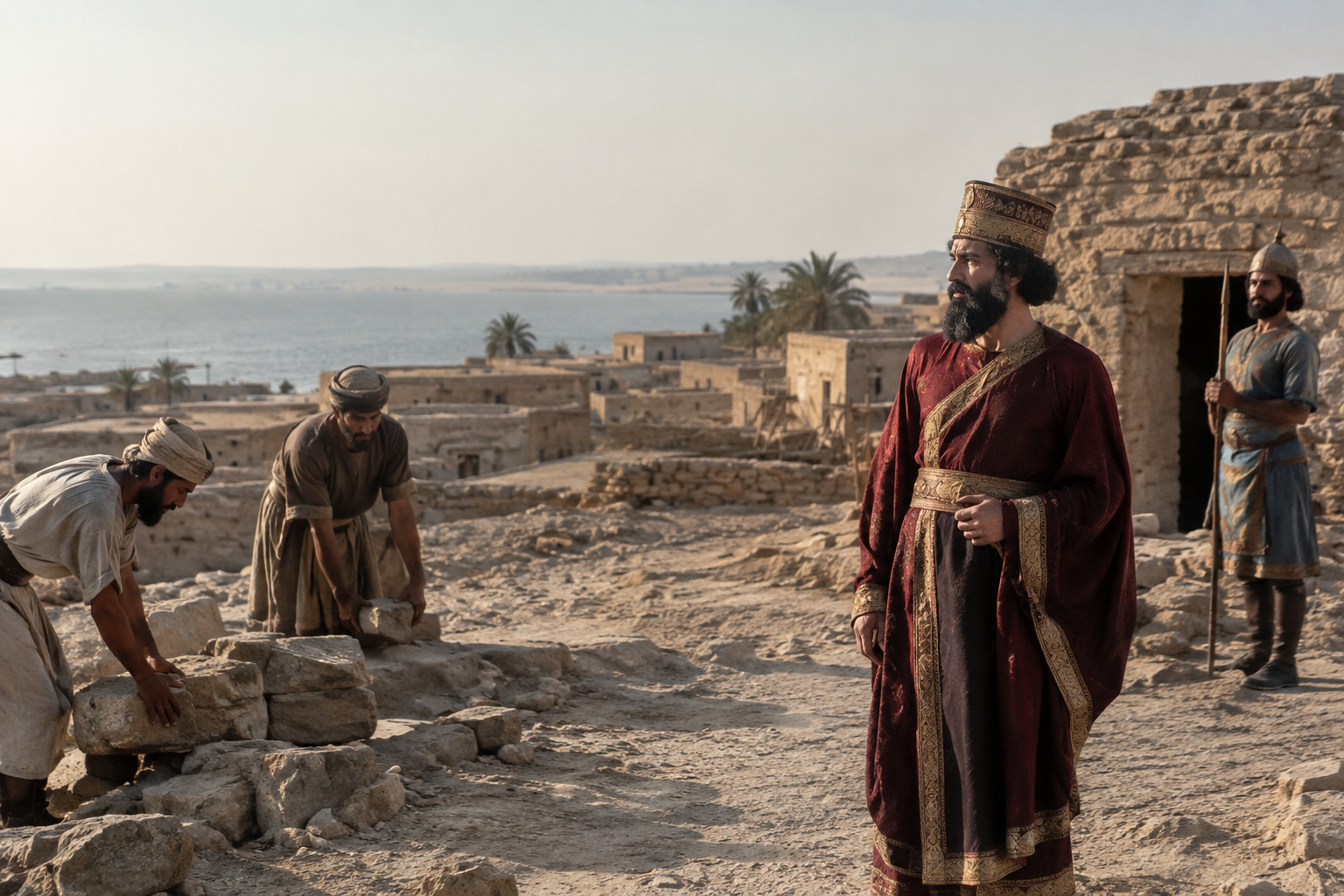
At Madinat Hamad in Bahrain, one ancient individual from the Sasanian period, sample MH3_LT, offers a small but unusually evocative clue to the history of haplogroup U8b1a2a. The date, around AD 612, places this person in the last century of Sasanian power, when Bahrain sat inside a world tied to the Persian Gulf, southern Mesopotamia, and the Iranian plateau by shipping, administration, religion, and trade.
That matters because U8b1a2a is a mitochondrial lineage, not a Y-DNA branch. In other words, it traces one direct maternal line rather than a father's line or a person's whole ancestry. Even with just one identified ancient carrier here, the find is valuable: it anchors this maternal branch in a real archaeological setting at the Gulf crossroads just before the early Islamic era.
Bahrain is often imagined through its Bronze Age Dilmun fame, but by late antiquity it was also deeply connected to the Sasanian imperial sphere. The islands were not isolated outposts. They were part of a maritime zone linking ports, merchants, soldiers, religious communities, and farming settlements across the Gulf.
Sample MH3_LT comes from that late antique setting. Without inventing details that have not been published for this individual, we can still say something important: a maternal lineage classified as U8b1a2a appears in Bahrain at a moment when the Gulf was one of western Asia's busiest corridors of movement. An ancient DNA study of the region and its burials, published in this research article, is part of the growing work showing how human remains from such sites can illuminate the people living inside these connected coastal societies.
Because U8b1a2a is a very specific mitochondrial branch, it should be handled carefully. It would be wrong to project onto this narrow subclade every movement ever associated with the much wider U family. Ancient DNA lineages work rather like surnames in reverse: they are precise along one line of descent, but they do not summarize the whole family story.
For MH3_LT, the safest historical reading is also the most interesting. This lineage shows that one direct maternal line present in Sasanian Bahrain belonged to the broader population mix circulating through the Gulf world. That does not prove where this woman's mother's mother's line first arose, nor does it prove recent migration from any single mainland region. But it does place U8b1a2a within a documented late antique community at a strategic island node between Arabia and Iran.
This is exactly why mitochondrial data can be so revealing in archaeology. A single branch cannot define a kingdom, a language, or an ethnicity, yet it can show that the people buried at a site were part of long-lived networks of kinship and movement. Bahrain in the early 7th century was not a fringe. It was a hinge.
The Gulf compresses geography. Distances that look substantial on a modern map can represent routine journeys by sea, and for much of antiquity maritime links were often more efficient than overland ones. Bahrain therefore makes an excellent testing ground for ancient population history: if a lineage turns up here, it may reflect local continuity, regional mobility, or both.
Under the Sasanians, the Gulf was tied into imperial taxation, trade, and political control, but also into older patterns that long predated any one empire. So when we find U8b1a2a in MH3_LT, we should imagine neither a sealed island population nor a random cosmopolitan blur. The more plausible picture is a settled community shaped by repeated contacts across generations.
Iranian Plateau to Sassanid Era
That broader context also helps explain why Bahrain matters for readers interested in maternal ancestry. Many lineages survive not because of spectacular migrations alone, but because ordinary families kept living, marrying, and raising children in places that sat along durable exchange routes. Ports, islands, and frontier provinces are often where those quiet histories become visible.
One of the strongest lessons from ancient DNA in recent years is that late antique societies were often more mixed than older textbook pictures allowed. That does not mean every burial ground was full of long-distance migrants, or that political rule instantly remade local populations. It means that communities in this period could include people whose ancestors had arrived through different channels and at different times.
For Bahrain around AD 612, that is especially plausible. The island world of the Gulf brought together Arabian, Iranian, and Mesopotamian connections in ways that do not fit neat modern national boxes. A lineage like U8b1a2a becomes historically meaningful here not because it carries a simple ethnic label, but because it reminds us that family history in this region was made inside overlapping spheres of empire, commerce, and local continuity.
There is a useful comparison with other early medieval and late antique studies across Eurasia: again and again, genetic evidence shows that burials from this era resist tidy cultural stereotypes. A cemetery may belong archaeologically to one political or religious setting while the individuals themselves reflect deeper and more varied family backgrounds.
It is tempting, when a rare or specific lineage appears, to build a grand migration saga around it. Good archaeology asks for more discipline. With MH3_LT, the secure point is that U8b1a2a was present in Sasanian-period Bahrain. That alone gives the lineage a historically grounded presence in the Gulf shortly before the great political transition from Sasanian to Islamic rule.
Equally important is what this sample helps us avoid. It cautions against treating Bahrain's late antique inhabitants as genetically uniform, and against imagining that maternal lineages can be read straight off the political map. Empires organize territories; families move through them in more intricate ways.
As more ancient DNA from the Gulf and adjacent mainland regions is published, branches like U8b1a2a may become easier to place within a fuller web of maternal relationships. For now, MH3_LT is less a final answer than a fixed point: one real person, from one real burial population, showing that this lineage was part of the human landscape of the late Sasanian Gulf.
The distinctive lesson of U8b1a2a, as far as the present evidence allows, is not royal glamour or sweeping conquest. It is something subtler and more historical: this maternal branch is documented in a person living in Bahrain at a moment when the Gulf connected Iran, Arabia, and Mesopotamia in everyday life. If this is your lineage, the ancient evidence does not reduce your ancestry to one people or one migration, but it does place one direct maternal line within the busy, entangled world of late antique western Asia.
Comments