Haplogroup T1a2b1a1

– 5 min read


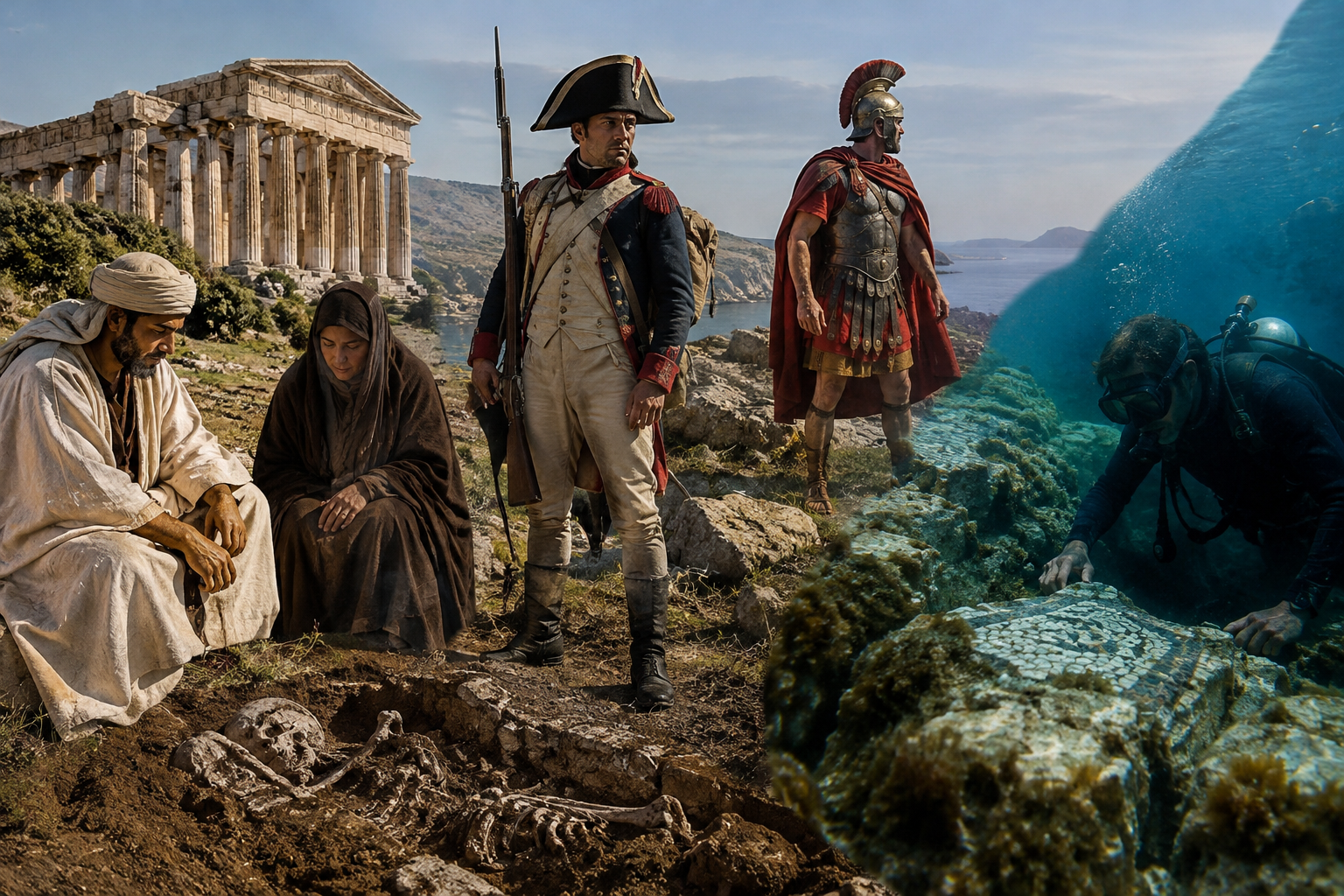
At Segesta in medieval Sicily, two men from a Muslim burial ground, identified as SGBN7 and SGBN7c, bring T1a2b1a1 into unusually sharp focus. Their graves belong to around AD 1140, a moment when Sicily was politically under Norman rule but still socially and culturally mixed: Arabic-speaking communities, Greek Christians, Latin newcomers, and long-established island populations were all part of the same world. That is exactly what makes these Y-chromosome findings so interesting. They do not point to a single "Sicilian type" at all, but to a paternal line moving through a very connected Mediterranean society.
Y-DNA tracks one narrow line of descent, father to son, rather than a person's total ancestry. Even so, when the same branch appears in a small cluster and then reappears in Roman Anatolia and much later in a Napoleonic mass grave, it becomes historically useful. T1a2b1a1 looks, in this set of evidence, less like a local curiosity and more like a marker of long-distance male mobility around the eastern and central Mediterranean, with later spillovers far beyond it.
The Segesta burials are the strongest opening because they are specific, paired, and historically legible. Two men from the same medieval Muslim grave context in Sicily, SGBN7 and SGBN7c, are associated with the haplogroup featured here. That matters because one isolated Y-line can always be dismissed as an individual anomaly; two in the same cemetery begin to suggest that this paternal branch had some real presence in that community.
Sicily in the 11th and 12th centuries was famously layered. Muslim rule had ended politically in much of the island, but Muslim communities continued under the Normans for generations. An ancient DNA study of the island's medieval population has helped show just how mixed these communities could be, not merely in religion and language but in ancestry too. For this context, the broader discussion in research on medieval Sicily is especially relevant: the island was not a sealed-off province, but a crossroads where lineages from different parts of the Mediterranean could persist side by side.
For men carrying T1a2b1a1 today, Segesta offers a sensible historical frame. It suggests that this branch could be present in Islamic-period and post-Islamic Sicily without requiring any fantasy of a single conquest-wave founder. The more sober interpretation is better and more interesting: paternal lines like this one could arrive, survive, and mingle through trade, settlement, military service, and family life across several centuries.
Another important appearance comes from Roman-era Samsun on the Black Sea coast of Anatolia: sample I4530, dated to around AD 301. This is a very different setting from Norman Sicily. We are now in the world of the late Roman Empire, in a coastal region tied into imperial administration, shipping, and military movement between Anatolia, the Caucasus, and the wider Mediterranean.
The significance of I4530 is not that it "proves" a migration route all by itself. Rather, it gives T1a2b1a1 a documented place in Roman Anatolia, which is precisely the sort of setting where eastern Mediterranean and Black Sea lineages could circulate widely. If Segesta shows the branch in a medieval Islamic community in Sicily, Samsun shows it in an earlier imperial landscape further east. That combination immediately broadens the historical picture.
There is a useful parallel here with wider discussions of mobility in Roman-period populations. The Roman world moved people constantly: soldiers, merchants, sailors, enslaved people, tax officials, pilgrims, craftsmen, and families. A paternal lineage appearing in Anatolia and later in Sicily does not require a neat straight line from one named man to another. It fits the far messier, and more realistic, human traffic of the Roman and post-Roman Mediterranean.
A second Anatolian case strengthens that impression further: I14799 from the Byzantine-period underwater basilica at Nicaea, dated here to around AD 375. Nicaea was no backwater. It sat in northwestern Anatolia within one of the most important Christian and imperial zones of Late Antiquity, close to the routes linking the Aegean, Constantinople, and inland Asia Minor.
Archaeologically, the basilica is striking enough on its own, but genetically the key point is continuity of setting rather than drama. T1a2b1a1, or a reported association with this branch, appears again in Anatolia, now in a Christian-era Byzantine context rather than a Roman Black Sea one. That does not mean the same family line can be traced directly from Samsun to Nicaea. It does mean this paternal signature was present in more than one Anatolian milieu during late antiquity.
Taken together, I4530 and I14799 make Anatolia hard to ignore in any discussion of this haplogroup's documented ancient footprint. Not because Anatolia must be its ultimate origin - that would be claiming far too much from too little - but because the evidence places this branch within the kind of interconnected eastern Mediterranean world that repeatedly fed people westward into the islands and coasts of the central Mediterranean.
The latest sample in this group is the most unexpected: YYY092B from the mass grave of Napoleon's Grande Armée, dated to AD 1812 and listed here as Vilnius, despite the label's confusing mention of Latvia. This is a useful reminder that genetic evidence often survives in records more neatly than in historical categories. The essential fact is secure enough for our purposes: the branch appears in an early 19th-century military dead associated with Napoleon's catastrophic eastern campaign.
This does not make T1a2b1a1 a "Napoleonic haplogroup", obviously. What it does show is durability and dispersal. By the early modern period, male lines with older Mediterranean or Near Eastern histories could be found inside huge composite European armies, where recruits came from many provinces and client states. A major ancient DNA study of the 1812 retreat opened that world in biological terms, showing how the dead of the Grande Armée were anything but uniform. The broader context can be explored through research on the 1812 Vilnius mass graves.
There is something rather telling in that jump from Segesta and Anatolia to Vilnius. It captures the way paternal lines travel through institutions as much as through homelands: empire, church, port city, and army. The Y chromosome does not narrate the whole life of a person, but it can preserve these long, uneven tracks of movement.
With T1a2b1a1, the safest and most interesting reading is not one of narrow ethnic identity, but of repeated appearance in highly connected societies. The known ancient examples here cluster around the Mediterranean and its near approaches: Roman Anatolia, Byzantine Anatolia, medieval Muslim Sicily, and then a much later imperial army in eastern Europe. That pattern suits a lineage carried through circulation, settlement, conversion, service, and intermarriage over many centuries.
It is also worth keeping the level of certainty straight. The article haplogroup is T1a2b1a1, but ancient samples are only as precise as their reported resolution allows. In some cases, the assignment may be secure to this branch; in others, the sample may be associated through a broader parent line in published or database-style reporting. The larger historical point still stands: this is a paternal lineage turning up in places where the Mediterranean, Black Sea, and European worlds overlapped.
If you belong to T1a2b1a1, these ancient finds suggest a paternal past that fits bustling contact zones rather than a single isolated homeland. The strongest documented appearances link your branch to Roman and Byzantine Anatolia, to Muslim-community burials in medieval Sicily, and to the far-flung human mix of a Napoleonic army. It is a small evidence set, but a distinctive one: not static, not purely local, and very much at home in the complicated history of the Mediterranean world.
Comments