Haplogroup T1a2b1a

– 5 min read


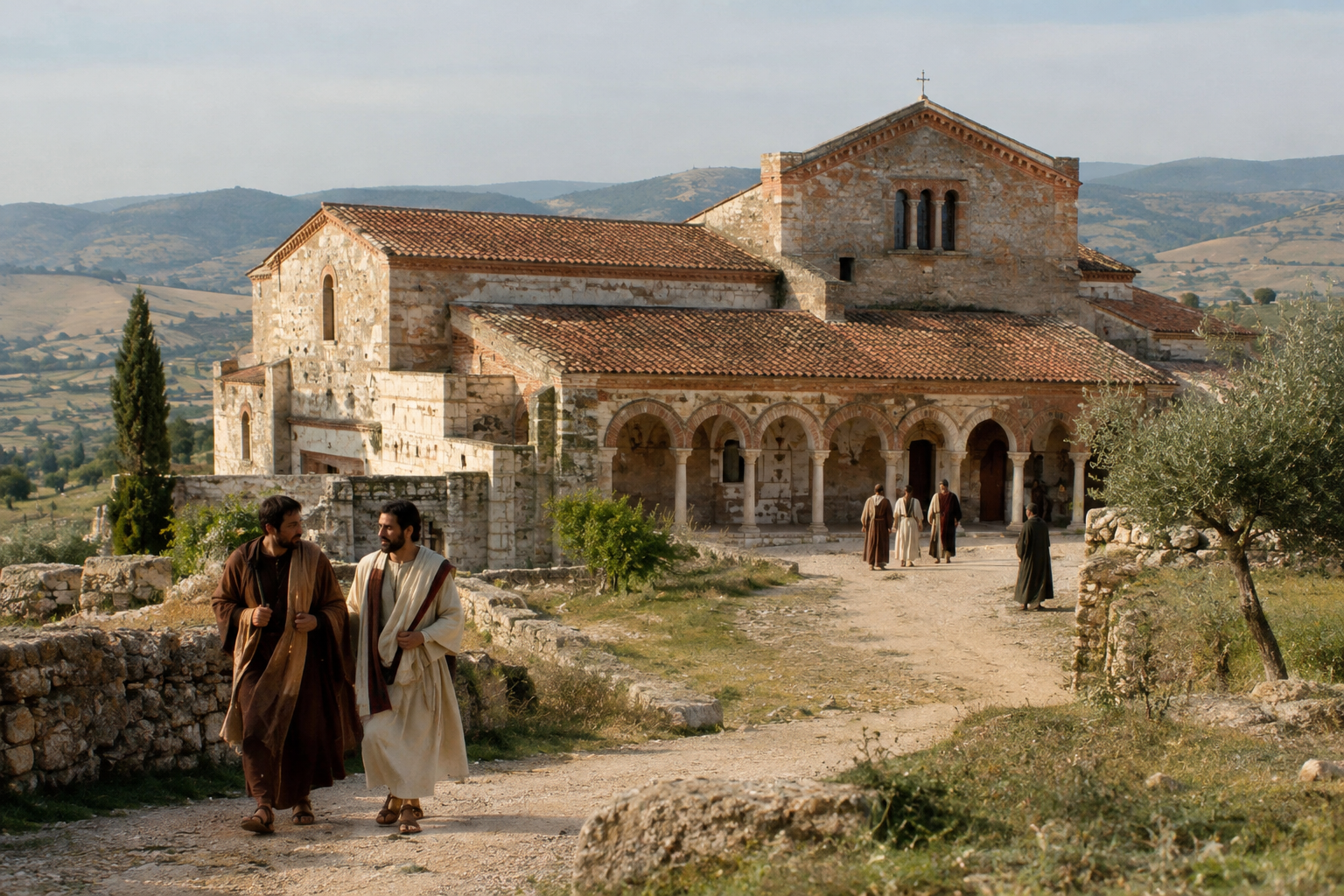
At Lucena in Cordoba province, an ancient individual labeled I35898 brings haplogroup T1a2b1a into unusually sharp focus. He dates to around AD 450, in the last century of Roman power in Hispania, and comes from the Cortijo Basilica del Coracho cemetery. That is already enough to make him interesting: this is not an abstract lineage floating on a map, but a man buried in southern Spain at a moment when imperial rule, local identity, and Mediterranean mobility were all being renegotiated.
For anyone researching T1a2b1a today, this matters because Y-DNA follows one direct paternal line. It does not describe the whole ancestry of a person, but it can place one branch of father-to-son descent into a real historical setting. In this case, the setting is late Roman Baetica, one of the most urbanized and connected regions of the western Mediterranean.
Lucena lay within a landscape shaped for centuries by Roman roads, estates, churches, and towns. By around AD 450, Hispania was no longer the secure imperial province of the high Roman age. Power was fragmenting, political authority was shifting, and communities were adapting to a world in which Roman institutions still mattered but no longer operated with the same reach or confidence.
The burial of I35898 at Cortijo Basilica del Coracho belongs squarely in that transitional world. Even with limited personal detail, the combination of place, date, and Y-DNA branch is important. T1a2b1a is not one of the most common western European paternal lineages in popular discussion, so finding it in late Roman southern Spain is a reminder that Roman Iberia was not genetically simple or sealed off. It was part of a larger Mediterranean system that had been drawing in people, families, and paternal lines for centuries.
A wider discussion of that background can be found in this MyTrueAncestry article on Roman-period continuity and change in Iberia.
The crucial point is to separate the exact branch in this article from the broader history of haplogroup T. The parent haplogroup has a long and geographically wide story reaching across parts of western Eurasia, the Mediterranean, and the Near East. But a narrower branch like T1a2b1a should not automatically inherit every migration tale attached to the larger family.
What the Lucena evidence gives us is something more disciplined and, in its way, more revealing: by late antiquity, a paternal line associated here with T1a2b1a was present in southern Iberia. That places this branch inside a Roman and post-Roman provincial population, not on some distant margin of history. It suggests that men carrying related paternal lines could be fully part of local communities in Hispania, whether their deeper ancestry had been in Iberia for many generations or had entered through earlier Mediterranean movements.
That distinction matters because late Roman Spain was not populated by neat, isolated biological blocks. It was a province of soldiers, merchants, enslaved people, estate workers, clerics, townsmen, and families with origins that could be local, regional, or far-flung. A single Y-line does not tell us which role I35898 or his paternal ancestors held, but it does tell us that this branch had found a place in that society.
Baetica had long been one of the wealthiest and most connected parts of Roman Iberia. Olive oil from the region moved in enormous quantities across the empire. Cities and rural estates linked inland Andalusia to the Guadalquivir valley and to maritime routes reaching the western and central Mediterranean. If we are asking how a lineage such as T1a2b1a might appear in Lucena by AD 450, this is the proper historical frame: not a single dramatic migration, but centuries of movement through an imperial world.
That is precisely why southern Spain is such a useful setting for this haplogroup. Roman rule created conditions in which paternal lines from different backgrounds could settle, persist, and become locally rooted. By late antiquity, the men buried in cemeteries like Cortijo Basilica del Coracho were living after generations of that process. Their DNA reflects not only the upheavals of the fifth century, but also the quieter accumulation of earlier connections.
Research on ancient populations from Iberia has repeatedly shown that the peninsula cannot be reduced to a single continuous local profile untouched by outside contact. One MyTrueAncestry discussion of diverse origins in an early medieval burial ground near Madrid is useful here, because it shows how post-Roman Iberian cemeteries can capture surprisingly varied backgrounds within one regional setting.
There is a temptation, whenever a less familiar paternal lineage appears in Europe, to assign it quickly to one famous people: Phoenicians, Jews, Syrians, North Africans, soldiers from the East, or some other ready-made historical category. Archaeology is rarely that tidy. A fifth-century burial in southern Spain does not by itself prove one specific ethnic identity, language, or migration route.
What it does prove is presence. I35898 was there, in Lucena, in a Christian-period funerary landscape of late Roman Spain. That alone is historically weighty. The paternal branch T1a2b1a was not merely somewhere in the abstract Mediterranean past; it had become part of the human reality of Hispania at the end of empire.
This is where archaeogenetics is especially valuable. It does not replace history or archaeology, but it stops us from imagining ancient populations as flatter and more homogeneous than they really were. A cemetery can look regionally familiar in its material culture while still containing lineages that reflect centuries of wider movement.
A broader ancient DNA study of Iberian populations in the Roman and post-Roman periods has helped frame exactly these questions of continuity, mixture, and mobility in the peninsula, and the Lucena individual sits naturally within that larger research conversation: a genetic study of ancient Iberian populations.
It is true that the evidence here is modest: one named ancient individual, one late Roman cemetery, one exact Y-DNA label. But modest evidence is not worthless evidence. In haplogroup work, a securely placed ancient person can be more illuminating than pages of speculation. I35898 anchors T1a2b1a in a specific place and time: southern Spain, around AD 450, at the hinge between Roman and post-Roman worlds.
That anchor matters especially because many paternal branches are discussed in sweeping geographic terms but remain poorly grounded in excavated individuals. When a branch turns up in a real archaeological context, it becomes part of a documented human story. Lucena tells us that T1a2b1a belongs, at least in one attested case, to the lived history of late antique Iberia.
Readers interested in how similar methods illuminate neighboring Mediterranean regions may also want to compare work on Italy, where Roman and early medieval cemeteries likewise reveal layered paternal and genome-wide histories.
For present-day men in haplogroup T1a2b1a, the Lucena burial offers a careful but meaningful clue. Your direct paternal line is now documented in late Roman southern Spain, in a region shaped by deep Mediterranean exchange and by the social transformations of the fifth century. That does not make every modern carrier "Roman," "Spanish," or descended from one known ancient man. But it does place this branch within the real population history of Iberia at a pivotal historical moment.
The most distinctive lesson of I35898 is not glamour but solidity. T1a2b1a was present in the human landscape of Lucena when Roman Hispania was giving way to something new, and that makes this lineage part of one of the most important transitions in European history.
Comments