Haplogroup T1a1a1b2b1a
– 5 min read


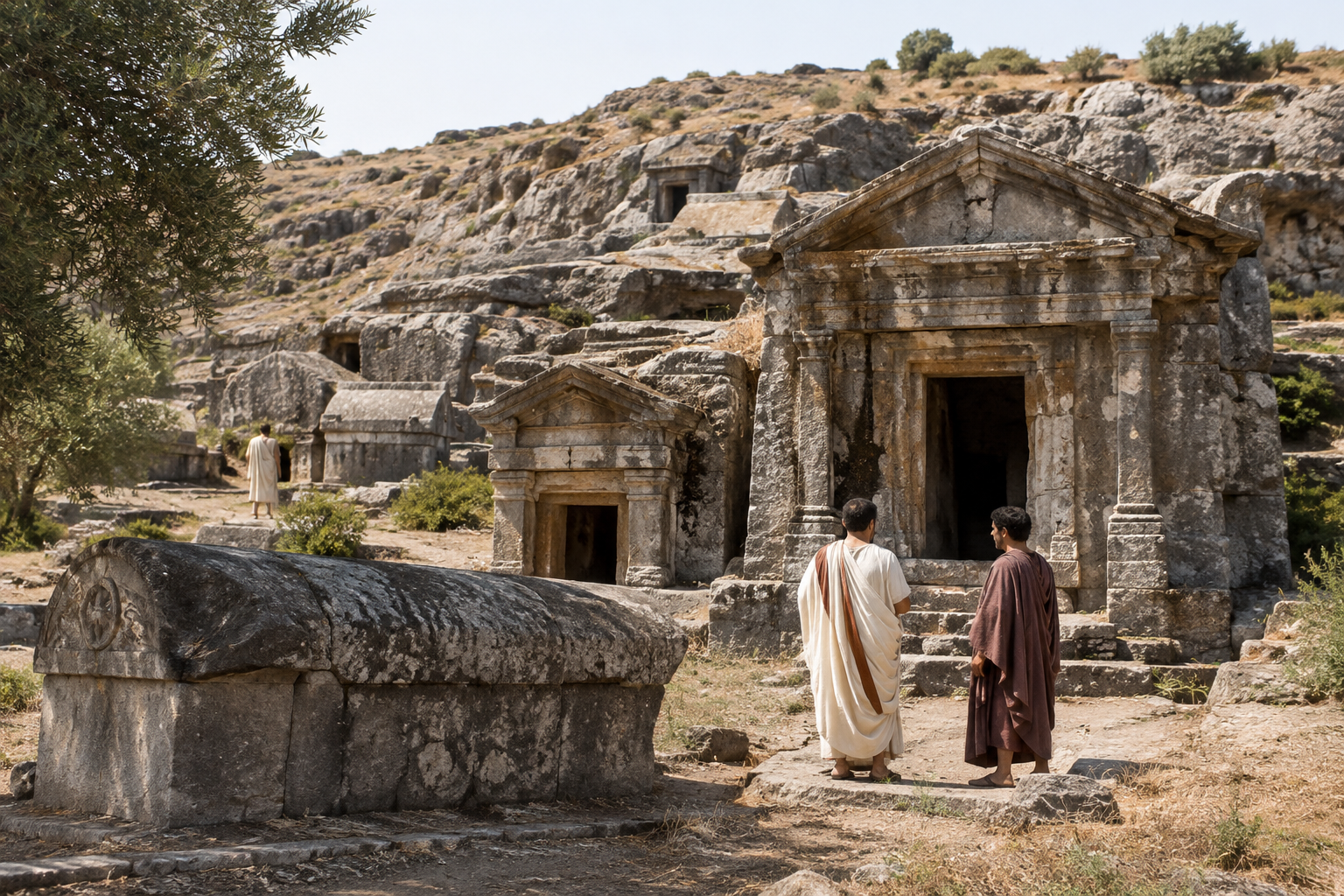
At an Anatolian Roman necropolis, one man labeled R1543 brings an unexpectedly long story into focus. He lived around AD 200, in a world ruled from Rome but knitted together by older eastern Mediterranean connections, and he is associated here with the Y-DNA haplogroup T1a1a1b2b1a. That combination is what makes him interesting: not because one burial can stand for a whole empire, but because it places a very specific paternal line inside one of the most mobile and cosmopolitan landscapes of the ancient world.
That needs stating carefully. Y-DNA follows one direct paternal line only: father to son to son. It is not the same thing as a person's whole ancestry, language, or identity. Still, when a lineage like T1a1a1b2b1a turns up in Roman Anatolia, it helps us think about how older Near Eastern paternal lines could persist, mix, and travel within imperial settings rather than being swept away by them.
The sample record is spare: Anatolian Roman Necropolis MR, around AD 200, individual R1543. Even with limited detail, the context matters enormously. Roman Anatolia was not a remote frontier. It was one of the empire's great connective zones, linked by military roads, ports, taxation, trade, local city life, and long-established populations whose roots stretched back far before the Roman conquest.
That makes Anatolia exactly the sort of place where a lineage such as T1a1a1b2b1a becomes historically meaningful. Haplogroup T is generally discussed at the broader level as a lineage with ancient Near Eastern and eastern Mediterranean associations, but one must not lazily project the entire history of haplogroup T onto this narrower branch. What R1543 gives us is firmer and more modest: evidence that this paternal line, or a classification reported into this branch, was present in Roman-period Anatolia.
In practical terms, that means the male line behind R1543 may have been local to the region for many centuries, or it may reflect movements within the eastern half of the empire, or indeed older processes predating Rome altogether. Roman administration did not create all mobility from scratch; often it intensified routes that had existed for millennia.
An ancient DNA study that helped reshape discussion of population change across the Roman world was published in Science, and it is useful background here because it showed just how much movement and mixture could characterize imperial populations. R1543 sits neatly in that wider picture, even if the surviving sample note tells us much less about him as an individual than we might like.
It is tempting, when confronted with a very precise label like T1a1a1b2b1a, to imagine a neat arrow on a map: origin here, migration there, arrival at this grave. Real history is rarely that obedient. Anatolia has been one of Eurasia's great meeting grounds since prehistory, and by the Roman period its people carried layers of ancestry tied to local Bronze Age populations, Aegean contacts, Persian rule, Hellenistic kingdoms, and imperial Roman networks.
So the significance of R1543 is not that he proves a single migration event. It is that he reminds us how paternal lines with deeper roots in the Near East could remain visible within Roman burial populations. In other words, empire did not erase regional genetic history. It reorganized it, connected it, and sometimes redistributed it.
That is especially important for men researching rare or less-discussed Y lines today. A branch like T1a1a1b2b1a is not one of the big headline European haplogroups, which can sometimes make it seem anomalous. In fact, the Roman east is precisely the kind of place where such lineages make historical sense: urban, old, crowded with merchants and soldiers, yet also full of families whose local roots ran very deep.
One of the most useful things archaeology teaches, sometimes against our instincts, is that a cemetery does not hand us a simple ethnic tag. A Roman-period necropolis in Anatolia can contain people whose paternal, maternal, and autosomal ancestries reflect quite different stories. Some may come from local lineages embedded in Anatolia long before Augustus. Others may descend from migrants who arrived under Hellenistic or Roman rule. Some may have moved within their own lifetimes; others may have been locals whose ancestry already reflected centuries of earlier movement.
This is why R1543 is best understood not as "a Roman" in a biological sense, nor as a stand-in for any single ancient people, but as one man from a burial community inside the imperial system. The Y-chromosome tells us about his direct paternal line. Archaeology tells us he belonged to a Roman-period funerary landscape. History tells us Anatolia was a place where those two facts could intersect in many ways.
That broader caution is not a limitation so much as the point. Ancient DNA has become most interesting precisely when it stops trying to force people into tidy boxes and instead lets us see how messy, layered, and human the past really was.
If your paternal line belongs to T1a1a1b2b1a, Anatolia deserves attention not just because of geography, but because of chronology. The peninsula was a corridor between the Balkans, the Caucasus, the Levant, Mesopotamia, and the Aegean long before the Roman Empire. By the second century AD, that older world had not vanished. It had been overlaid by Roman roads, Roman taxation, Roman law, and Roman military power.
In such a setting, a lineage could persist locally for generations while also participating in movement on a much wider scale. Traders, craftsmen, sailors, soldiers, officials, freedmen, and their families all moved through the eastern Mediterranean. Yet many of the people filling Roman cities and necropoleis were not recent arrivals at all. They were descendants of populations already established in the region, now living under a new political order.
That is a particularly sensible framework for T1a1a1b2b1a. Rather than imagining a dramatic one-time arrival, it may be better to picture continuity with episodes of admixture and mobility layered on top. R1543 does not settle the balance between those possibilities, but he shows the branch belonged within that historical world.
Readers interested in how Roman-period genetics played out at the western edge of the empire may also want to compare the eastern evidence with Iberian material.
With only one ancient individual listed here, the article has to resist a common temptation: overbuilding the case. We cannot responsibly claim that T1a1a1b2b1a was common in Roman Anatolia from one man. We cannot identify his language, legal status, profession, or family story from the haplogroup alone. And unless a publication explicitly resolves him to that exact terminal branch, one should always remember that ultra-fine subclade assignments can be more fragile than broad haplogroup placement.
But one sample is not nothing. In a field where many paternal lines remain underrepresented, a securely dated Roman-period Anatolian example is valuable. It provides a historical anchor point. It says that by around AD 200, this paternal thread was present in a Roman necropolis in Anatolia, one of the great hinge regions of the ancient world.
That is often how archaeogenetics advances: not always by grand totals, but by patient accumulation of specific, dated lives. Each one is small; together they redraw the map.
The most useful insight from R1543 is not a fantasy pedigree but a historical setting. T1a1a1b2b1a appears here in Roman Anatolia, a region where deep local ancestry and long-distance imperial movement lived side by side. For someone exploring this paternal line today, that is a meaningful clue: your direct male line fits naturally into the complicated human traffic of the eastern Mediterranean, where continuity mattered just as much as migration.


Comments