Haplogroup T1a1a1b
– 5 min read


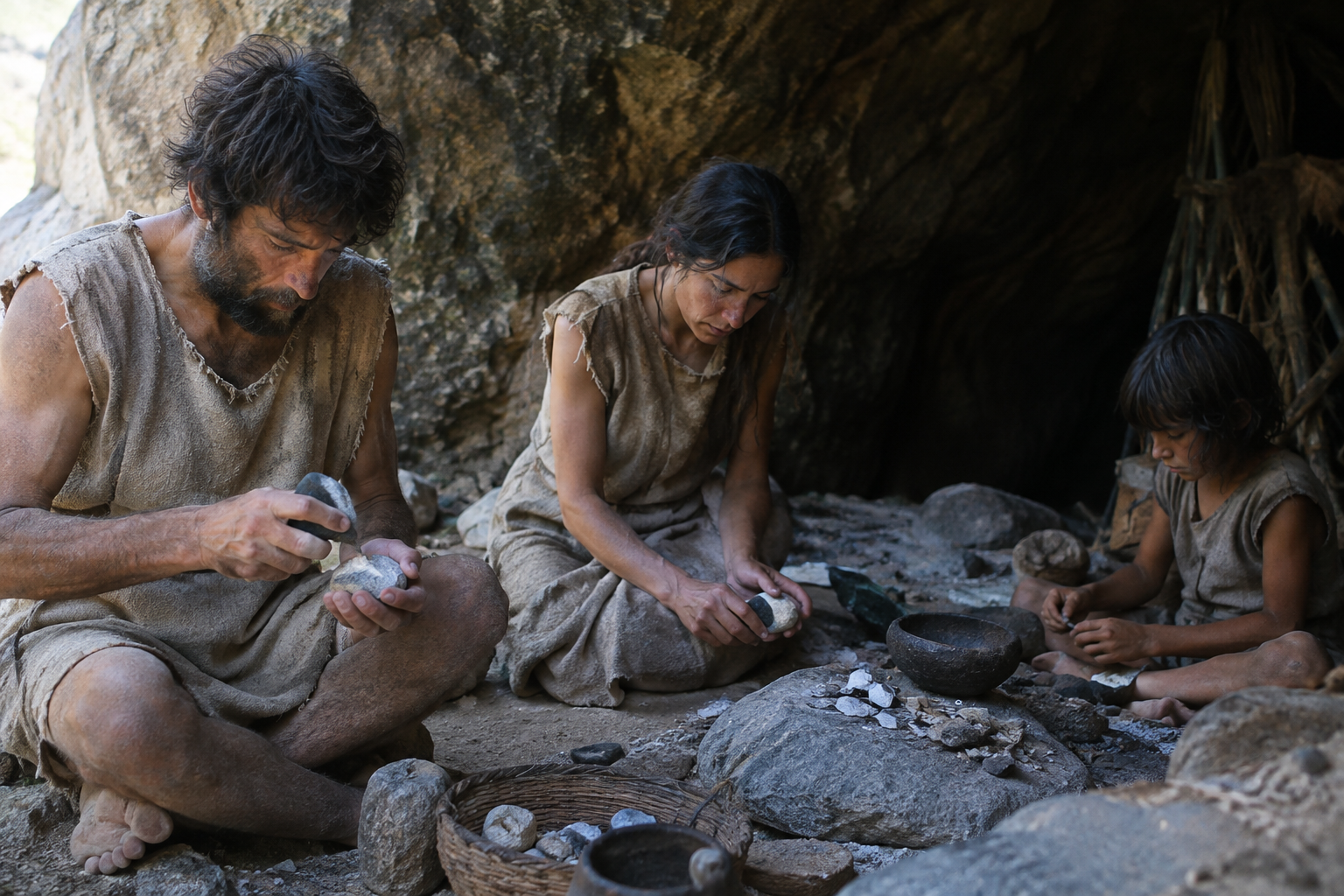
At Peqi'in Cave in the Upper Galilee, three men from the Chalcolithic period stand out for a very specific reason. The individuals labeled I1178, I1166, and I1170, dated to around 3900 BC, have been associated with the Y-DNA haplogroup T1a1a1b. That matters because Peqi'in is not just any prehistoric cave site in the Levant. It is one of the most striking ancient DNA windows onto a society living at the threshold of major change, when villages, ritual life, and long-distance connections were becoming more elaborate.
For anyone who carries T1a1a1b today, this is an unusually concrete ancient foothold. Instead of a vague map or a grand migration story, we have multiple male samples from one well-known Chalcolithic site in the southern Levant. Y-DNA follows one direct paternal line only, not a person's total ancestry, but repeated appearances of the same paternal branch at one site can still tell us something valuable about the men who belonged to that community and the world they inhabited.
Peqi'in Cave is famous because it preserved the remains of many individuals from the late Chalcolithic of the Levant, a period often dated to the 5th and 4th millennia BC. Archaeologically, this was an age of striking experimentation. Communities in the region were farming, building villages, producing elaborate material culture, and participating in increasingly wide networks of exchange.
The three men linked here to T1a1a1b, I1178, I1166, and I1170, all come from this same setting around 3900 BC. Even with only these bare identifiers, the pattern is important. This is not a lone outlier buried centuries away from everyone else. It is a small cluster from one cave context, suggesting that this paternal line was present among real Chalcolithic men in the Levant, not merely passing through the genetic record by chance.
An ancient DNA study examining this population brought Peqi'in to wider attention by showing that the cave's people were part of a distinct Chalcolithic community in the region, one with a genetic profile that helped illuminate broader population shifts in the Levant. Readers who want the scientific context for these burials can consult the research published here: https://www.nature.com/articles/s41467-018-05649-9.
Single ancient Y-DNA assignments can be tantalizing but fragile. A lone individual may represent a traveler, a minority lineage, or simply a branch that happened to survive in the sample set. Three men from the same broad place and period are more informative. They suggest that the paternal line associated here with T1a1a1b had some local standing within this Chalcolithic community.
That does not mean Peqi'in was a "T haplogroup society", nor that every male there belonged to the same paternal line. Archaeological populations were mixed, and genetic communities never map neatly onto one lineage. But repeated male-line evidence is exactly the sort of thing that helps move us away from fantasy-history and toward something more grounded: a paternal branch documented among actual prehistoric Levantine people.
In practical terms, Peqi'in gives T1a1a1b a securely ancient Near Eastern setting. It places this branch, or at least a lineage associated with it in reported results, in the southern Levant during a period of complex village life, ritual behavior, and social differentiation long before the better-known empires of the Bronze and Iron Ages.
One of the refreshing things about these samples is that they come from prehistory before the familiar parade of named dynasties. No kings stride in here, no tidy genealogies survive, and no later chronicler tells us who these men thought they were. What we have instead is better in its way: evidence from the ground. A cave. A date. A community. A set of bones that still carry a paternal signature.
That matters because later historical identities in the Levant were layered and repeatedly transformed. The men of Peqi'in lived thousands of years before Canaanite city-states, before Israelite polities, before Phoenician expansion, before the successive Assyrian, Babylonian, Persian, Greek, and Roman worlds. T1a1a1b, in this article's evidence, appears not in the age of texts but in the deeper human background from which later Levantine histories emerged.
Neolithic Expansion in the Aegean
Haplogroup T as a broader paternal family has a wide and complicated distribution in parts of the Near East, Northeast Africa, the Mediterranean, and beyond. But one must be careful here. The wider history of haplogroup T is not automatically the history of T1a1a1b. Subclades can have very different trajectories, and the temptation to import every claim about parent haplogroup T into this narrower branch should be resisted.
What the Peqi'in evidence does support is more modest and more useful. It shows that a lineage associated with T1a1a1b was present in the Chalcolithic Levant around 3900 BC. That gives this branch a firm archaeological setting in a region central to early farming societies, technological change, and long-term population interaction.
In other words, if you belong to T1a1a1b today, one defensible way to think about your paternal line is not through romantic claims of royal descent or simplistic ethnic labels, but through its presence among real prehistoric men in a Levantine community at a pivotal moment in Near Eastern prehistory.
The Chalcolithic in the Levant was not merely a waiting room before the Bronze Age. It was a world of its own, with regional identities, specialized craftsmanship, and increasingly elaborate social practices. Sites from this period have long attracted archaeologists because they hint at social complexity without yet becoming urban states in the Mesopotamian sense.
Peqi'in fits that wider picture beautifully. The cave has become important not just because it yielded ancient DNA, but because it captures a population that was part of these developments. The three T1a1a1b-associated males therefore belong to a society already experimenting with new ways of living, organizing, and commemorating the dead.
That also helps explain why Peqi'in attracts so much interest among genetic historians. A cluster like I1178, I1166, and I1170 does not simply add names to a spreadsheet. It anchors a paternal branch in one of the crucial prehistoric crossroads of western Asia, where demographic continuity and population change can both leave their mark.
Bronze and Iron Age Mesopotamia
The strongest ancient signal here is simple and quite powerful. T1a1a1b is linked in this evidence to multiple Chalcolithic males from Peqi'in Cave in the Levant around 3900 BC. That does not tell the whole story of the haplogroup, and it does not reduce anyone's ancestry to one paternal thread. But it does place that thread in a real prehistoric community at a formative moment in Near Eastern history.
For descendants exploring this branch today, Peqi'in offers something better than myth: context. Your direct male line is associated, in the ancient record we currently have, with men living in the Chalcolithic Levant, in a landscape of early farmers, cave burials, and emerging social complexity.
Comments