Haplogroup R1b1a1b1a1a2b1c2b1a

– 5 min read


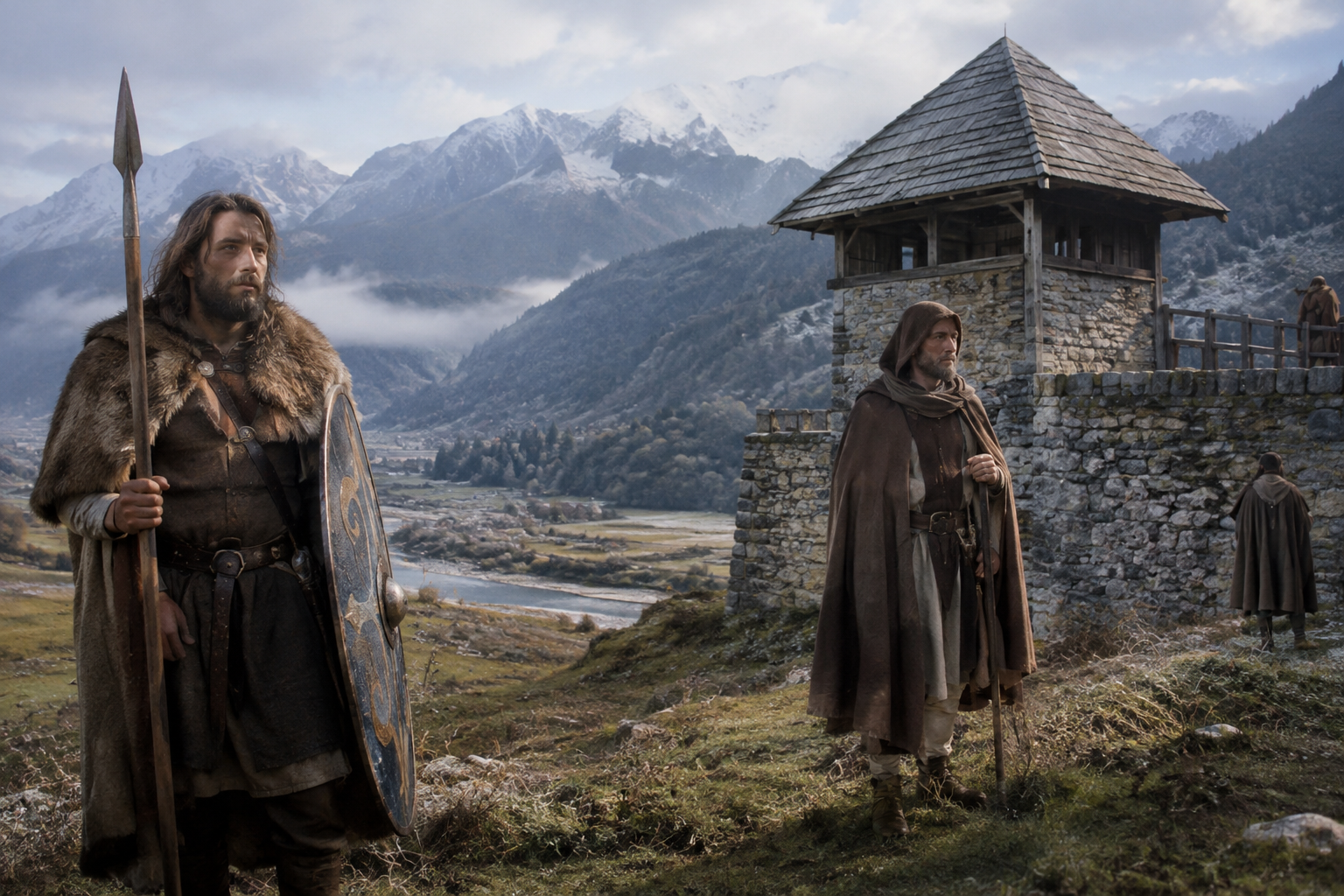
At Malles Burgusio Santo Stefano in South Tyrol, one man dated to around AD 450 carries an unusually suggestive clue for the paternal history of haplogroup R1b1a1b1a1a2b1c2b1a. He appears in the record as sample 2417_23, from a landscape that sat at a genuine frontier: the Alpine world between late Roman Italy and the routes leading north and west into central Europe. That matters because this is exactly the sort of place where ancient DNA often stops us from telling tidy stories.
The second clue comes from much earlier and much farther west: CGG023702, dated to around 500 BC at Parancot in Gaul and associated in the record with the Sequani region. Put together, these two men do not form a dynasty, a tribe, or a neat migration map. What they do offer is a rare glimpse of one paternal branch appearing in two very different archaeological settings: Iron Age eastern Gaul and the post-Roman Alpine world of northern Italy.
The label R1b1a1b1a1a2b1c2b1a is a very narrow twig on the much larger R1b tree, one of the major Y-DNA lineages found across western Eurasia. Y-DNA traces only one line of descent, from father to son, so it is never the whole story of a person's ancestry. Still, when a specific sub-branch turns up in ancient burials from particular places and periods, it can help us ask sharper historical questions about continuity, movement, and the survival of local male lines.
In this case, the evidence is modest but interesting. We are not looking at dozens of graves from one cemetery, nor at a securely documented noble pedigree. We are looking at two separated finds that place this branch, or an assignment associated with it, in western and southern Europe across roughly a thousand years.
Celtic origins and ancient DNA
The earlier sample, CGG023702, is placed at Parancot in Gaul around 500 BC, in territory linked here with the Sequani. That date lands in the later Iron Age world of eastern France, a region long important for debates about Celtic-speaking communities, river corridors, and connections between the upper Rhone, the Saone basin, and lands toward the Rhine and the Jura.
We should be careful with the tribal label. "Sequani" is a historical designation, while a burial and a Y-chromosome are archaeological and genetic data. One does not automatically prove the other. But the regional association still matters, because eastern Gaul was one of the great contact zones of later prehistoric Europe: metalworking, exchange, local elites, and interlinked communities all flourished there.
If this assignment is correct at the branch level given, then CGG023702 places the haplogroup within an Iron Age setting that is entirely plausible for a western European R1b-derived paternal line. It does not tell us the man's language, social rank, or precise ancestry mix. What it does do is anchor the branch in a real pre-Roman context rather than only in later medieval or modern genealogies.
A recent ancient-DNA preprint on France may eventually sharpen the context for such finds, especially in understanding regional continuity and population structure, though one should be cautious not to overstate details beyond the basic site and date available here: research on ancient populations in France.
Sample 2417_23 from Malles Burgusio Santo Stefano belongs to a very different world. Around AD 450, the western Roman Empire was fragmenting, but Alpine corridors remained as vital as ever. South Tyrol was not some remote mountain backwater; it was a strategic region of passes, valleys, garrisons, estates, churches, and travelling communities.
The value of this sample lies in timing as much as place. A man carrying this paternal line appears in northern Italy at the edge of late antiquity, during the centuries when the peninsula was being reshaped by military movement, political collapse, local continuity, and new forms of community. Ancient DNA from Italy has repeatedly shown that this period cannot be reduced to a simple replacement story. Local lineages persisted, newcomers arrived, and the resulting picture is often mixed and regionally specific.
An ancient DNA study of Italian populations, including shifts from Roman to early medieval contexts, helps frame the importance of finds like this one, even when the individual sample details available here are spare: research published on ancient Italian populations.
It would be tempting to draw a line on the map from Iron Age Gaul to late antique South Tyrol and declare the route solved. History is rarely that obliging. What the two samples really show is that a paternal branch associated with R1b1a1b1a1a2b1c2b1a had a presence in two zones that were deeply connected over the long term: eastern Gaul and the Alpine approaches to Italy.
Those connections existed long before Rome and long after it. Trade, military service, seasonal mobility, colonization, marriage networks, and the plain stubborn endurance of local families could all move or preserve Y-chromosome lines. A thousand years separates CGG023702 and 2417_23; that is far too much time to imply direct descent between them. But it is enough to suggest that this branch belonged to the durable human background of western and south-central Europe, rather than appearing in only one brief episode.
This is one of the useful things about narrow haplogroup studies. They remind us that large historical labels, Celtic, Roman, post-Roman, do not replace family history. The same paternal lineage can pass through radically different cultural worlds while the men carrying it live as Iron Age Gauls, provincial Romans, frontier farmers, soldiers, or churchyard burials in entirely different political systems.
Because the parent haplogroup R1b is so common in western Europe, it is easy to become lazy and treat every narrow descendant branch as if its history were already obvious. That would be a mistake here. The specific subclade R1b1a1b1a1a2b1c2b1a is much narrower than its parent, and the two ancient associations supplied here are not enough to define its full origin, peak distribution, or exact migration path.
What they do support is something more restrained and, in its own way, more useful. This branch fits into the archaeological record of western Europe before the Roman conquest, and it is also present in the complex human landscape of northern Italy in late antiquity. That combination makes it a good example of how paternal lines can persist through major cultural change without being tied to only one identity.
For readers interested in the Italian side of that story, other MyTrueAncestry work on peninsular population change gives helpful background on how Roman and post-Roman communities could preserve continuity while still absorbing newcomers.
Medieval paleogenomics in Italy
If your Y-DNA falls under R1b1a1b1a1a2b1c2b1a, the ancient evidence here points toward a paternal history rooted in the long-settled populations of western Europe, with confirmed or associated appearances in Iron Age Gaul and late antique northern Italy. That is not a promise of descent from a tribe, a kingdom, or a named historical figure. It is better than that, in a sense: it places your direct male line inside real archaeological landscapes where people lived through the making and unmaking of ancient Europe.
For this haplogroup, the most distinctive insight is continuity across very different worlds. One branch of one paternal line can be found among communities shaped by Iron Age Gaul and again in the Alpine borderlands of a fading empire. That is a modest claim, but a solid one, and ancient DNA is often at its best when it lets modest claims speak clearly.






Comments