Haplogroup S1
– 5 min read


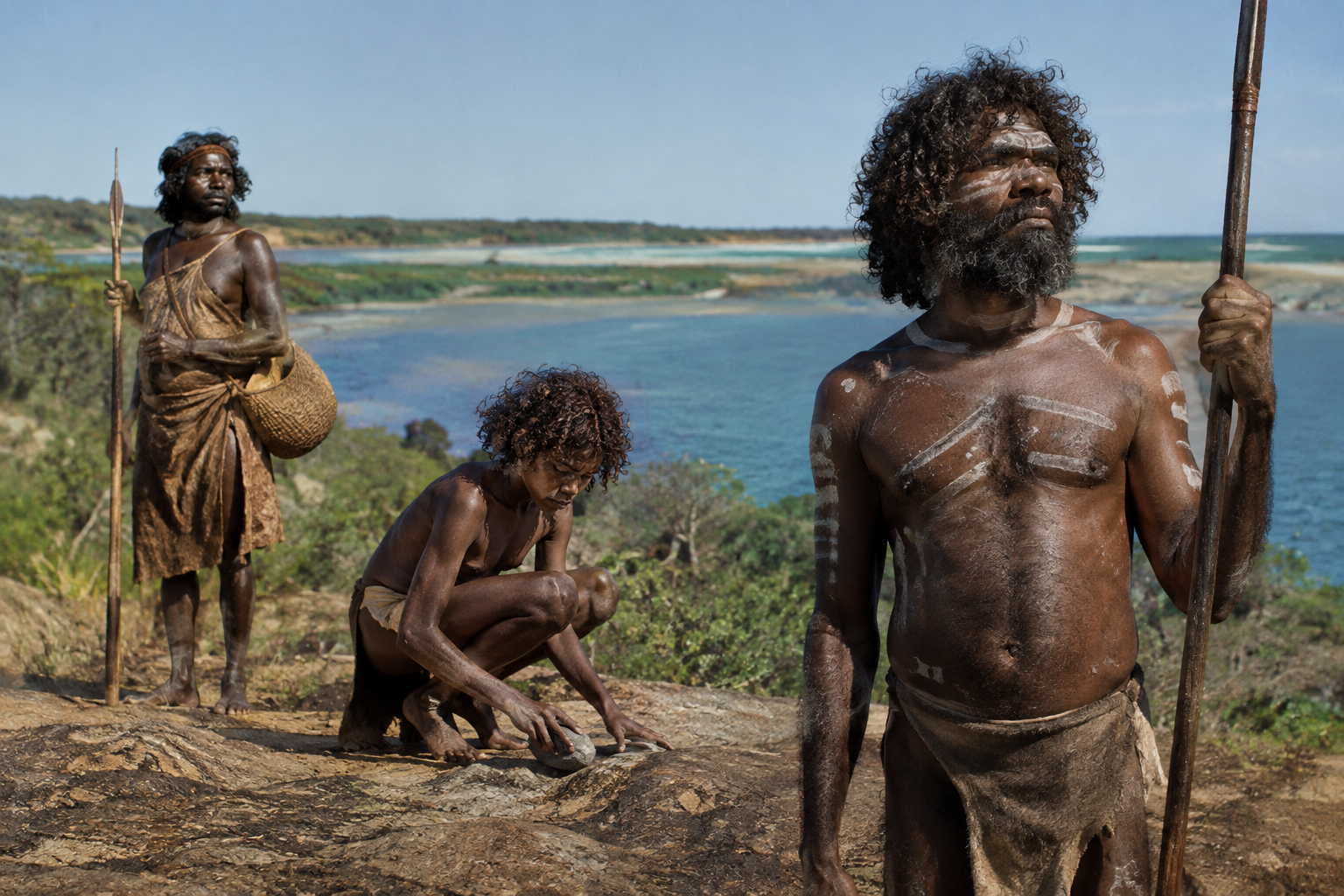
At Willandra Lakes in southeastern Australia, one ancient individual in this set stands out for sheer chronological depth: WLH4, dated here to around AD 100. That is not the oldest human presence in Australia, of course, not by a very long way. But as a Y-DNA data point connected with haplogroup S1, WLH4 matters because it places this paternal line within one of the most archaeologically important landscapes on the continent: a region whose lakes, lunettes, burials, and occupation evidence have long shaped debates about the antiquity and diversity of Aboriginal Australia.
That is the right scale on which to understand S1. Y-DNA traces one direct paternal line only, not a person's whole ancestry, language, or identity. Even so, when the same branch appears in ancient Aboriginal Australian individuals from Willandra Lakes, Cape York, and the Cairns region, it begins to look less like an isolated laboratory label and more like part of a deep and geographically wide Aboriginal paternal history.
Haplogroup S is one of the major Y-chromosome lineages associated especially with populations of Sahul and nearby parts of Oceania. The narrower label S1 is more specific than that broader parent haplogroup, but the evidence here is still quite lean at the level of named ancient individuals. So the responsible way to read these samples is not to attach grand migration stories to a tiny branch, but to note that S1 appears among Aboriginal Australian remains from more than one region and more than one period.
That fits a wider picture in which ancient DNA has increasingly shown long-term continuity in parts of Sahul, alongside regional population structure rather than a single undifferentiated past. A broader ancient DNA study of the region, published in Science Advances, helped bring that picture into much sharper focus by examining Aboriginal Australian genomic history in relation to place, time, and deep population divergence.
Ancient DNA and archaeogenetics
Willandra Lakes is one of those archaeological names that carries real weight. The lake system in western New South Wales has produced some of the most famous human remains in Australia, along with abundant evidence for long occupation in an often harsh and changing environment. To mention a Willandra sample, then, is to step into a landscape already central to the history of archaeology in Australia.
WLH4, dated here to around AD 100, does not by himself summarize that immense history. What he does offer is a later snapshot from a place better known for its Pleistocene antiquity. That matters because it reminds us that Willandra was not just an ancient threshold of first settlement; it remained part of Aboriginal life over very long spans of time. In that setting, the reported association of WLH4 with S1 suggests the persistence of this paternal branch within a region marked by extraordinary time depth.
It is also a useful caution against flattening Australian prehistory into a single founding event. Archaeology at Willandra is about continuity, yes, but also about local histories, environmental adaptation, and the survival of communities across changing conditions. A Y-chromosome lineage found there belongs inside that richer story, not above it.
The sample MH8 comes from Mapoon on Cape York and is dated here to AD 1880. Plainly, this is not "ancient" in the same way as a prehistoric burial, but it is still historically valuable. Nineteenth-century Aboriginal remains sit very close to the edge of colonial disruption, missionization, forced movement, and the violence of frontier expansion. In other words, they can preserve paternal lineages that were part of regional Aboriginal populations just before or during periods of enormous upheaval.
Cape York itself is a region of striking archaeological and anthropological importance. It is a northern peninsula with long Indigenous histories of mobility, coastal and inland adaptation, and interaction across different ecological zones. The presence of S1 in MH8 shows that this lineage was not confined to one famous inland site or one narrow district. It was present far to the north, in a landscape with its own deep and distinctive history.
That geographic spread is interesting precisely because it should not be oversimplified. A shared Y-DNA branch between Willandra and Cape York does not mean one recent migration between those exact places, and it certainly does not turn all Aboriginal groups into one genetic bloc. What it does suggest is that S1 belongs to a set of paternal lines with a substantial Aboriginal Australian footprint.
The third individual, PA86 from the Cairns region, is dated here to around AD 1500. Together with MH8 from Cape York, PA86 gives S1 another northern Australian appearance, but in a different setting and at an earlier date. That matters because repeated occurrences are often more informative than a single dramatic sample. They do not prove a dynasty or a clan, but they do make it harder to dismiss the lineage as an oddity of one place or one burial.
The Cairns region sits within tropical northeast Australia, a part of the continent with its own environmental challenges and long Aboriginal histories. Archaeology here has illuminated coastal use, rainforest adaptation, and regional cultural continuity, even if this particular sample list does not provide detailed burial information for PA86. In such a context, the S1 assignment is best understood as another sign that this paternal branch had a real place in Aboriginal Australia before modern demographic dislocation.
Long isolation in Near Oceania
On paper, three individuals may not sound like much. But archaeology is full of cases where a small number of well-placed finds changes the tone of a discussion. Here the pattern is clear enough to be meaningful: one sample from the renowned Willandra Lakes region in southeastern Australia, one from Cape York in the far north, and one from the Cairns area in northeastern Australia, spanning roughly from AD 100 to AD 1880.
That spread tells us something modest but solid. S1 is not appearing in a single tightly bounded episode. It is turning up in Aboriginal Australian contexts across a broad sweep of country and over a long historical interval. For people researching their paternal ancestry, that is often more useful than a flashy but weakly supported claim. It places the lineage within the durable human history of Australia itself.
There is also a wider methodological point. Ancient DNA works best when set beside archaeology, geography, and Indigenous history rather than treated as an oracle. A haplogroup label on its own can look sterile. Put beside Willandra Lakes, Mapoon, and Cairns, however, S1 starts to acquire human context: lakeside country, tropical north, and generations of Aboriginal men whose direct paternal lines endured through very different worlds.
Using ancient DNA to decode history
For a MyTrueAncestry user with Y-DNA haplogroup S1, the strongest supported message is not a fantasy of named kings or neatly traced migration arrows. It is something more grounded and, in its way, more impressive: this paternal branch is represented in Aboriginal Australian individuals from widely separated regions, including the historically famous landscape of Willandra Lakes. In other words, S1 sits within an ancient and enduring Aboriginal Australian story whose roots run far deeper than the few dated samples we currently have.
Comments