Haplogroup R2a2

– 5 min read


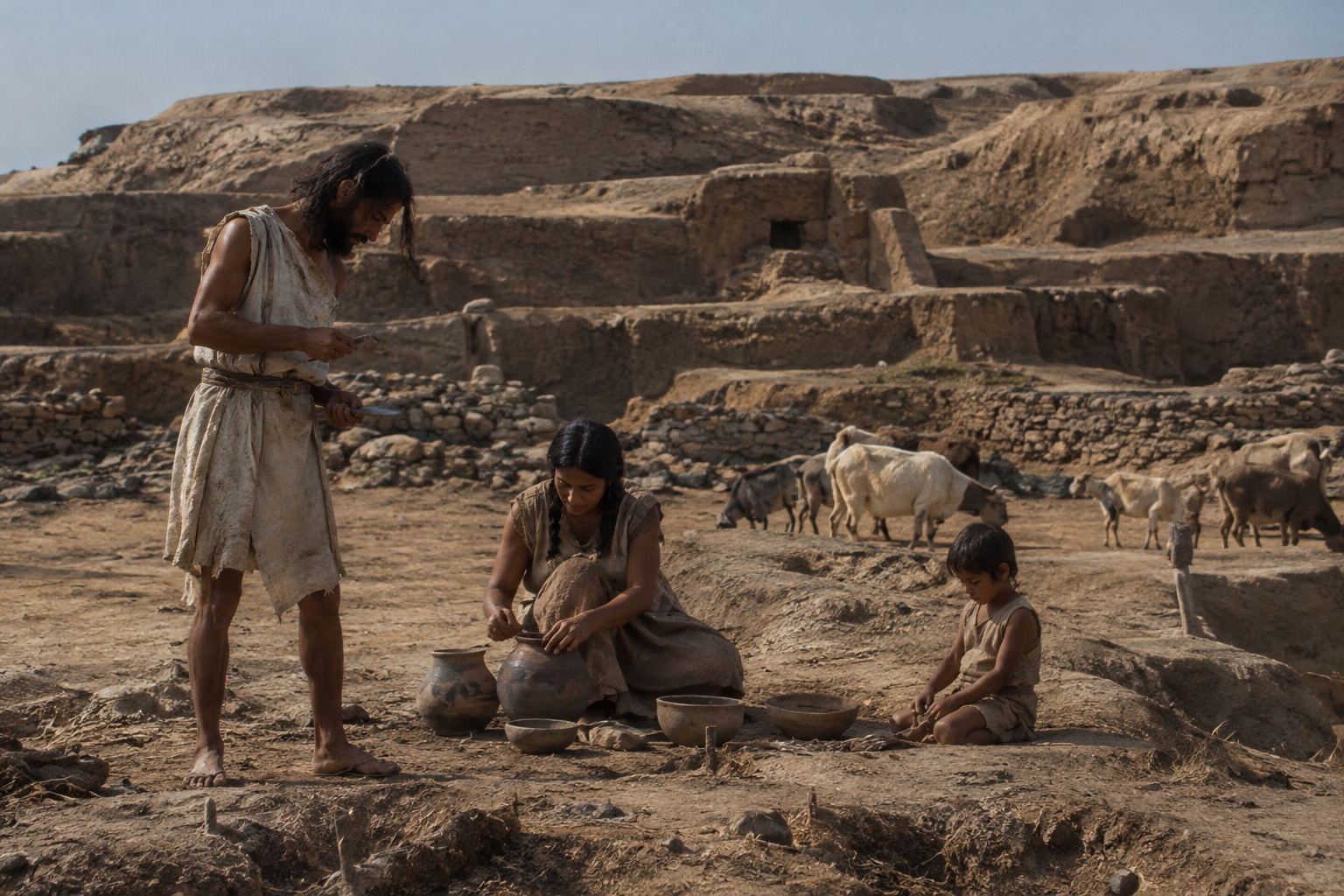
At Sappali Tepe in southern Uzbekistan, one Bronze Age man has become an unexpectedly useful witness to a much larger story. Sample I7492, dated to around 1903 BC, is reported in association with Y-DNA haplogroup R2a2. That is a small, very particular paternal branch, and its appearance at Sappali Tepe matters because this was no remote outpost: it sat within the Oxus world of Bronze Age Central Asia, a region of fortified settlements, irrigation agriculture, and far-reaching exchange.
That is where R2a2 becomes interesting. Not because one burial can explain an entire people, and not because a Y chromosome tells us everything about ancestry - it only follows one direct paternal line - but because a lineage like this, found in a place like Sappali Tepe, anchors discussion in something real. Instead of vague talk about "ancient migrations," we are dealing with a named site, a dated individual, and a paternal line present in a crossroads society of the early 2nd millennium BC.
Sappali Tepe belongs to the Bronze Age cultural sphere often linked with the Bactria-Margiana Archaeological Complex, or more broadly the Oxus Civilization. This was a world stretching across parts of present-day Turkmenistan, Uzbekistan, Tajikistan, and northern Afghanistan, marked by substantial settlements and ties to neighboring regions. Southern Uzbekistan, in particular, was not sealed off from events farther south and east; it was part of a contact zone where farming communities, mobile groups, and trading networks overlapped.
In that setting, I7492 gives R2a2 an archaeological foothold. The value of the sample is not that it proves where the entire haplogroup "came from," because a single individual cannot do that. Its value is that it shows this paternal branch in a Bronze Age Central Asian population at a time when the region was deeply involved in movements of goods, ideas, and people.
A useful broader research gateway for the ancient DNA record behind finds like this is the Harvard Dataverse collection associated with these ancient genomes: https://dataverse.harvard.edu/dataset.xhtml?persistentId=doi:10.7910/DVN/7RVV9N. Even when the individual-level historical detail is limited, the larger significance lies in placing paternal lines into excavated populations rather than treating them as abstract modern labels.
R2a2 is a downstream branch within the wider haplogroup R. That wider parent haplogroup has an enormous history across Eurasia, but it would be a mistake to pour all of that history directly into this narrower branch. The responsible point is simpler: R2a2 is present here in Bronze Age Central Asia, and that presence fits a region known for population mixture and long-distance contact.
For family historians, this distinction matters. If your paternal line belongs to R2a2, that does not make you a direct continuation of one archaeological culture, one language, or one ancient kingdom. What it does suggest is that one strand of your direct male-line ancestry may connect into the broad human landscape of Inner Asia and adjacent regions where such lineages were already established by the Bronze Age.
The date of I7492 - roughly the early 1900s BC - falls in a period when Central Asia was full of local development but also external contact. This is the age in which archaeologists trace connections between the Oxus settlements and surrounding zones, including the Iranian plateau, the steppe, and regions farther toward South Asia. Sappali Tepe sits neatly inside that historical problem: how stable farming settlements and mobile networks interacted in a world before imperial borders.
That is one reason a paternal lineage at this site matters more than it might at first seem. Y-DNA can sometimes reveal that communities with similar material culture were not biologically uniform, or that people with different paternal backgrounds lived inside the same archaeological horizon. In places like Bronze Age southern Uzbekistan, that is exactly the sort of question worth asking, because the archaeology already tells us this was a zone of connection rather than isolation.
There is a nice parallel here with later studies of population complexity across Eurasia: ancient DNA repeatedly shows that cultural labels and biological ancestry do not line up in any simple one-to-one way. The lesson from Sappali Tepe is not to chase a single origin myth, but to see Bronze Age Central Asia as a place where lineages met, persisted, and were absorbed into new local societies.
One reason R2a2 attracts interest today is that branches of haplogroup R2 are more often discussed in relation to South Asia than to Europe. That makes a Bronze Age occurrence in Uzbekistan especially suggestive, though still not a license for overstatement. Sappali Tepe lies in a region that helped connect Central Asia with areas to the south, and so an R2a2 lineage here fits the geography of interaction remarkably well.
But "fits the geography" is not the same as proving a single migration event. It would be careless to claim that I7492 marks the spread of one language family, one ethnic group, or one exact route into later populations. What the sample does provide is a firm reminder that paternal lines now associated with populations farther south or east were part of the Bronze Age human landscape north of the Hindu Kush as well.
That point becomes even more valuable because ancient DNA from Central and South Asia is still uneven. Every securely placed Bronze Age individual helps fill in the map. R2a2 at Sappali Tepe therefore matters not because it settles the argument, but because it prevents us from telling too neat a story about ancient boundaries.
There is also something methodologically useful about a case like this. We have one named ancient individual, one date, one site, and one haplogroup assignment associated with the article's branch. That may seem sparse, but sparse evidence is not useless evidence. In fact, archaeology often advances by carefully positioning exactly these modest but reliable points.
Sappali Tepe is not important because it lets us fantasize about princes or lost dynasties. It is important because it belongs to a well-known Bronze Age settlement tradition in a region where ancient DNA has begun to illuminate the human side of old archaeological questions. Who lived in these fortified communities? How much continuity was local, and how much came from neighboring populations? How did paternal lines circulate within settlement systems tied to trade and mobility?
Those are precisely the questions a sample like I7492 helps sharpen. Even a single R2a2-associated individual adds weight to the view that Bronze Age Central Asia contained more paternal diversity, and more historical entanglement, than older textbook sketches once allowed.
The most distinctive thing about R2a2 in this article is not a grand empire or a famous surname. It is the quiet fact that this paternal branch appears in Bronze Age Sappali Tepe, in a society positioned between major cultural worlds. For someone researching a modern R2a2 line, that is a meaningful clue: your direct paternal ancestry belongs to a lineage already present in one of ancient Eurasia's great contact regions more than 3,900 years ago.
That does not hand you a ready-made identity. It does something better. It places your paternal line inside the real archaeology of Central Asia, where settled communities, exchange networks, and human movement shaped the Bronze Age world in ways we are only beginning to map clearly.
Comments