Haplogroup R2a
– 4 min read


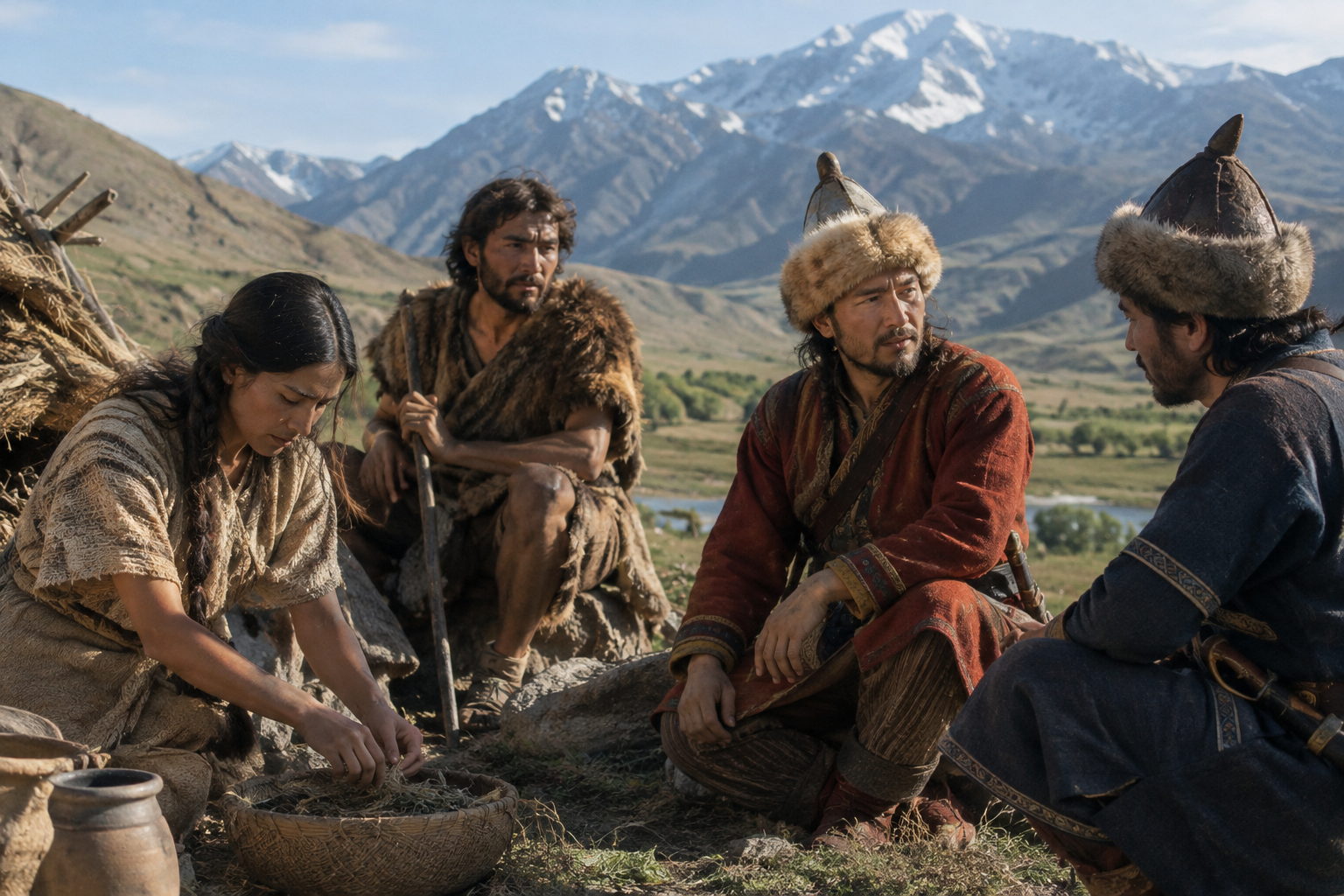
At Ganj Dareh in the Zagros Mountains of western Iran, one early farming community has become unexpectedly important to the history of Y-DNA haplogroup R2a. Among the ancient individuals recovered there is sample I1947, dated here to around 8000 BC. That matters because Ganj Dareh sits near one of the great early centers of herding and village life, and an R2a-associated male in that setting places this paternal line in a landscape that was already central to the Neolithic transformation of Southwest Asia.
R2a is a Y-chromosome lineage, so it traces one direct paternal line only: father to son across many generations. It does not sum up a person's whole ancestry, language, or identity. But when the same broad branch appears in both an early Neolithic Iranian context and much later Central Asian steppe-related settings, it offers a useful clue about continuity, movement, and survival across a very long stretch of Eurasian history.
Ganj Dareh is famous because it belongs to the earliest village horizon of the eastern Fertile Crescent, a world of mud-brick architecture, managed animals, and changing lifeways. Research on early populations from the region, including work published in an ancient DNA study of early Southwest Asian populations, helped show just how genetically varied the first farming communities were across the Near East. They were not all one uniform people spreading outward in lockstep.
That is the right setting in which to think about I1947. The interest of the sample is not that one man can stand for all Neolithic Iran; he cannot. The interest is that R2a, or an association with that branch, appears in a place where early food production was taking shape locally and where deep regional population history mattered. In other words, this is not a lineage arriving only in much later historical times. It is present in one of the foundational archaeological zones of the ancient Iranian world.
For family historians, this is a useful corrective to a very common mistake. People often imagine paternal lines as belonging neatly to a single empire or famous migration. Ganj Dareh suggests something older and less tidy: some R2a-associated ancestry was already part of the human background of the Iranian plateau and its neighboring highlands in the deep Neolithic.
R2a is a specific branch within the broader Y-chromosome tree, and it has often been discussed in connection with South Asia, Iran, and adjacent regions. Ancient DNA makes that picture more concrete, but also more complicated. A haplogroup can persist through language shifts, marriage networks, conquests, and cultural change without implying that every later carrier belonged to one continuous tribe or people.
That is especially important here because the evidence for this article is spread across very different times and places. One sample comes from an early Neolithic village in Iran; two others come from individuals classified as early Alan-related in Tajikistan around 100 BC. The temptation would be to draw a single straight arrow across 8,000 years. Archaeology very rarely rewards that kind of tidy story.
The later part of the picture comes from two individuals in Tajikistan: I12260, labeled Early-Alan Mix Tajikistan, and I12292, labeled Early-Alan Tajikistan, both dated here to around 100 BC. Even from those short labels, something significant is clear. By the late Iron Age, an R2a-associated paternal line appears in a region where Iranian-speaking steppe groups, oasis populations, and mountain communities met and mixed.
The Alans were part of the wider Iranian-speaking nomadic world often linked to Sarmatian horizons of the Eurasian steppe. But Tajikistan was not simply "the steppe." It was a contact zone, tied to Bactria, Sogdiana, and the routes that would later feed into the Silk Roads. So the presence of R2a in these Alan-related individuals is interesting precisely because it sits at a crossroads rather than at the edge of a single ethnic map.
The label Early-Alan Mix for I12260 is also a useful reminder that ancient individuals do not always fit clean cultural boxes. Some burials or genomes show blended backgrounds, and that is historically normal. Steppe confederations and frontier societies were often made up of people with varied local and long-distance origins, united by politics, mobility, and culture more than by a single paternal signature.
Put the Iranian and Tajikistan evidence side by side and a pattern emerges, though it must be handled carefully. R2a is not shown here as the badge of one continuous dynasty or migrating clan. What the samples do suggest is that this paternal branch belonged to a broad eastern Iranian and Inner Asian world in which populations could remain locally rooted while also participating in large networks of movement.
That is why the combination is so suggestive. I1947 anchors the branch, or at least its reported ancient presence, in the early farming landscapes of the Zagros. I12260 and I12292 then show that R2a-associated male lines also existed much later among populations connected with the Iranian-speaking steppe sphere farther east.
Research associated with ancient genomes from this wider zone, including material linked through a preprint on ancient population history in Inner Asia, has underlined a broader point: Central Asia was repeatedly formed by admixture, persistence, and recombination rather than by simple replacement. That wider archaeological reality fits these R2a occurrences rather well.
Black Sea and steppe migrations
Three ancient samples are not enough to write the full biography of a haplogroup. But they are enough to make a historically useful point. R2a was present in places that mattered enormously to Eurasian prehistory and history: the early Neolithic communities of the Iranian highlands and the later interaction zones of Central Asia.
That alone makes R2a more interesting than any modern frequency map can show. A modern tester carrying this haplogroup may be seeing the paternal residue of very old population histories tied to Iran, adjacent highland regions, and the east Iranian or Inner Asian corridor. The ancient evidence does not narrow that to one tribe, one language, or one famous ancestor, but it does place the lineage in a serious archaeological landscape.
The most distinctive thing about R2a in the present evidence is its span. It appears in an early village world of the Zagros with I1947, and it appears again in Alan-related Central Asian settings with I12260 and I12292. For someone researching an R2a paternal line today, that does not promise a single named people or family. What it does suggest, responsibly, is a lineage with deep roots in the wider Iranian-Central Asian sphere and a history old enough to reach back to some of the earliest settled communities in that part of the world.
Comments