Haplogroup R1b6

– 5 min read


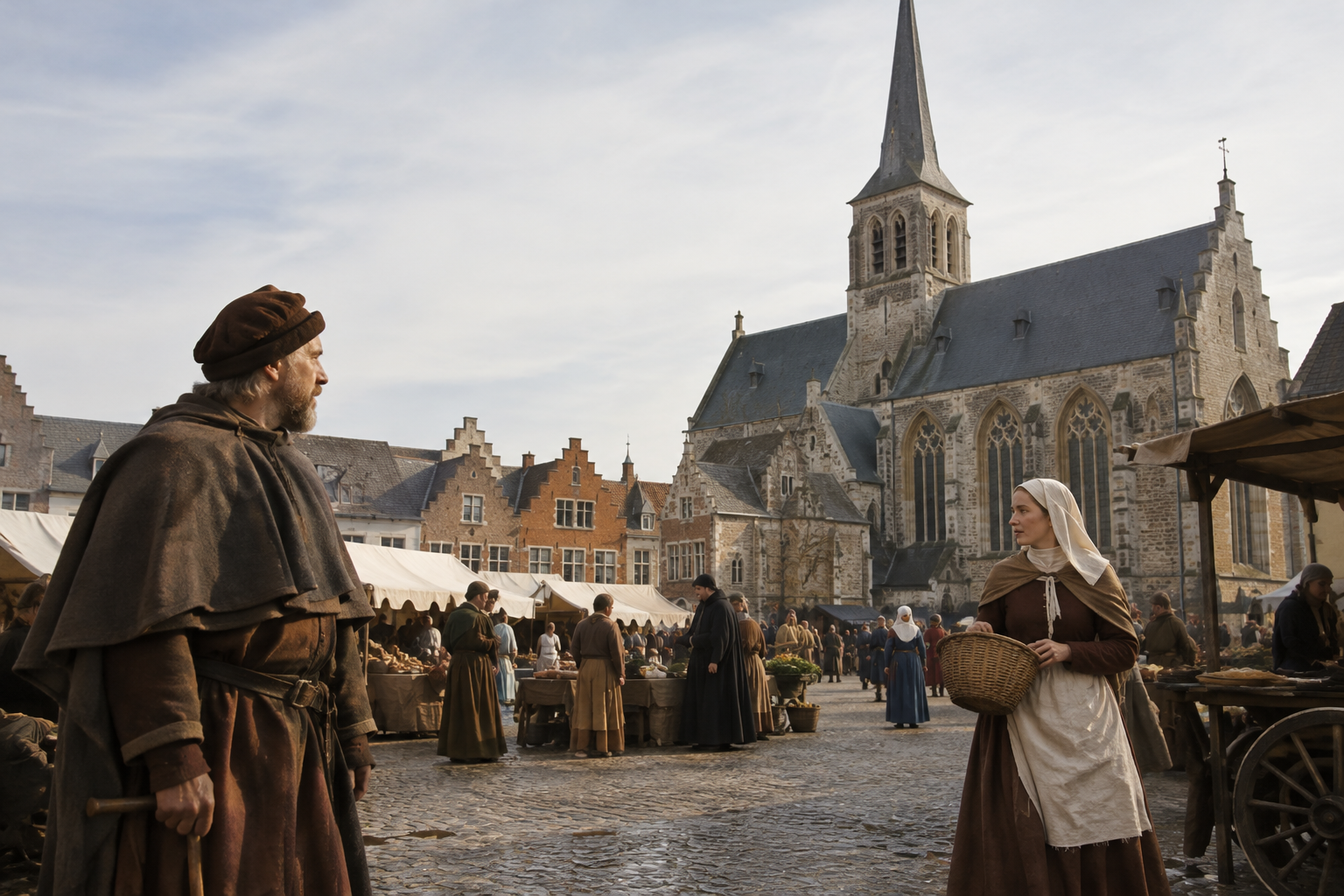
At Sint-Truiden in medieval Belgium, two male burials offer a small but telling glimpse of a paternal line that is rarely discussed on its own: R1b6. One man, sample ST2805, dates to about AD 1090 from Groenmarkt. Another, ST1044, dates to about AD 900 from Sint-Truiden Onze-Lieve-Vrouwekerk and is described as an outsider. That pairing is immediately interesting. We are not looking at a grand royal mausoleum or an epic battlefield, but at an urban medieval community where local continuity and human movement met in the same burial landscape.
That matters because Y-DNA tracks a direct paternal line only, not a person's whole ancestry. Even so, when the same branch appears in more than one man from the same town across roughly two centuries, it gives us a useful historical question: was R1b6 part of the local male population in medieval Sint-Truiden, or are we catching a lineage moving through a busy ecclesiastical and commercial center? An ancient DNA study of the site, published in Genome Biology, explored exactly this kind of urban genetic patterning.
Sint-Truiden was no backwater. In the early and high Middle Ages it was an important religious and regional center in what is now Belgium, shaped by churches, burial grounds, trade, and the movement of people through the Low Countries. That makes the two R1b6-linked men especially valuable, because medieval towns often reveal a more mixed social world than simple stories of "locals" and "newcomers" allow.
Sample ST1044, from around AD 900 at Onze-Lieve-Vrouwekerk, is the more provocative of the pair because he is explicitly labeled an outsider. That description should be handled carefully. It does not mean a foreign invader, nor does it automatically identify language, ethnicity, or birthplace. But it does suggest that the burial population at Sint-Truiden included men whose life histories were not identical to those of the surrounding core community.
Sample ST2805, from around AD 1090 at Groenmarkt, comes from a somewhat later medieval phase. Taken together, the two individuals show that the branch assigned here as R1b6 was present in Sint-Truiden across different burial locations and at different times. That is not proof of a continuous single family line, but it is enough to make R1b6 part of the town's documented paternal landscape.
R1b is a very large and widespread Y-chromosome family in western Eurasia, but that broad fact is not the same thing as the history of R1b6 specifically. A narrower branch must be treated on its own evidence. In this case, the secure story is modest but worthwhile: men associated with R1b6 appear in medieval Sint-Truiden, and at least one of them belonged to a burial context interpreted as socially or geographically non-local.
That combination is often more illuminating than a dramatic claim of conquest or dynasty. Medieval towns in the Low Countries sat within thick networks of monasteries, markets, lordships, and roads. Men moved for work, patronage, marriage, military service, devotion, and trade. A paternal branch turning up in both a regular medieval burial and an outsider burial fits that world rather well.
It also reminds us that a Y-line can persist through many kinds of historical experience. Some branches are carried by famous ruling houses; others are found in ordinary churchyards. Most ancient DNA work, in fact, is restoring those quieter male histories that written sources ignored.
The most suggestive single case here is ST1044. Found at Sint-Truiden Onze-Lieve-Vrouwekerk and dated to about AD 900, he belongs to a period when the post-Carolingian world was changing fast. Political authority was shifting, ecclesiastical institutions remained powerful, and long-distance contacts across the Meuse and Rhine regions were hardly unusual.
To call someone an outsider in an archaeological context is usually to flag difference within a burial population, not to assign a ready-made historical identity. The difference may come from mobility, ancestry, burial treatment, isotopic signals, or broader genomic profile, depending on the study. Without overreaching, ST1044 can be read as evidence that the R1b6 line was not confined to a purely local, closed paternal pool.
That point is worth underlining because medieval Europe is often imagined as immobile and parochial. Ancient DNA keeps showing otherwise. Communities could be stable in one sense and open in another, with churches and towns serving as places where local families, newcomers, pilgrims, laborers, and elites crossed paths.
By the time of ST2805 at Groenmarkt, around AD 1090, Sint-Truiden was living through the social thickening of the high Middle Ages. Urban life was becoming denser, institutions more elaborate, and communities more interconnected. The significance of ST2805 is not that he transforms the map of Europe, but that he anchors R1b6 within this later phase of town life.
Seen beside ST1044, ST2805 suggests a branch present across at least two centuries of burial evidence in the same town. That is precisely the sort of pattern that helps family historians think historically rather than romantically. A paternal line may endure in one region not because it belonged to a single powerful clan, but because ordinary men and their sons remained part of the local fabric while towns absorbed newcomers and reshaped identities.
This is one of the quiet strengths of urban archaeogenetics. Instead of searching only for spectacular founders, it lets us watch lineages embedded in real communities: parish by parish, cemetery by cemetery, century by century.
If there is a larger historical setting for these finds, it is the role of the Low Countries as a crossroads between the North Sea world, the Rhineland, and inland Francia. Movement through this zone long predated the medieval period, and it continued through trade, warfare, pilgrimage, and church networks. A branch like R1b6 turning up in Sint-Truiden should therefore be read against a background of connectivity rather than isolation.
That does not let us assign these men to a named tribe, a noble house, or a precise migration route. It does something more useful. It places them in a well-documented landscape where paternal lines could be both locally rooted and regionally entangled. Medieval identity was layered: a man could be buried in one town, born in another region, and belong to a paternal line with a still deeper history elsewhere.
Two individuals are not a population census. Still, small findings can be historically meaningful when they are well-contextualized. Here, the value lies in the combination of place, date, and social interpretation: ST1044 and ST2805 show R1b6 in a medieval Belgian town across different contexts, including one explicitly marked as non-local.
For people researching this haplogroup today, that is a grounded sort of connection. Not a fantasy of instant noble descent, and not a claim that one medieval town explains the whole branch. Rather, it suggests that R1b6 belonged to the lived human geography of medieval northwestern Europe, where urbanization did not erase older paternal lines but absorbed them into new and more mobile communities.
Lower Rhine-Meuse Deep History
The clearest supported insight for R1b6 is not grandeur but presence: this paternal branch appears in medieval Sint-Truiden in men buried about two centuries apart, one of them identified as an outsider within that community. That makes R1b6 part of a documented story of continuity, mobility, and urban life in the medieval Low Countries. If this is your haplogroup, these burials offer a plausible historical setting in which men of your direct paternal line could have lived: not on the margins of history, but in the busy, changing world of a medieval European town.

Comments