Haplogroup R1b1a1b1b3a3

– 5 min read


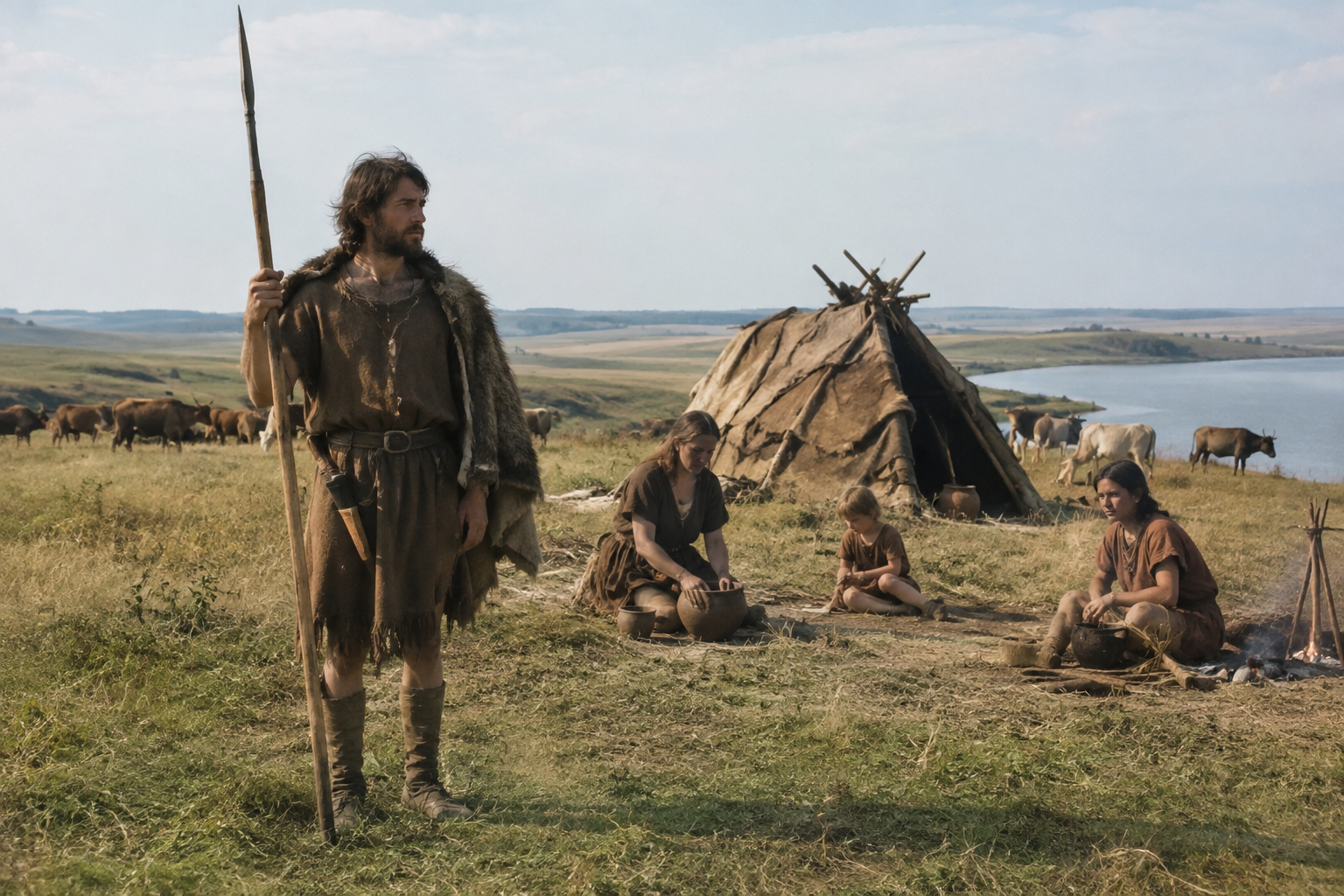
At Nizhnaya Orlyanka on the Samara steppe, one ancient man gives us a very direct glimpse of the deep paternal history behind haplogroup R1b1a1b1b3a3. The sample is I6728, dated to around 2982 BC and identified as a Yamnaya individual from Bronze Age Russia. That is already enough to make him historically important, because the Yamnaya horizon sits near the center of one of the great demographic shifts of Eurasian prehistory.
For anyone carrying this lineage today, that does not mean they are simply "a Yamnaya person" in any complete ancestral sense. Y-DNA follows one narrow paternal line out of thousands of ancestors. But it does mean that one branch of a modern family tree can be placed, quite concretely, in the world of mobile herders on the Volga-Ural steppe at the start of the Bronze Age.
The Samara region matters enormously in archaeogenetics because it lies within the wider steppe zone associated with the emergence and spread of Yamnaya populations in the late 4th and early 3rd millennia BC. Sample I6728 comes from that setting: open grasslands, river corridors, and communities whose lifeways were tied to herding, mobility, and burial traditions that archaeologists have studied for generations.
Even with only a single named individual here, the context is anything but small. A Yamnaya burial from Samara is not a stray curiosity from the edge of the map; it belongs to a region repeatedly used in ancient-DNA research to understand how steppe ancestry expanded westward and eastward during the Bronze Age. In that sense, R1b1a1b1b3a3 enters the historical record not in a medieval pedigree or a later kingdom, but in one of prehistoric Eurasia's most consequential population horizons.
An ancient DNA study of this wider steppe world is linked through the Harvard Dataverse research collection associated with this sample set: research on ancient Eurasian genomes and population history. Used carefully, work of this kind provides the broader framework for understanding why a Samara Yamnaya male matters so much in discussions of paternal lineages.
The exact article haplogroup here is R1b1a1b1b3a3. That is a very specific sub-branch inside the much larger R1b family. This distinction matters, because broad statements about "R1b" can become far too loose very quickly. The larger parent lineage appears across many regions and periods, while a narrower branch like this one must be handled with more restraint.
With the evidence provided here, the safe claim is that I6728 is an ancient individual associated with this haplogroup article and that he belongs to the Yamnaya setting of Bronze Age Samara. What makes that useful is not some fantasy of a perfect line from one excavated grave to every modern tester, but the fact that it roots this paternal strand in a real archaeological landscape and a real prehistoric population.
That is often the most revealing thing about Y-DNA. It does not tell the whole story of a person or a people, but it can pin one line of descent to a particular historical theater. In this case, the theater is the Eurasian steppe at the moment when pastoral societies were reshaping the genetic map of Europe and parts of Asia.
There is a reason Yamnaya burials turn up again and again in discussions of Bronze Age ancestry. Across many studies, these steppe groups are linked with a major expansion of ancestry that later appears widely in Europe. That does not mean every later population was simply Yamnaya in culture, language, or identity. It means that people connected to the steppe became an important ancestral component in many later communities.
For a paternal lineage such as R1b1a1b1b3a3, the Samara evidence is especially striking because it places the line within the steppe zone early enough to belong to that formative period. The burial of I6728 is therefore not just "old"; it sits close to a turning point in Eurasian prehistory, when mobility, herding economies, and new social networks were helping move both people and lineages across large distances.
This is also where archaeology keeps genetics honest. We are not talking about abstract arrows on a migration map. We are talking about a man buried at a known Bronze Age site in Russia, in a region long associated with steppe archaeology. The power of ancient DNA lies precisely in that combination of bones, place, date, and lineage.
One ancient sample cannot by itself narrate the whole later history of this branch. Still, the broader archaeological picture helps explain why a Samara Yamnaya lineage matters to so many present-day testers. Steppe-derived ancestry became entangled with later Bell Beaker, Corded Ware, and other Bronze Age developments in different parts of Europe, though each region followed its own path.
That is the important balance to keep. R1b1a1b1b3a3 should not be treated as a shorthand for all Indo-European languages, all Bronze Age elites, or all later western European paternal lines. Yet the presence of this branch in a Yamnaya individual from the Samara region does place it within the same broad historical environment that ancient-DNA studies have identified as central to major Bronze Age expansions.
Readers interested in how these large-scale shifts later played out in western Europe may find it useful to compare this steppe background with studies of the Rhine-Meuse world and Beaker-era change.
Bell Beaker in the Lower Rhine
It is very tempting to turn a Y-DNA branch into a ready-made identity badge. Ancient history is full of traps like that. A paternal haplogroup is not the same thing as a language, a tribe named in later texts, or a complete population. The Yamnaya were themselves human communities with varied family histories, and every modern person has countless ancestors beyond the one paternal line traced by Y-DNA.
But there is something genuinely solid here. If your direct paternal line falls under R1b1a1b1b3a3, the current evidence points toward a branch that was already present in the Bronze Age steppe world of Samara. That is not myth, and it is not a romantic guess. It is the sort of grounded statement ancient DNA makes possible: modest in scope, but wonderfully concrete.
The wider implications of steppe ancestry for later language spread remain one of the biggest questions in prehistoric Europe, and they continue to be explored through both archaeology and genomics.
Languages and ancient genomics
The most distinctive thing about R1b1a1b1b3a3 in this evidence is its appearance in I6728, a man from Nizhnaya Orlyanka in the Samara region around 2982 BC. That places this paternal line in the world of early Bronze Age steppe pastoralists at a historically pivotal moment. For someone researching their paternal ancestry, that is a meaningful clue: one strand of your family history reaches back, not vaguely into "ancient Europe," but into the Yamnaya horizon of the Eurasian steppe.

Comments