Haplogroup R1b1a1b1b3a1

– 6 min read


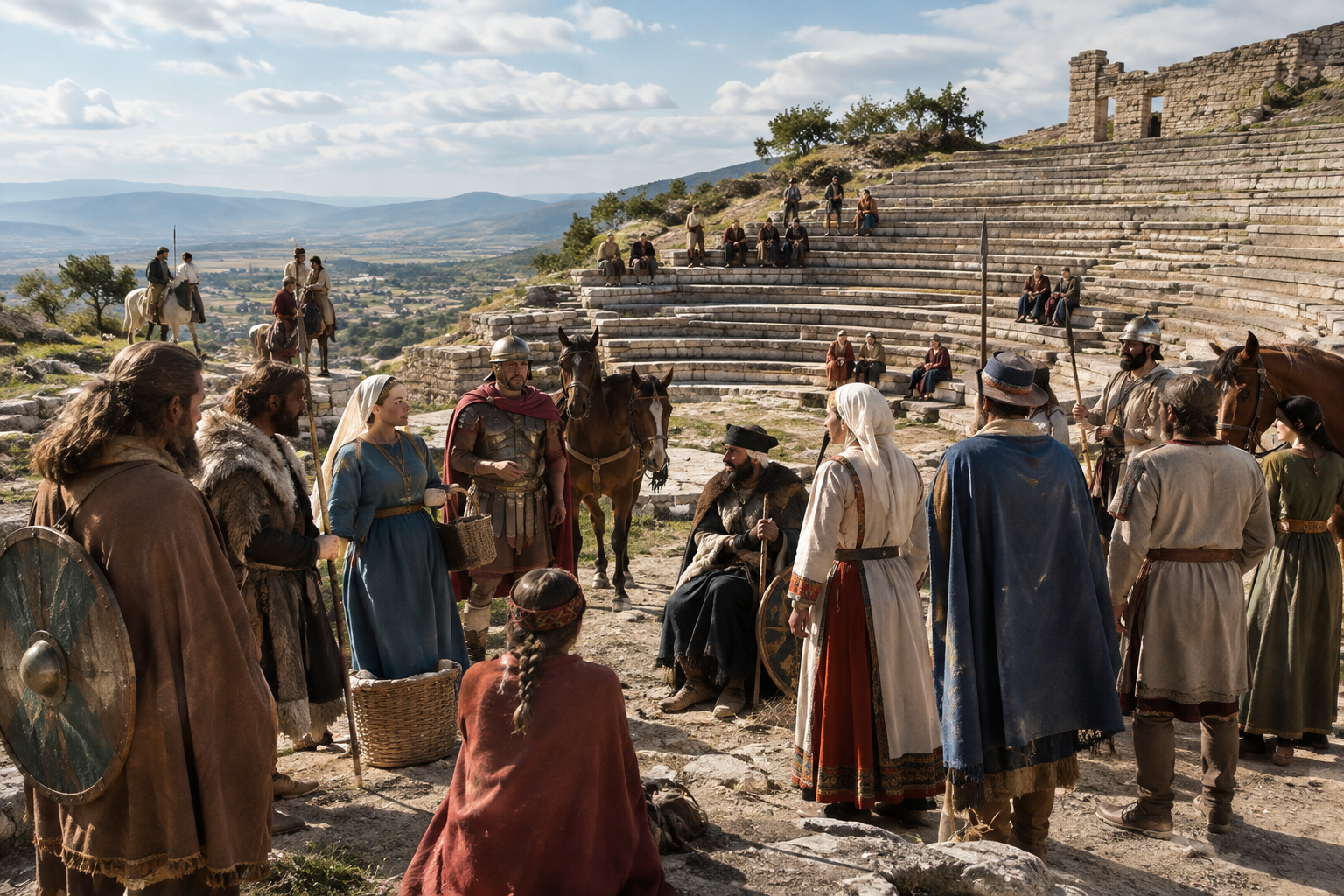
Some Y-DNA lineages announce themselves with a neat, tidy story. Haplogroup R1b1a1b1b3a1 does not. What makes it interesting is precisely that it turns up in places that force us to think historically rather than lazily: a Scythian-era individual in southern Moldova, men on the late Roman and post-Roman frontiers, an Iron Age burial in Pomerania, medieval Sicily, northern Spain, Hungary, and Piast-era Poland. This is not the pattern of a single tribe marching in a straight line. It is the pattern of Europe as it actually was: mobile, layered, argumentative, and full of people crossing frontiers.
As always with Y-DNA, we are talking about one very specific thread of ancestry: the direct paternal line, passed from father to son. That makes haplogroups powerful tools for reconstructing parts of the past, but only parts. They do not describe a person's whole ancestry, culture, language, or identity. For a subclade as specific as R1b1a1b1b3a1, caution matters even more. We can place it within the wider R1b world, one of the major paternal lineages in western Eurasia, but we should not simply pour the entire history of broad R1b into this narrower branch and call the job done.
In the broadest terms, R1b lineages are central to the paternal history of much of Europe and appear in many ancient and later populations. But the narrower branch R1b1a1b1b3a1 is best approached through evidence rather than assumption. The current sample set points less to one fixed homeland than to a corridor of movement stretching from the Black Sea and eastern-central Europe into the Roman and medieval worlds of the continent.
That is historically plausible. The later prehistoric and historic map of Europe was repeatedly reshaped by movement through the Danube basin, the North European plain, the Baltic zone, and the Mediterranean. Some paternal lines endured locally for long periods; others were carried by soldiers, traders, settlers, retainers, and migrating communities. A lineage like this may therefore reflect both continuity and mobility, depending on place and date.
If you want the wider background on how ancient DNA transformed this kind of question, MyTrueAncestry has a useful introduction to the field itself.
Explore the rise of archaeogenetics
The earliest supplied example is scy305, dated to 290 BC, from Scythian Southern Moldova. That alone is a reminder that paternal lines do not belong neatly to the stereotypes we inherit from old textbooks. "Scythian" is often imagined as a single steppe identity, but the archaeology and genetics of the wider north Pontic world show a far more mixed landscape. A lineage connected to R1b1a1b1b3a1 appearing here fits that world of contact between steppe zones, farming regions, and frontier exchange.
From there the evidence shifts westward into the Roman orbit. R10478, from Late Roman Era Emona Slovenia and dated 325 AD, places the lineage in a major urban and military region of the southeastern Alpine world. Emona sat in one of those strategic Roman corridors where roads, garrisons, commerce, and administrative power met. Men buried there were living in an empire held together as much by movement as by marble.
Then comes STRAZ_I_11 from Late Roman Frontier Straubing Azlburg Germany, dated 400 AD. Here the setting is even more suggestive: the imperial frontier itself, where the distinction between "Roman" and "barbarian" could be politically useful but biologically rather blurred. The presence of this paternal branch in such a context sits well with what frontier archaeology keeps telling us: border zones were not walls so much as filters.
Another revealing case is BRC005x from Migration Period Roman Saxony-Anhalt Bruecken, dated 500 AD. By then western imperial structures had fractured, but people had not stopped moving. If anything, some regions became more fluid. A lineage found in Roman, post-Roman, and migration-period settings hints at exactly the kind of continuity-through-change that written sources often obscure.
Readers interested in that blurred world between empire and its neighbors may enjoy this related piece on frontier mixing.
Explore frontier blending in late antiquity
The sample PCA0475 from Iron Age Pommerania Gdansk Wielbark, dated 200 AD, adds a Baltic-facing dimension. The Wielbark cultural sphere has long attracted attention because of its role in debates about mobility around the southern Baltic, including discussions connected with Gothic-era archaeology. One Y-lineage cannot solve those debates, of course. But it does show that this branch was present in the north-central European zone well before the high Middle Ages.
Further south, AHS22 from Medieval Hungary Carolingian Empire Zalavar Varsziget, dated 850 AD, shows the lineage in the Carpathian basin during a period when Frankish, Slavic, Avar, and emerging Hungarian worlds overlapped. Zalavar was no backwater. It belonged to a region where political authority was repeatedly renegotiated, and where paternal lineages from different earlier horizons could persist side by side.
For a broader look at this region and period, the Hungarian context is worth following further.
Discover medieval Hungary's DNA history
By the medieval period, R1b1a1b1b3a1 appears in settings that feel unmistakably historical rather than merely archaeological. ldo263 from Medieval Northern Spain Las Gobas, dated 1000 AD, places the lineage in Iberia at a time when Christian, Muslim, and older local populations had already been interacting for centuries. Northern Spain is exactly the kind of region where paternal continuity and historical upheaval can coexist. A Y-line may remain in place while regimes, languages of power, and legal identities change around it.
Two especially striking samples come from Sicily: SGBN22x and SGBN22, both from Medieval Sicily Teatro di Segesta and dated 1220 AD. Medieval Sicily was one of the most cosmopolitan places in Europe, shaped by Greek, Arab, Norman, Latin, and local Sicilian influences. The appearance of this haplogroup there should not surprise us if we remember what Sicily was: not an isolated island, but a crossroads. A paternal lineage turning up in Segesta tells us less about one "people" than about the density of human traffic through the central Mediterranean.
That Sicilian complexity is explored in more depth here.
Read medieval Sicily's multi-faith DNA story
Finally, PCA0516 from Piast Dynasty Poland Santok Lubusz Province Gorzw Wielkopolski, dated 1100 AD, brings the lineage into the orbit of one of medieval Europe's rising dynastic landscapes. Santok was a strategic stronghold in the Piast realm, where river routes and frontier politics mattered enormously. This does not prove that the ruling Piasts themselves carried this exact branch. It does show that men bearing it were present within the social and political world of Piast Poland.
The supplied noble-family field is empty, and that is actually a useful discipline. It means we should resist the temptation to bolt this haplogroup onto some grand medieval surname and declare the matter solved. Genetics does not work like heraldry, and heraldry never worked quite as neatly as later genealogists liked to pretend.
Still, the historical settings attached to these samples naturally lead us into the world of strongholds and dynasties. Santok in Piast Poland, Zalavar in the Carolingian-border world, Emona in the late Roman southeast, Segesta in Sicily: these were places where power was anchored in fortified landscapes, administrative centers, and elite households. Castles and strongholds preserve memory, but they do not themselves prove paternal descent. What they do give us is context. They show where lineages lived, served, married, fought, traded, and disappeared into the documentary fog.
The Piast connection is especially worth exploring carefully, because it illustrates how archaeology, dynastic history, and genetics can illuminate one another without collapsing into fantasy.
Explore the DNA of the Piast world
R1b1a1b1b3a1 is historically interesting because it refuses to stay in one box. The current evidence places it in the north Pontic zone, in late Roman and migration-period central Europe, in the Baltic sphere, in the Carpathian basin, in Iberia, in medieval Sicily, and in Piast-era Poland. That distribution suggests a paternal lineage participating in some of the great connective systems of European history: steppe interaction, Roman mobility, frontier settlement, medieval state formation, and Mediterranean exchange.
What it does not show is that all these men were close kin, or that anyone carrying this haplogroup today descends from a named dynasty, a castle-owning family, or a single ancient tribe. Shared Y-DNA can indicate deep paternal relationship, but over long stretches of time that relationship may be very distant indeed. The real value here is broader and, frankly, more interesting: ancient DNA lets us watch one paternal branch surface again and again in very different historical worlds.
If your own Y-DNA belongs somewhere in the vast R1b family, MyTrueAncestry can help you explore whether your results show links to ancient populations like those discussed here. These matches can offer remarkable historical perspective, even when they do not amount to proof of direct descent from a particular medieval house or ancient individual.
Comments