Haplogroup C1a2b

– 6 min read


Some Y-DNA haplogroups dominate the headlines because they are common, expansive, or attached to famous later populations. Haplogroup C1a2b is interesting for almost the opposite reason. It appears in ancient DNA as a small but striking paternal thread, turning up in early farming worlds, in southeastern Europe, and then again in later prehistoric and Iron Age settings. That makes it less a story of a single conquering people than of persistence, dispersal, and survival in unexpected places.
As always, it is worth pausing over what a Y-DNA haplogroup can and cannot tell us. Y-DNA traces one direct paternal line only: father to father to father. It does not describe a person's whole ancestry, culture, language, or identity. But when ancient burials from different centuries and regions share related paternal branches, they can help us reconstruct how male lineages moved, endured, or faded within the much larger human story.
C1a2b belongs within the broader Y-chromosome tree of haplogroup C, a very old and globally important paternal lineage. But one must be careful here: the deep history of haplogroup C as a whole should not simply be pasted onto a much narrower branch like C1a2b. What matters for this article is that the supplied ancient evidence places this lineage in a very specific archaeological pattern, above all among early and middle farming communities stretching from Anatolia into southeastern and western Europe.
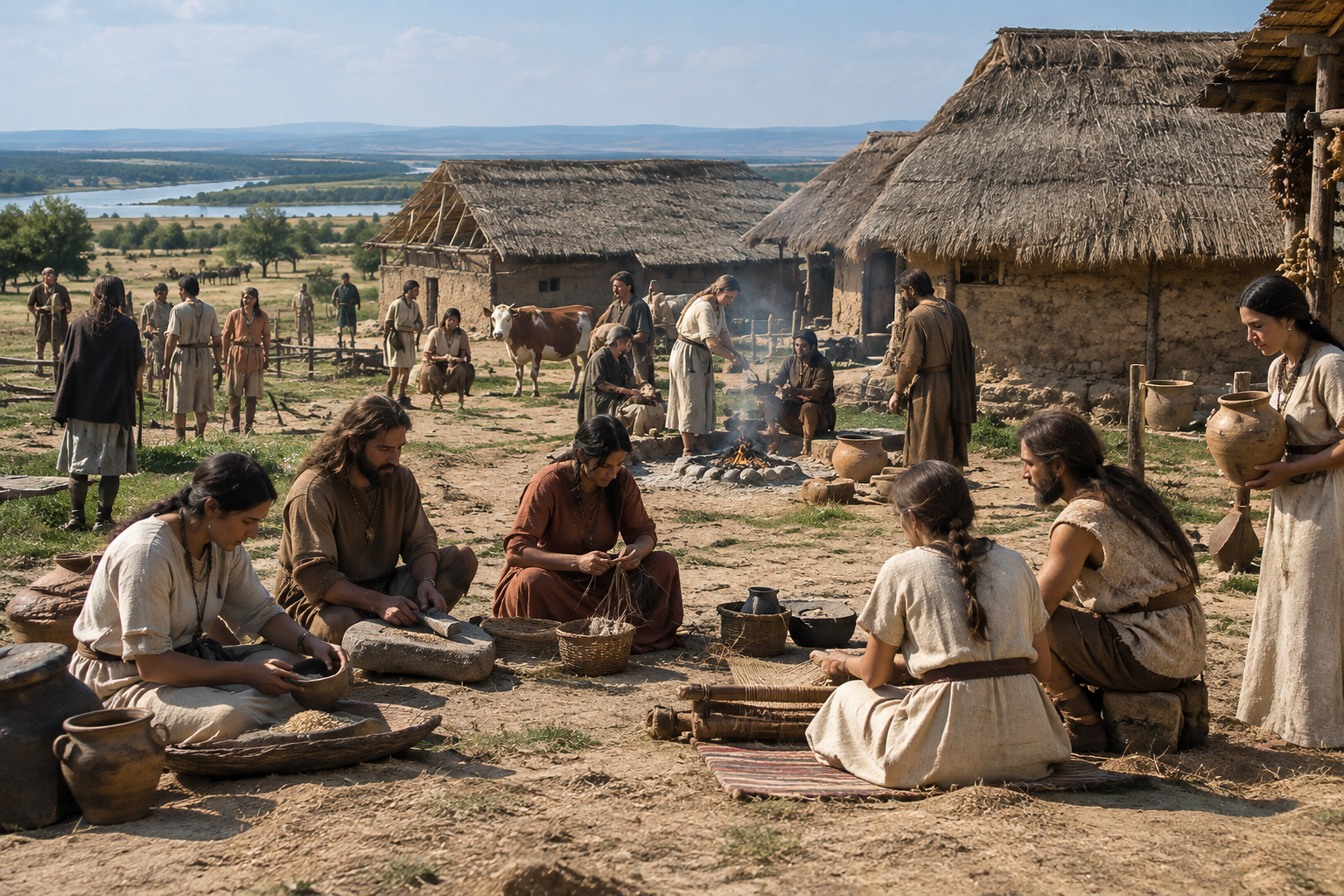
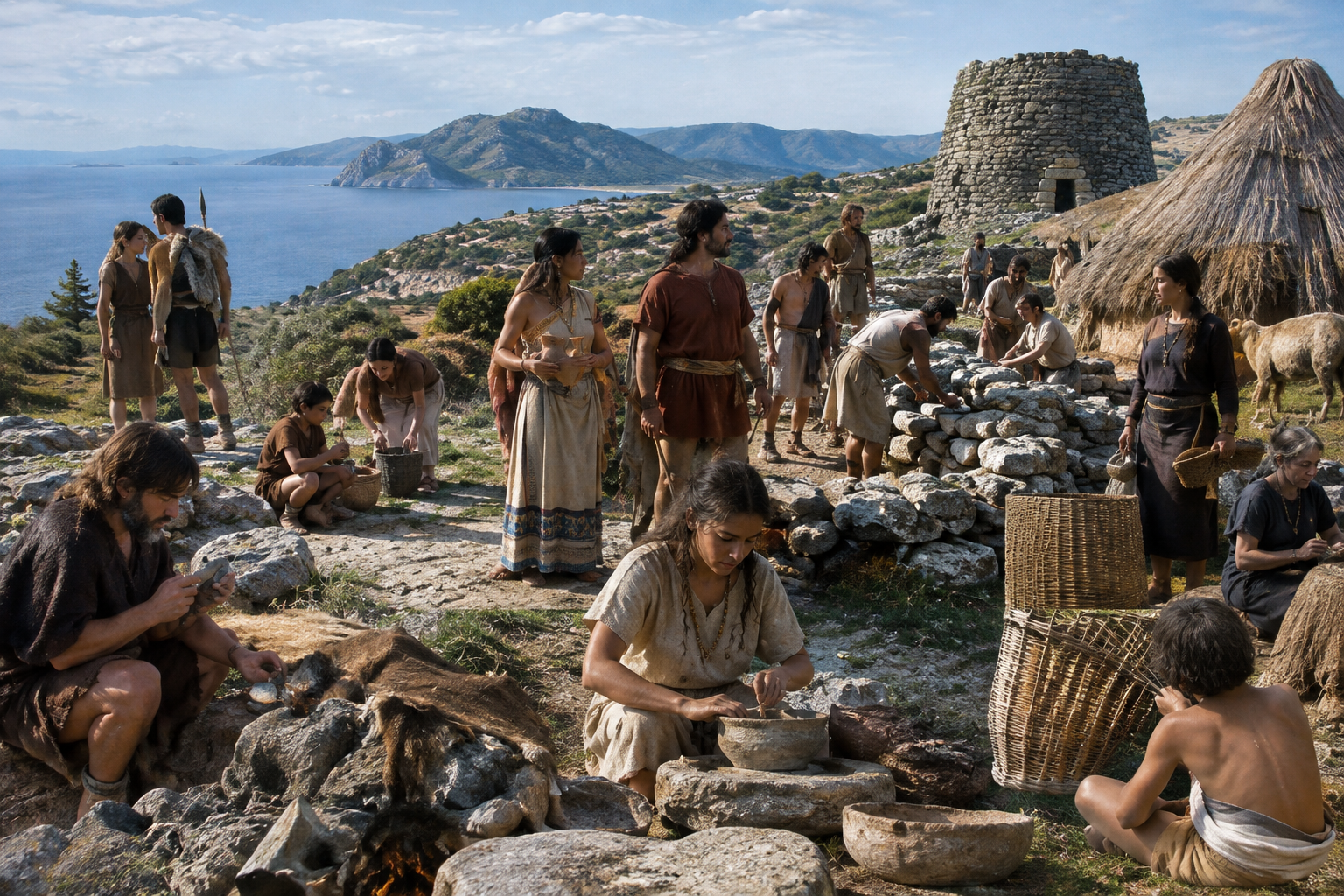
The earliest clues in this dataset come from Catalhoyuk in Anatolia, one of the great Neolithic settlements of the ancient world. There, cch505, dated to 6500 BC, and cch130, dated to 5200 BC, show that this paternal line was present in the farming societies of central Anatolia across a long span of time. That matters because Anatolia sits at the heart of one of the best-attested population processes in Eurasian prehistory: the spread of early farming communities into Europe.
That does not mean every carrier of C1a2b in Europe came directly from Catalhoyuk, nor that a single migration explains all later appearances. But the pattern is suggestive. This is the kind of evidence that makes archaeogenetics so useful: one can begin with a site of mudbrick houses, burials under floors, and dense village life, and then trace echoes of paternal lines far to the northwest.
Explore Neolithic Expansion in the Aegean
Once we move into southeastern Europe, C1a2b appears again in ways that are archaeologically revealing. At Giurgiu Pietrele Magura Gorgana in Romania, the Neolithic sample PIE063 is dated to 4100 BC, while the Early Bronze Age sample PIE076 is dated to 3000 BC. Two dates, one region, and two very different prehistoric worlds. The earlier burial belongs to the late Neolithic and Chalcolithic horizon of the lower Danube, while the later one belongs to the transformed societies of the Bronze Age. Even without claiming direct continuity from one man to the other, the recurrence of the lineage in the same broad region raises the possibility of long local persistence alongside all the demographic change of the period.
Something similar can be said of YUN013 from Yunatsite in Bulgaria, dated to 3120 BC. Yunatsite is one of those sites that reminds us how dynamic the Balkans were in later prehistory: tells, settlements, exchange, and repeated cultural change. A paternal lineage like C1a2b appearing there fits well with a southeastern European landscape that was neither static nor simple.
The story does not stop in the Balkans. DER017 from Derenburg-Meerenstieg II in Germany, dated to 6000 BC, places the lineage in Neolithic central Europe. Further west still, the French Neolithic samples OBN006 and SCH016, both dated to 3500 BC, show that this paternal branch was present in prehistoric France as well. That westward spread, from Anatolia through the Balkans and into central and western Europe, is precisely the kind of broad arc one would expect to investigate in relation to early farmers and their descendants.
And then there is the later outlier, perhaps the most arresting sample of all: UKR002 from Early Iron Age Ukraine Kartal Odesa Thracian Hallstatt, dated to 800 BC. Here the lineage appears in the northwestern Black Sea region in an Iron Age context associated in the supplied description with a Thracian Hallstatt setting. That does not license grand ethnic conclusions. Still, it shows that C1a2b was not merely an early Neolithic curiosity that vanished from the record. It could still be found in the complex cultural frontier between the Balkans, the steppe, and the Black Sea many millennia later.
If one steps back from the individual burials, a broad picture emerges. C1a2b in this dataset seems closely tied to the world of Neolithic and post-Neolithic Europe, especially the chain of populations linking Anatolia, the Balkans, the lower Danube, central Europe, and France. That does not prove a single uninterrupted paternal corridor, but it does show that this lineage moved through the same geographical theatre as the first farming expansions and remained present through later transformations.
This is important because later European history is often told backwards, as though Iron Age tribes, Roman provinces, and medieval kingdoms were the only things that mattered. Ancient DNA keeps spoiling that tidy view. Under those later historical labels lie much older demographic layers. A paternal lineage found in an Early Iron Age burial on the Black Sea coast may ultimately belong to a much deeper pattern of settlement and movement that began with prehistoric farmers, local continuities, and repeated regional mixing.
Readers interested in the wider prehistoric backdrop may also enjoy work on the Balkans themselves, where hunter-gatherer survival, incoming farmers, and later mixtures created some of the most complicated population histories in Europe.
In this case, the supplied field for associated noble families and castles is effectively empty. Oddly enough, that is a useful reminder in itself. Genetics and genealogy do not always line up neatly with heraldry, family legend, or medieval architecture. Many noble houses preserve exquisite records from the Middle Ages onward, but a lineage such as C1a2b is visible to us above all through much earlier archaeological horizons: Catalhoyuk, the lower Danube, Yunatsite, Neolithic Germany, Neolithic France, and Iron Age Ukraine.
So rather than inventing a castle connection where none has been supplied, it is better to be candid. Haplogroups do not need a baronial hall or a ruined keep to be historically important. In fact, one of the pleasures of ancient DNA is that it shifts attention away from dynasties alone and back toward the countless ordinary and semi-ordinary men whose paternal lines once formed part of settlements, cemeteries, and local communities.
That said, the geographical regions in which C1a2b appears did later become lands of forts, hilltop strongholds, princely centers, and medieval castles. Romania, Bulgaria, Ukraine, Germany, and France all built later political worlds atop much older prehistoric landscapes. Ancient DNA does not turn a Neolithic farmer into a medieval lord, but it does remind us that the ground beneath later castles had already been inhabited, cultivated, and buried in for thousands of years.
For those who enjoy the bridge between archaeology and the later historical world, another useful comparison is how ancient DNA can illuminate regional continuity and change in France across deep time.
C1a2b is a good example of why rare or less-discussed haplogroups deserve attention. Its value lies not in modern fame but in archaeological reach. The samples supplied here place it in Anatolia, Romania, Bulgaria, Germany, France, and Ukraine, across a span from 6500 BC to 800 BC. That is enough to show that this paternal branch participated in some of the biggest population processes of prehistoric Europe, especially those tied to farming dispersals and later regional survival.
It also illustrates a basic truth about Y-DNA: a paternal lineage can persist through profound cultural change. The men carrying it may live in mudbrick Neolithic towns, Danubian farming settlements, Balkan Bronze Age communities, central European village cemeteries, or Iron Age Black Sea societies. The haplogroup is the thread, but the societies around it change dramatically.
That is why ancient DNA and written history complement each other so well. Written records usually begin late and focus on elites. Ancient DNA reaches further back, often into periods with no texts at all. It cannot tell us everything, and it certainly cannot prove that someone belongs to a later noble family just because they share a broad haplogroup. But it can recover forgotten structure in the past: who was there, when, and sometimes how paternal lines endured across astonishing stretches of time.
If your own paternal line connects to a rare or unusual branch, that does not make your ancestry narrow. Quite the reverse. It may place one strand of your family story inside a very old human map stretching across villages, burial grounds, and prehistoric migrations. MyTrueAncestry lets you compare your DNA with ancient individuals and historical populations, offering fresh clues about where parts of your ancestry may fit within the archaeological record. Those matches are not proof of direct descent from any specific ancient person or noble house, but they can open a remarkable window onto the past.
Comments