Haplogroup R1b1a1b1a1a2c1c1

– 5 min read


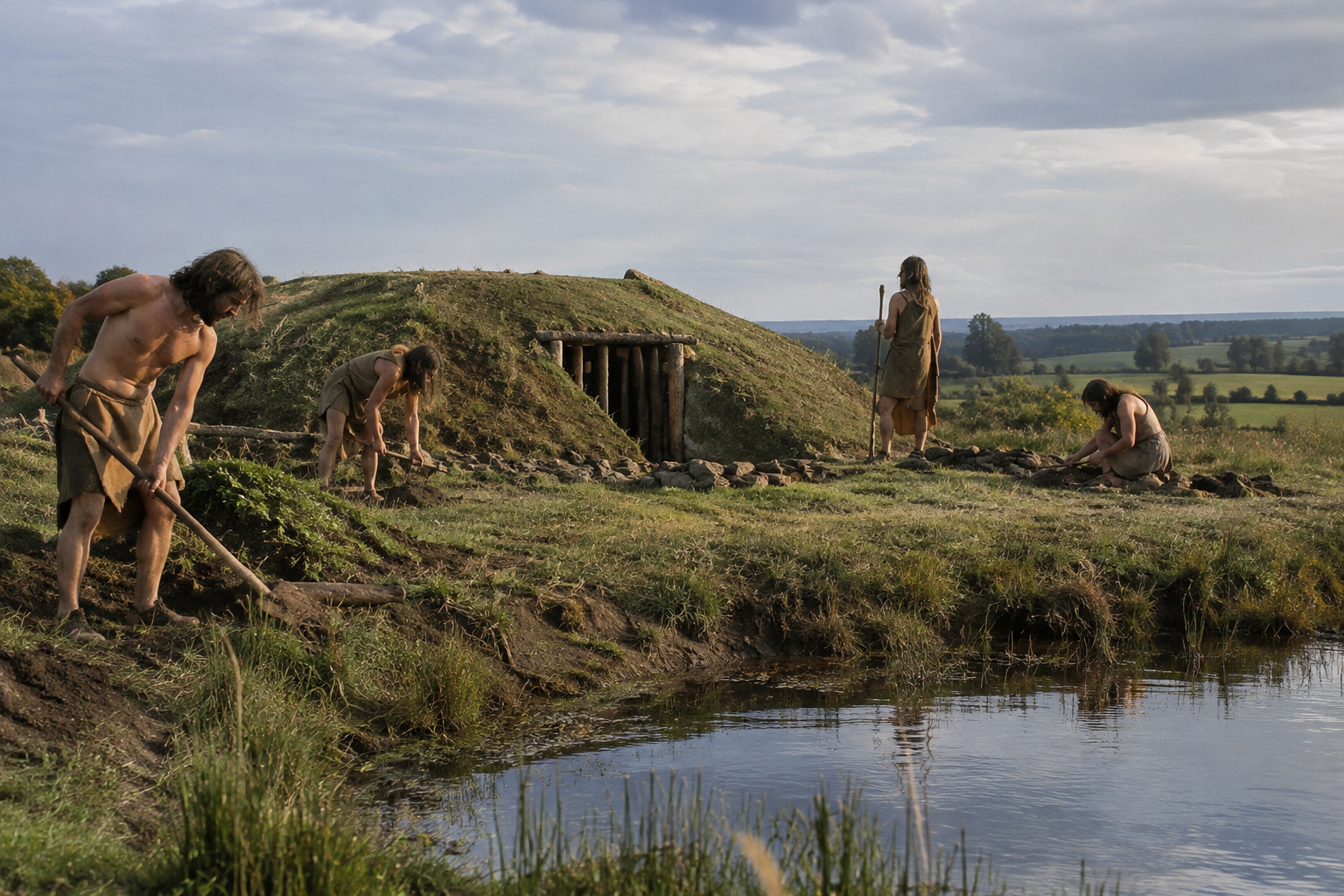
At Down Farm Pond Barrow in Cranborne Chase, Dorset, one Bronze Age man dated to around 1900 BC carries the article haplogroup R1b1a1b1a1a2c1c1. In the records he appears simply as dfb004, which is rather typical of ancient DNA: a modern code attached to a life lived nearly four thousand years ago. Yet even with limited personal detail, that single paternal line places him in one of the most important archaeological landscapes in prehistoric Britain.
Cranborne Chase is not some anonymous patch of countryside. It is one of the classic regions for understanding later prehistory in southern England, with barrows, field systems, settlements, and monuments that have kept archaeologists busy for generations. So when a male individual from a pond barrow there is linked to R1b1a1b1a1a2c1c1, the interest lies not in grand fantasy about kings or tribal founders, but in seeing how one very specific Y-chromosome branch appears inside the lived world of Early Bronze Age Wessex.
Y-DNA follows a direct paternal line: father to son to son, across many generations. That makes a haplogroup useful for tracing one thread of ancestry, but only one thread. It is not the same thing as a person's whole ancestry, language, status, or identity, and it certainly does not turn one excavated man into a spokesperson for all Bronze Age Britain.
Even so, the exact branch matters. R1b1a1b1a1a2c1c1 is a narrow subclade within the much larger R1b family, a paternal lineage that became very prominent in much of Bronze Age western Europe. The safe historical point is this: dfb004 shows that this particular paternal branch was present in southern England by about 1900 BC. That is already significant, because it anchors the lineage not in vague modern distributions, but in a real burial landscape.
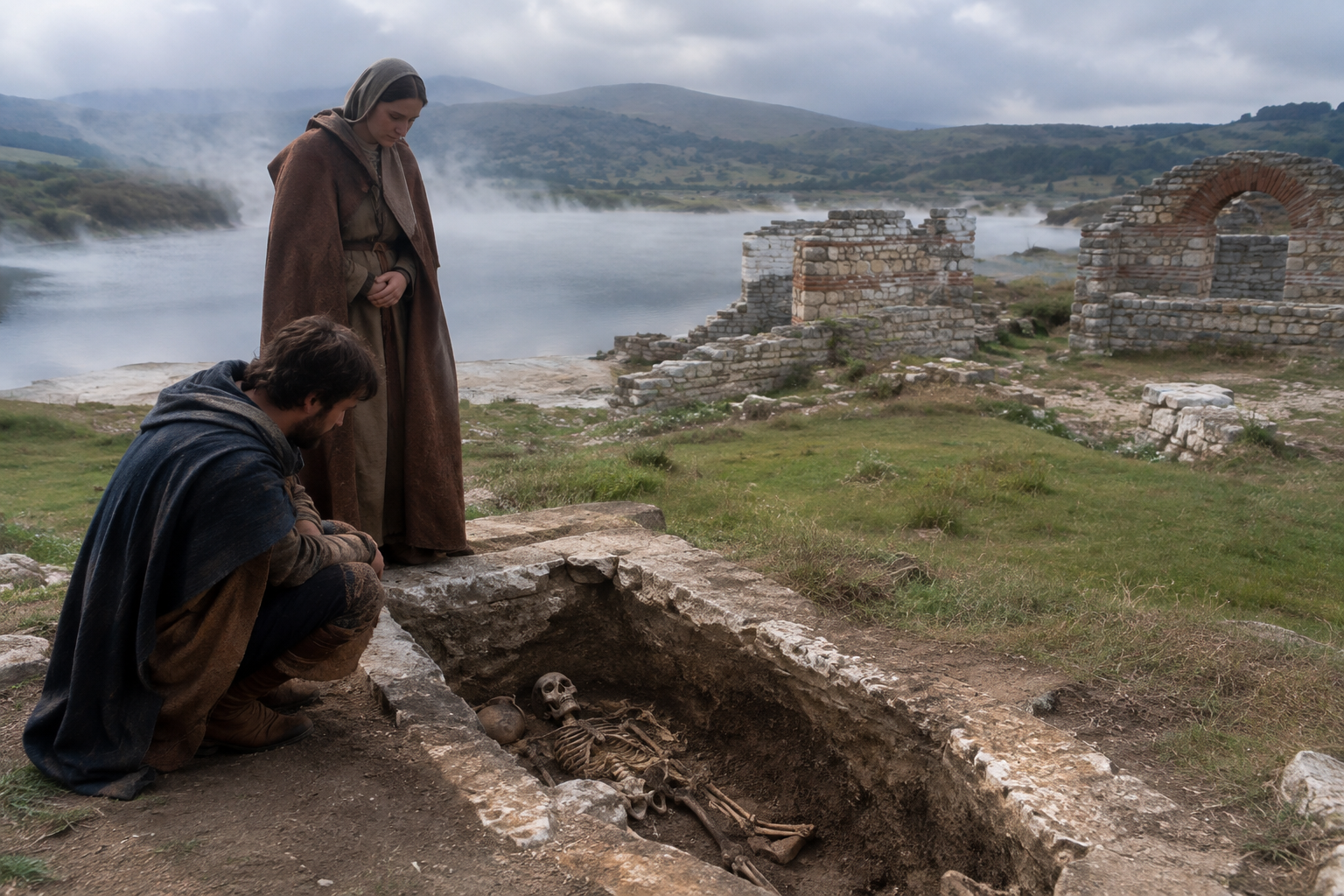
The phrase "pond barrow" deserves a pause. These circular earthworks, often appearing as shallow depressions surrounded by banks, are among the more curious monuments of British prehistory. Their function has long been debated, and they sit within a wider ceremonial world of round barrows, burial mounds, and commemorative landscapes. To find an ancient male line here is to place it in a setting shaped by memory, monument building, and repeated use of land.
That matters because Early Bronze Age Britain was not merely a period of isolated burials. It was an age in which communities marked territory, ancestry, and social presence through conspicuous earthworks. A paternal lineage identified in such a setting is therefore part of a broader archaeological story about how families and communities occupied the land, buried their dead, and made claims that endured in the landscape long after any individual name was forgotten.
An ancient DNA study associated with these British remains is linked through this research archive entry. Without inventing details beyond the supplied record, it is enough to say that the genetic evidence helps pin one paternal line to a well-known ceremonial zone in Bronze Age Dorset.
Bronze Age tomb reuse in SW Britain
One sample is not a population. But one sample from the right context can still be extremely informative. Southern Britain around 1900 BC sits after the major demographic changes associated with the Bell Beaker horizon and the wider transformation of European populations during the 3rd and early 2nd millennia BC. By this point, paternal lineages within the R1b family had become deeply embedded in many parts of Britain.
So dfb004 is best understood as evidence of continuity within that reshaped Bronze Age world. He does not prove a migration event by himself, nor does he identify a tribe, a language, or a dynasty. What he does show is that this narrower paternal branch had already taken its place within the communities living among the barrows and ritual landscapes of Wessex-era Britain.
This is where ancient DNA is at its most useful. It lets us move away from the old habit of speaking about "Bronze Age people" as though they were a single block. Instead, we can see actual paternal lines appearing in specific places, at specific times, inside recognisable archaeological settings.
Archaeologists have long been drawn to Cranborne Chase because it preserves the traces of repeated human activity so unusually well. Neolithic monuments, Bronze Age burials, later field systems, and settlements all crowd into the same broad region. That layering matters. When a man such as dfb004 was buried in this landscape, he entered a countryside already thick with the remains of earlier generations.
There is something very British, and very prehistoric, about that persistence. Later communities did not simply occupy empty ground. They lived among visible monuments and older burial places, sometimes reusing them, sometimes avoiding them, sometimes building new statements nearby. A Y-lineage recovered from such a place is not merely a biological fact; it is tied to a cultural habit of remembering through land and earthwork.
Because R1b lineages are so common in later western Europe, there is always a temptation to leap straight from a Bronze Age burial to sweeping claims about Celts, proto-Celts, or the spread of later populations. That is exactly where caution is needed. The sample dfb004 is securely useful as evidence for a paternal branch in Early Bronze Age England; it is not a licence to flatten centuries of cultural change into one genetic slogan.
Still, the wider historical backdrop is real. Bronze Age Britain was connected, directly and indirectly, to continental networks of mobility, metalworking, exchange, and ancestry change. Research on ancient genomics has increasingly shown how language spread, migration, and local continuity can overlap in complex ways rather than following a single tidy route. For readers interested in that wider debate, one helpful comparison is MyTrueAncestry's discussion of how ancient genomes are used in arguments about language dispersal.
Celtic language origins and DNA
That broader context helps place R1b1a1b1a1a2c1c1 where it belongs: not as a magical ethnic label, but as one branch among many that participated in the remaking of prehistoric Britain. In other words, the haplogroup is historically interesting precisely because it is specific. It gives us a finer-grained view of paternal ancestry inside a landscape already famous for its archaeology.
If your own Y-DNA falls on or near R1b1a1b1a1a2c1c1, the most defensible takeaway from the present evidence is modest but meaningful. This branch is attested in southern England by around 1900 BC, in the monumental world of Cranborne Chase and the Down Farm Pond Barrow burial landscape. That does not make every modern carrier "from Dorset," but it does place the lineage within the archaeological reality of Bronze Age Britain rather than in mere family legend.
For family historians, that is often the real thrill: not fantasy pedigrees, but a documented paternal line turning up in a recognisable ancient place. Here, the place is one of Britain's great prehistoric landscapes, and the man is dfb004, whose Y-chromosome quietly preserves one small but solid link between modern testers and the barrow-building world of Bronze Age Dorset.
Comments