Haplogroup R1b1a1b1a1a2c1a5a2a2

– 5 min read


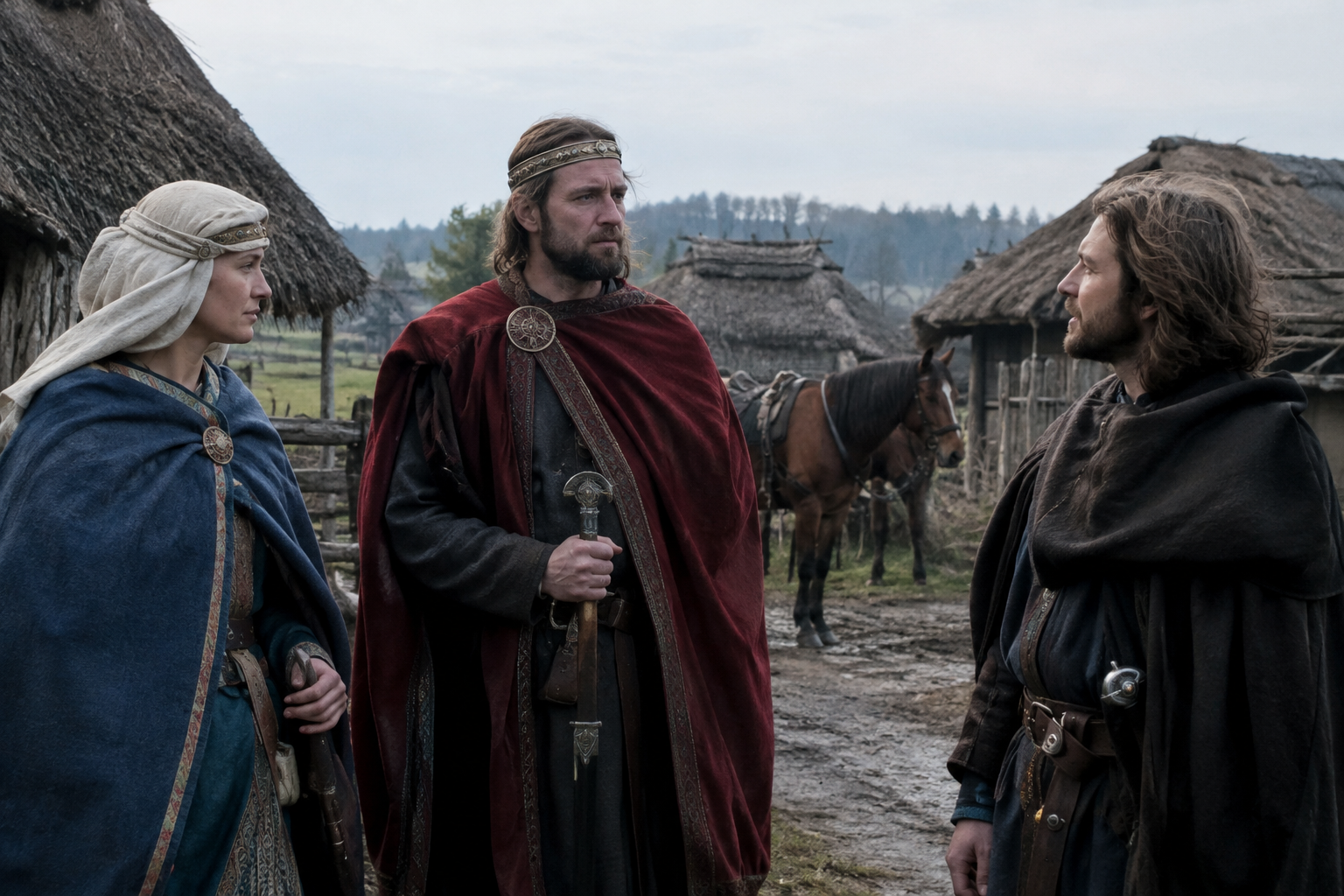
At Moemlingen in southern Germany, one excavated man from the Merovingian period offers a very precise glimpse of an otherwise very narrow paternal line. The individual known as Mln9, dated to around AD 650, has been associated here with the Y-DNA branch R1b1a1b1a1a2c1a5a2a2. That long label is not a grand ethnic badge. It is a fine-grained marker on one direct male line, preserved in the remains of a man who lived in the Frankish world of the early Middle Ages.
What makes Mln9 interesting is not that one burial can explain "the Franks" as a whole. It plainly cannot. The value lies in scale. Early medieval cemeteries often show us large political names in miniature: households, villages, local elites, converts, migrants, and long-settled families all folded into the same burial ground. A lineage like R1b1a1b1a1a2c1a5a2a2 becomes historically useful when it is anchored to a real person, in a real place, at a real moment when post-Roman Europe was being remade.
Moemlingen sits in a region that, by the seventh century, belonged to the broad orbit of the Merovingian kingdoms. This was not the age of tidy national borders. It was a landscape of former Roman territories, local communities, church foundations, rural cemeteries, and power negotiated through kinship, landholding, and allegiance. A Frankish-period burial from this setting is valuable precisely because it belongs to that in-between world: after Rome, before the high medieval order.
Mln9 is described as a Merovingian Period Frankish individual from Germany, around AD 650. That tells us enough to place him historically, even if it does not license romantic inventions about weapons, dress, or rank. His Y chromosome links him to one paternal line within the much wider haplogroup R1b, a major branch common in western Europe today and well represented in many different historical populations. The article's branch, however, is vastly narrower than R1b as a whole, and it should not be treated as if it carries the entire prehistoric and medieval history of that parent lineage on its own.
The wider context for such finds has been strengthened by recent ancient-DNA work on early medieval Europe, including research on frontier and post-Roman populations such as this study in Nature. Even where one paper does not exist to explain one cemetery in total, that larger body of work has made one point increasingly clear: communities labeled "Frankish," "Gothic," or "Roman" were often more biologically mixed and historically local than older tidy narratives allowed.
The cumbersome name R1b1a1b1a1a2c1a5a2a2 is a reminder of how archaeogenetics actually works. We are not dealing here with a simple, legendary clan-marker handed down unchanged from some single named tribe in the written sources. We are dealing with a deeply nested branch inside a larger paternal tree. In practice, that means Mln9 helps document one line of descent present in the Frankish-era population of southern Germany, not a universal Frankish signature.
This distinction matters. Y-DNA follows the direct paternal line only: father to son to son across generations. It can be wonderfully sharp for tracing one strand of ancestry, while saying nothing by itself about most of a person's forebears, language, social identity, or legal status. A man buried in a Frankish-period cemetery may carry a paternal line that had been in the region for many centuries, or one that arrived more recently through migration, marriage networks, military movement, or inheritance of land and status. The Y chromosome alone does not choose between those stories.
Still, precision has its own fascination. Broad labels like "R1b" can span enormous stretches of Europe and multiple periods. A terminal branch such as this one begins to matter for family history when it appears in dated archaeological individuals. It gives genealogists and ancient-DNA enthusiasts a fixed point: whatever else we may debate about identity, one line of descent represented by this haplogroup was present in Merovingian-period Germany.
The seventh century is one of those periods that can look murky in the written record and yet become unexpectedly vivid through graves, settlement archaeology, and biomolecular evidence. The Merovingian realms inherited Roman infrastructure in fragments, but they did not simply continue Rome. Nor were they socially uniform "Germanic" blocks. Instead, local populations carried forward older regional ancestries while political identities shifted above them.
That is exactly why a sample like Mln9 deserves attention. Southern Germany in this period sat within overlapping zones of influence: Frankish power, Alemannic and Bavarian regional identities, ecclesiastical expansion, and the long afterlife of Roman provincial society. To find a specific paternal branch there is not to solve the whole puzzle, but to pin one thread onto the map with unusual firmness.
Ancient genomics has repeatedly complicated older migration stories by showing both movement and continuity. Some early medieval cemeteries contain people with surprisingly varied ancestry backgrounds; others show substantial local persistence beneath changing political labels. That broader lesson fits well with a cautious reading of Mln9: this individual belongs to a historically Frankish-period context, but the paternal line itself should be understood as part of a living regional population, not as a tribal emblem marching across a textbook map.
One of the most useful ways to think about the Moemlingen evidence is through transition rather than rupture. By AD 650, the western Roman Empire had long disappeared, but Roman landscapes had not. Roads, estates, burial grounds, agricultural systems, and Christian institutions remained part of the background against which Frankish rule operated. People did not wake up one morning and become genetically new because a kingdom changed hands.
That perspective helps keep the haplogroup evidence in proportion. R1b1a1b1a1a2c1a5a2a2 in Mln9 does not prove a sudden migration at the moment of Merovingian expansion, nor does it prove immemorial local rootedness. What it does show is that this direct paternal line formed part of the male population living within an early medieval Frankish community in the German lands.
For readers interested in how post-Roman populations were assembled more generally, Iberia and Britain offer good comparisons. Again and again, ancient DNA suggests that political change could coexist with substantial continuity, while still allowing newcomers to enter the population in noticeable ways. The early medieval West was less a chessboard of sealed peoples than a patchwork of communities with different mixtures of ancestry and allegiance.
There is something pleasingly concrete about a single identifier like Mln9. It rescues discussion from vague slogans. Instead of saying only that a branch is "European" or "medieval," we can say that one man carrying or associated with this branch was buried at Moemlingen around AD 650 in a Frankish-period context. That is modest, but it is real evidence.
For someone researching the haplogroup R1b1a1b1a1a2c1a5a2a2 today, the main historical takeaway is therefore specific rather than sweeping. This paternal line had a foothold in early medieval southern Germany, inside the Merovingian world that emerged from the Roman frontier zone and helped shape Latin Christian Europe. That does not make every present-day bearer "Frankish" in any full cultural sense, but it does place one attested branch of the lineage inside a documented historical landscape.
The most distinctive thing about this haplogroup article is its scale. We are not looking at a famous dynasty or a parade of spectacular graves. We are looking at one carefully placed anchor point: Mln9, a Merovingian-period man from Moemlingen, living in the seventh-century Frankish sphere. For anyone exploring this paternal line, that is enough to say something meaningful and responsible: one branch of your deep male-line history was present in the communities that inhabited post-Roman Germany as the early medieval order took shape.
Comments