Haplogroup R1b1a1b1a1a2c1a1a1a1a1e
– 5 min read


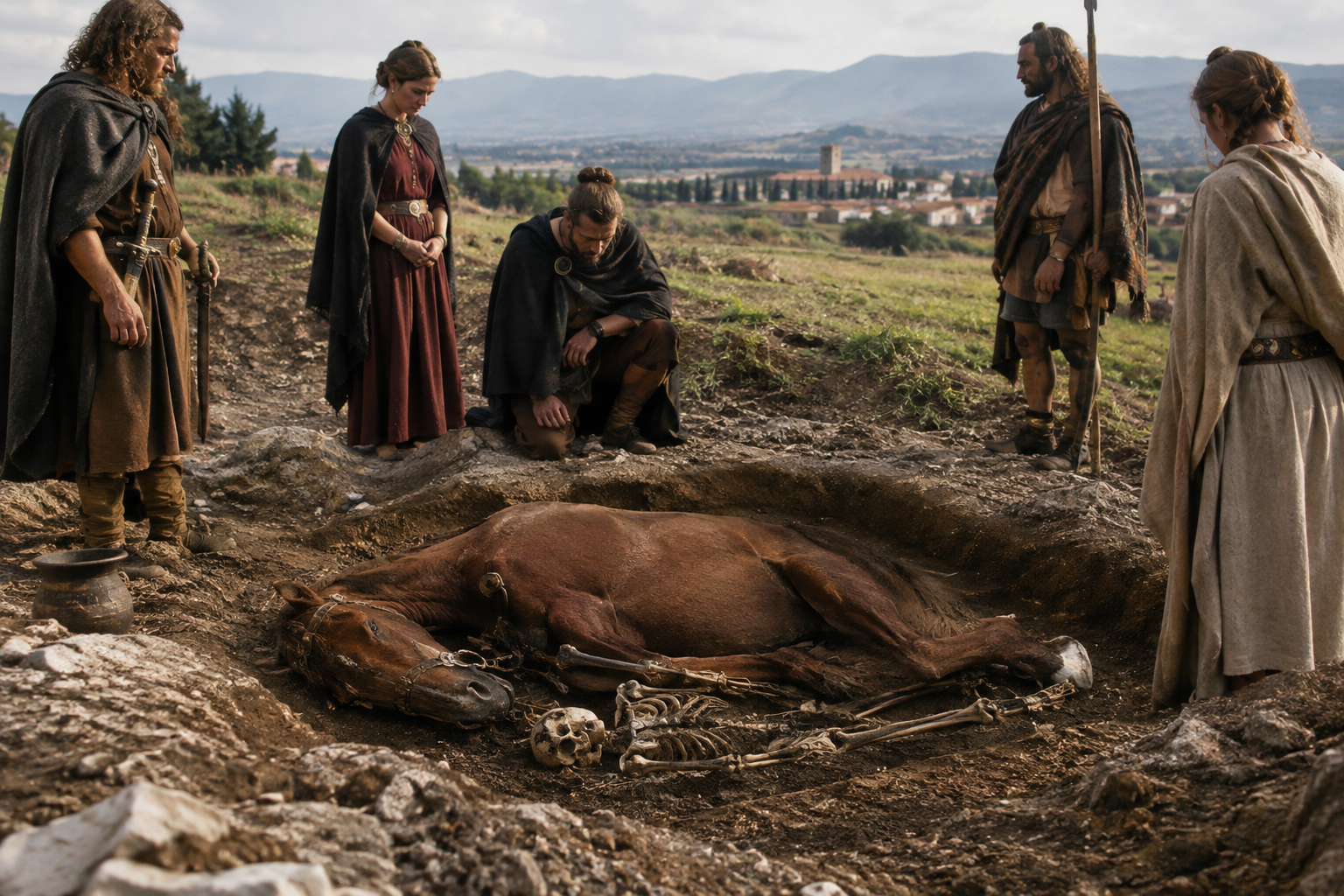
At Verona, in northern Italy, one Iron Age burial stands out for its unusual companionship: a human interred with a horse. The individual is associated with the Gallic Cenomani and dated to around 300 BC at Seminario Vescovile, with the identifier 3232s. For anyone tracing the Y-DNA haplogroup R1b1a1b1a1a2c1a1a1a1a1e, this is the sort of discovery that matters, because it places a paternal line connected with this branch in a very specific archaeological world: Celtic-speaking northern Italy in the centuries before Rome absorbed the region.
The burial is interesting not because it gives us a grand heroic story - archaeology is usually less obliging than that - but because it ties a lineage to a real place, real funerary practice, and a real historical frontier. In this case, the frontier was Cisalpine Gaul, where communities described in ancient sources as Gauls lived alongside, traded with, and eventually confronted Roman power. Y-DNA tracks one direct paternal line only, not a person's whole ancestry, but even that narrow line can anchor family history in a striking setting.
The Cenomani are known from classical sources as a Gallic people settled in the Po Valley, especially in the area of modern Lombardy and Veneto. Verona sat in a zone where local traditions, transalpine influences, and expanding Mediterranean networks all met. A burial from this setting, especially one involving a horse, immediately tells us we are dealing with status, symbolism, or both, even if the exact social meaning remains debated from case to case.
Sample 3232s, described as a Gallic Cenomani tribe horse co-burial from Verona's Seminario Vescovile, belongs to that world. The archaeological significance lies in context as much as genetics: this was not an anonymous point on a modern frequency map, but a person buried in a community that participated in the Late Iron Age cultures of northern Italy. That makes the haplogroup's appearance here a useful clue for understanding how some paternal lines linked with western European R1b branches were present among Celtic groups south of the Alps.
A study of ancient material from this setting was published in research on Iron Age burials in Verona, helping place these individuals within the wider archaeological landscape of the region. Even without forcing every detail into a single ethnic story, the combination of burial context, date, and paternal lineage is already quite informative.
The haplogroup name here is extremely specific: R1b1a1b1a1a2c1a1a1a1a1e. That matters. It sits deep within the broader R1b family, a major Y-chromosome lineage with many branches spread across western Eurasia, but a very narrow subclade should never be treated as if it carries the whole history of R1b on its shoulders.
In practice, that means caution. The Verona sample can support the statement that a paternal line associated with this branch was present in Iron Age northern Italy, in a burial attributed to the Cenomani context around 300 BC. It does not, by itself, prove where the branch first emerged, how common it was among all Cenomani, or that everyone with this haplogroup today descends from a specifically Italian Iron Age ancestor. Ancient DNA is powerful precisely because it gives us fixed points, not unlimited certainty.
Still, fixed points are valuable. A branch this specific can be far more useful for family-history interpretation than a broad label alone, because it narrows the paternal story to a smaller portion of the Y-tree. When such a branch appears in a documented Iron Age burial, the result is a rare and rather satisfying meeting of genealogy and archaeology.
Horse burials and horse-associated burials in Iron Age Europe are never just background decoration. They tend to signal that horses had social, ritual, or symbolic importance within the community. That does not automatically make every buried individual a warrior aristocrat - one should resist that temptation - but it does place the deceased within a recognisably distinctive funerary tradition.
In northern Italy, this matters because the region was not culturally uniform. Etruscan, Venetic, Lepontic, and Gallic traditions overlapped in complicated ways, and local burial practice is one of the best guides to those differences. A Gallic burial with a horse in Verona therefore helps root this paternal line in a specifically Late Iron Age social setting, rather than in an abstract map of population movements.
It also reminds us that "Celtic" was not one simple biological category. Archaeology, language, and genetics each describe different aspects of the past. A man buried in a Gallic cultural context may carry a Y-line shared with other regions, just as neighbouring communities with different customs may share ancestry. The value of sample 3232s is that it lets us see one paternal line operating inside a clearly identifiable historical milieu.
Around 300 BC, Verona belonged to a northern Italian world that Rome had not yet fully mastered. This was the age when transalpine connections still mattered greatly, and when communities in the Po basin maintained identities that Roman authors would later flatten into broad tribal names. The Cenomani are one of those peoples, known in part through texts and in part through their archaeology.
That is where this haplogroup becomes historically suggestive. A lineage linked to R1b1a1b1a1a2c1a1a1a1a1e appears not in an imperial Roman cemetery or a medieval genealogy, but in a pre-Roman community at a time when northern Italy was a contact zone. If your paternal line falls on or near this branch, the ancient connection is less about one grand migration tale than about belonging to the male-line diversity present in Iron Age western and central Europe.
This also fits a broader pattern seen in ancient DNA studies of Celtic-associated regions: paternal continuity and movement often turn out to be more local, layered, and regionally varied than older all-purpose invasion models allowed. Some lineages spread widely; others appear in clustered local contexts; many did both at different times.
Etruscan change in northern Italy
One reason this Verona sample is so useful is that Italy's genetic history is now being reconstructed at much finer scale than before. Rather than speaking vaguely of "Italians" in antiquity, researchers can increasingly distinguish between regions, periods, and communities: Etruscan cities, Iron Age uplands, Roman ports, Alpine valleys, and post-Roman cemeteries all tell slightly different stories.
That growing precision is especially important for paternal lineages. A rare or deeply nested branch such as R1b1a1b1a1a2c1a1a1a1a1e gains meaning only when we can attach it to an archaeological setting. Verona provides exactly that: not merely Italy, but Iron Age Verona; not merely an ancient male line, but one associated with a Gallic burial context and horse co-burial practice.
Readers interested in how ancient genomes are sharpening regional history in the peninsula may also want to look at related work on other Italian populations.
Ancient Italy from Rome to medieval times
The most distinctive thing about R1b1a1b1a1a2c1a1a1a1a1e in the present evidence is not royal glamour or a sweeping empire-wide saga. It is the far more solid fact that a paternal line associated with this branch appears in an Iron Age burial from Verona tied to the Gallic Cenomani, and in a funerary setting memorable enough to include a horse. For someone exploring their paternal ancestry, that offers a tangible historical foothold: a direct male line connected, at least at one ancient point we can see, to the Celtic world of pre-Roman northern Italy.






Comments