Haplogroup R1b1a1b1a1a2b1c2bu

– 4 min read


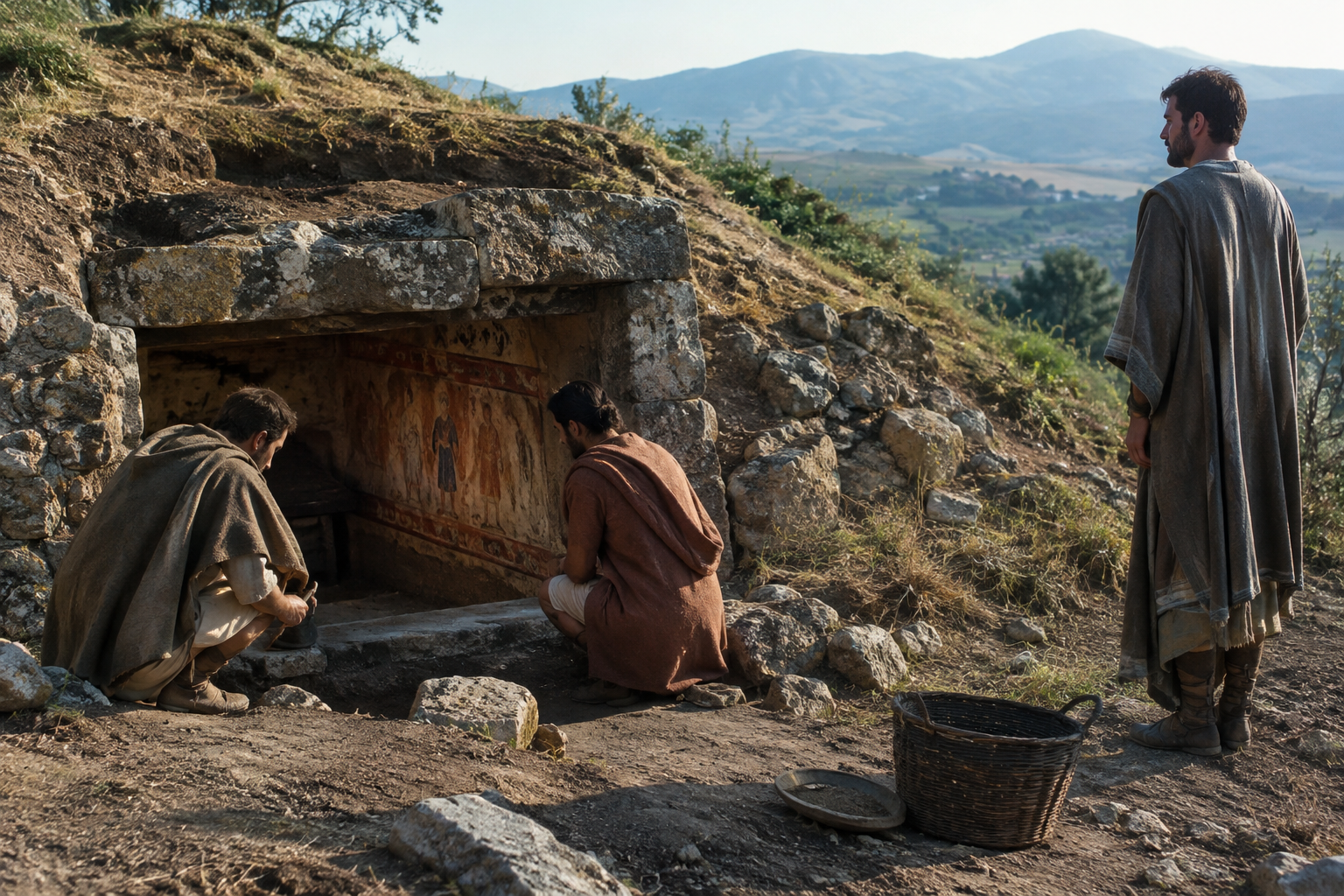
At Castel Sozzio in northern Italy, Tomb 27 from around AD 600 offers one of those sharply focused moments that make ancient DNA so useful. The individual identified as P9884k belongs, in this dataset, to the Y-DNA haplogroup R1b1a1b1a1a2b1c2bu, a very narrow paternal branch recovered from a burial placed in the unsettled centuries after the Western Roman Empire had fallen apart.
That matters because post-Roman Italy was not a blank space after Rome, nor a simple story of "Romans replaced by newcomers." It was a world of surviving towns, changing power, mobile soldiers, local families, church institutions, and communities adapting to new rulers. A Y-chromosome result traces only one direct paternal line, not a whole identity, but even a single well-placed burial like P9884k can anchor a much larger historical question: who was living in these Italian landscapes as Roman rule gave way to early medieval society?
The sample comes from the Castel Sozzio Necropolis, specifically Tomb 27, dated here to about AD 600. That date places the burial in a period when Italy had already experienced the Gothic wars, the imperial ambitions of Constantinople, and the growing consolidation of Lombard power in parts of the peninsula. In other words, this is not "classical Rome" at all, but a later and more fragmented Italy in which communities still carried Roman habits while living through major political change.
Castel Sozzio is useful precisely because it belongs to that transition zone. Cemeteries of this period can show continuity as much as disruption. The dead are not political slogans; they are evidence of who remained, who arrived, and how mixed local populations may already have been. P9884k, associated here with R1b1a1b1a1a2b1c2bu, adds one small but concrete paternal datapoint to that wider reconstruction.
The first thing to say about R1b1a1b1a1a2b1c2bu is that it is a very specific terminal-style label inside the much broader R1b family, one of the major Y-chromosome groupings found across much of western Eurasia. But the big parent branch and the tiny downstream twig are not the same thing historically. You cannot simply take a general statement about R1b in prehistoric or medieval Europe and assume it applies neatly to this exact subclade.
That is particularly important in Italy, where paternal lineages had already been shaped by millennia of movement before AD 600: Bronze Age expansions, Iron Age regional diversity, Roman-era mobility, and the migrations of Late Antiquity all formed part of the background. So the significance of P9884k is not that it "explains" Italy, but that it shows this fine-grained paternal branch present in a real post-Roman burial context.
A technical point also deserves mention. Ancient Y-DNA results depend heavily on how well skeletal material preserves DNA, especially in dense parts of the petrous bone. One research lead associated with this sample set, this study on optimizing ancient DNA yields from petrous bone powders, is a reminder that even seemingly narrow historical conclusions rest on painstaking laboratory work before any lineage label can be assigned at all.
A burial around AD 600 sits at an awkward and fascinating moment. Roman administrative structures had weakened or vanished in many areas, yet the old social and cultural fabric did not disappear overnight. Latin-speaking populations persisted, churches gained weight, regional elites adapted, and new military and political groupings took root.
For genetics, this period often resists easy labels. A man buried in northern Italy around AD 600 might descend mainly from local families with deep roots in the peninsula, or he might have more recent paternal ties to groups moving through post-imperial Europe, or both. A single Y-line alone cannot decide between those possibilities. What it does provide is a traceable male-line signature fixed to a date and place.
That is why a cemetery like Castel Sozzio matters more than an abstract map of haplogroup frequencies. Archaeology gives the lineage context. Without the burial ground, the chronology, and the regional history, the code R1b1a1b1a1a2b1c2bu would be little more than a string of letters and numbers.
One of the most useful comparisons for understanding P9884k is not another single haplogroup article, but the broader genetic picture emerging from Italian sites that span the Roman and early medieval periods. Studies of ancient Italian populations increasingly show that continuity and incoming ancestry coexisted. Some communities retained strong local signatures; others reveal clear evidence of long-distance mobility or admixture tied to imperial and post-imperial networks.
That larger pattern helps keep Castel Sozzio in proportion. We should not force this burial into a story of pure continuity, nor into a dramatic tale of foreign replacement. Northern Italy in the sixth and seventh centuries was exactly the sort of place where populations could be both rooted and mixed at once.
This is where the archaeology and the genetics become most interesting together. A post-Roman cemetery is not merely a register of biological descent. It also records how communities buried their dead, where they chose to maintain cemeteries, and how life went on after empire. The paternal line of P9884k belongs inside that lived history.
Italy after Rome was still tied to the wider Mediterranean, even as political authority fractured. Armies, clerics, merchants, and families moved through the peninsula; some movements were dramatic, others ordinary and local. Ancient DNA has begun to show that these centuries cannot be reduced to a single ethnic label attached to a cemetery.
That is why narrow paternal branches such as R1b1a1b1a1a2b1c2bu are worth noticing. They help build a finer map of male-line diversity within a period often discussed too broadly. Each securely dated burial adds one more point to the question of how post-Roman societies were actually composed on the ground.
Readers interested in similar complexity beyond Italy may find a useful parallel in work on seventh-century Iberia, where burial communities also turn out to be more diverse than older historical stereotypes allowed.
The distinctive value of this haplogroup article lies in its precision. R1b1a1b1a1a2b1c2bu is not presented here as the signature of a whole people, a kingdom, or a famous dynasty. Instead, it is anchored to a documented man from Tomb 27 at Castel Sozzio, around AD 600, in a region where Roman legacies and early medieval change were colliding every day. For anyone researching this paternal line today, that makes the branch historically tangible: it was present in post-Roman northern Italy, in a real cemetery, among the ordinary dead who lived through one of Europe's great transitions.
Comments