Haplogroup R1b1a1b1a1a1c2b2b1a1a1b2

– 4 min read


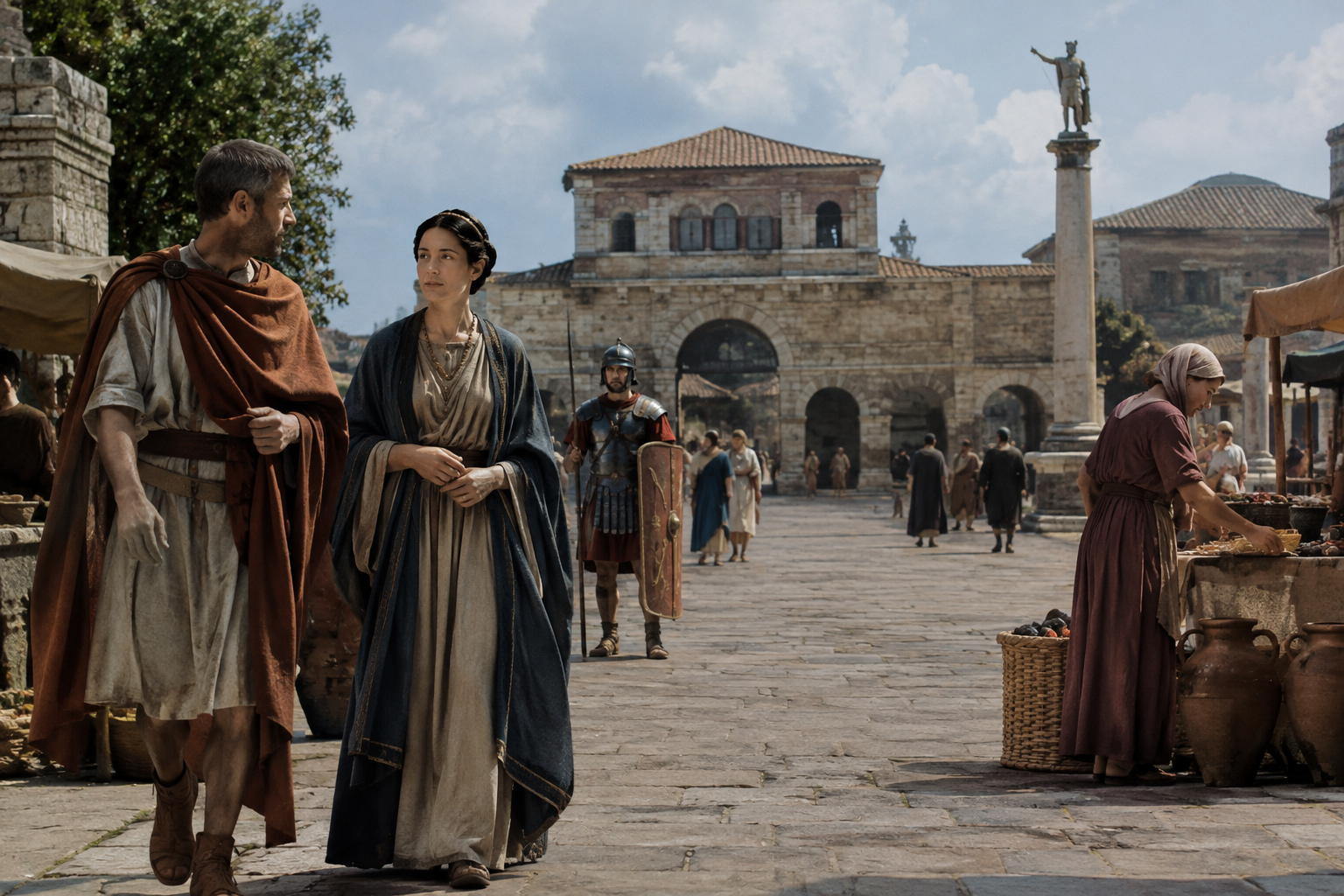
In about AD 425, someone was buried at Arrabona, in modern Gyor, at Szechenyi Square in northwestern Hungary. The ancient individual recorded as GYS018 comes from a moment when the old Roman order in Pannonia was fraying and new political worlds were forming along the Danube frontier. That is what makes this sample so useful: not because one grave can explain an era, but because a Y-chromosome lineage such as R1b1a1b1a1a1c2b2b1a1a1b2 turns up here in exactly the kind of borderland where identities, armies, and families were constantly being remade.
This is a very narrow paternal branch, far more specific than the broad and famous umbrella of R1b. Y-DNA follows one direct male line only, so it does not tell us everything about a person's ancestry, language, or status. But in a place like late Roman Pannonia, even a single secure paternal signal matters, because it lets us place one man inside a landscape of forts, civilian settlements, migrants, and successor communities at the edge of empire.
Arrabona was no remote outpost. It sat in the Little Hungarian Plain, part of the chain of Roman sites that watched roads, rivers, and movement through the northwest of the Carpathian Basin. By the early 5th century AD, this was a region under strain: imperial administration weakened, military structures shifted, and populations with different backgrounds were living side by side or arriving in new combinations.
That wider picture helps explain why GYS018 is interesting. A late Roman burial in Pannonia is never just "Roman" in some simple textbook sense. By this date, communities in the region could include descendants of earlier provincial populations, people tied to frontier garrisons, and newcomers associated with the migration-period upheavals that touched the middle Danube. The value of this haplogroup find lies in its setting: it belongs to a man from a frontier world where continuity and disruption were happening together.
A major ancient DNA study on this period and region has helped sharpen that picture of post-Roman life in the Little Hungarian Plain, showing how varied these communities could be and how misleading tidy ethnic labels can be in the archaeological record. That broader research context is the right one for understanding a sample like GYS018, rather than trying to force him into a single neat historical box: https://www.science.org/doi/10.1126/science.aec2634.
The sheer length of the label R1b1a1b1a1a1c2b2b1a1a1b2 is a reminder that we are dealing with a fine twig on a very large tree. Broad R1b lineages have deep roots in later European prehistory and became widespread in many regions long before the late Roman period. But it would be a mistake to drag all of that grand prehistory directly onto this one late antique burial. The narrower branch in this article is not automatically the same thing as the history of R1b as a whole.
What we can say more safely is that this paternal line appears in a man buried in a frontier province at a historically charged moment. That matters for family historians because narrow branches often become visible in ancient DNA not through famous kings or grand myths, but through ordinary or semi-ordinary people living in strategic places. In other words, the story here is not prestige. It is placement.
Northwestern Hungary in late antiquity was one of Europe's great contact zones. Roman roads linked it westward toward Noricum and Italy, northward toward the upper Danube world, and eastward into the wider Carpathian Basin. Empires like to draw hard lines on maps, but archaeologists usually find something more untidy: forts that become mixed settlements, cemeteries that show changing customs, and populations that do not stay put.
For that reason, a Y-lineage from Arrabona is best read as evidence from a corridor of movement. The man's paternal ancestry may have been local to the region for generations, or it may reflect more recent mobility within the imperial and post-imperial world. Without a larger cluster of closely related males from the same cemetery and stronger contextual publication for this individual burial, we should resist overclaiming. Still, the location alone is eloquent. Arrabona sits exactly where one would expect lineages to survive, mingle, and reappear under changing political masters.
One of the most useful lessons from recent archaeogenetics is that labels such as Roman, Goth, Hun, or barbarian often describe political or cultural settings better than they describe biological uniformity. A burial from AD 425 in Pannonia belongs to a world in which military service, alliance, resettlement, and household mobility all complicated older provincial identities. That is why a paternal branch found in one individual should be treated as a clue to social history, not a badge of ethnicity.
In practice, that means GYS018 should be imagined not as a representative of a pure tribe, but as part of a population living through administrative breakdown and regional recombination. This is very much in line with other late antique genetic studies from central and southeastern Europe, where burial communities turn out to contain people of mixed backgrounds rather than neatly separated biological blocs.
It is easy to dismiss a lone ancient Y-DNA result as too small to matter. But archaeology often works like that: one inscribed tile, one grave, one repaired wall, one skeleton from the right place at the right date. GYS018 anchors this haplogroup in the late Roman middle Danube with a concrete time and place. That is already more informative than many purely modern distributions, which can show where a lineage is found now but not where it was living during a moment of historical transformation.
For members of the MyTrueAncestry community, this kind of evidence can be especially helpful when a paternal line points toward central Europe or the wider Danubian zone. It does not prove descent from this individual, or from any named people of the age. What it does offer is a historically grounded glimpse of one branch of the paternal tree surviving in a provincial town at the edge of a changing empire.
The most distinctive thing about R1b1a1b1a1a1c2b2b1a1a1b2 in this case is not a legendary ancestor or a royal connection, but its appearance in GYS018 at late Roman Arrabona around AD 425. That places the lineage in one of the most historically dynamic regions of Europe, where Roman provincial life, military movement, and post-Roman reshaping all met. If this is part of your paternal story, the responsible takeaway is a good one: your direct male line may connect, at least in broad historical terms, to the complicated human world of the Danube frontier rather than to a single modern nation or simple ethnic label.





Comments