Haplogroup R1b1a1b1a1a1c2b2a1b1b1a1a

– 5 min read


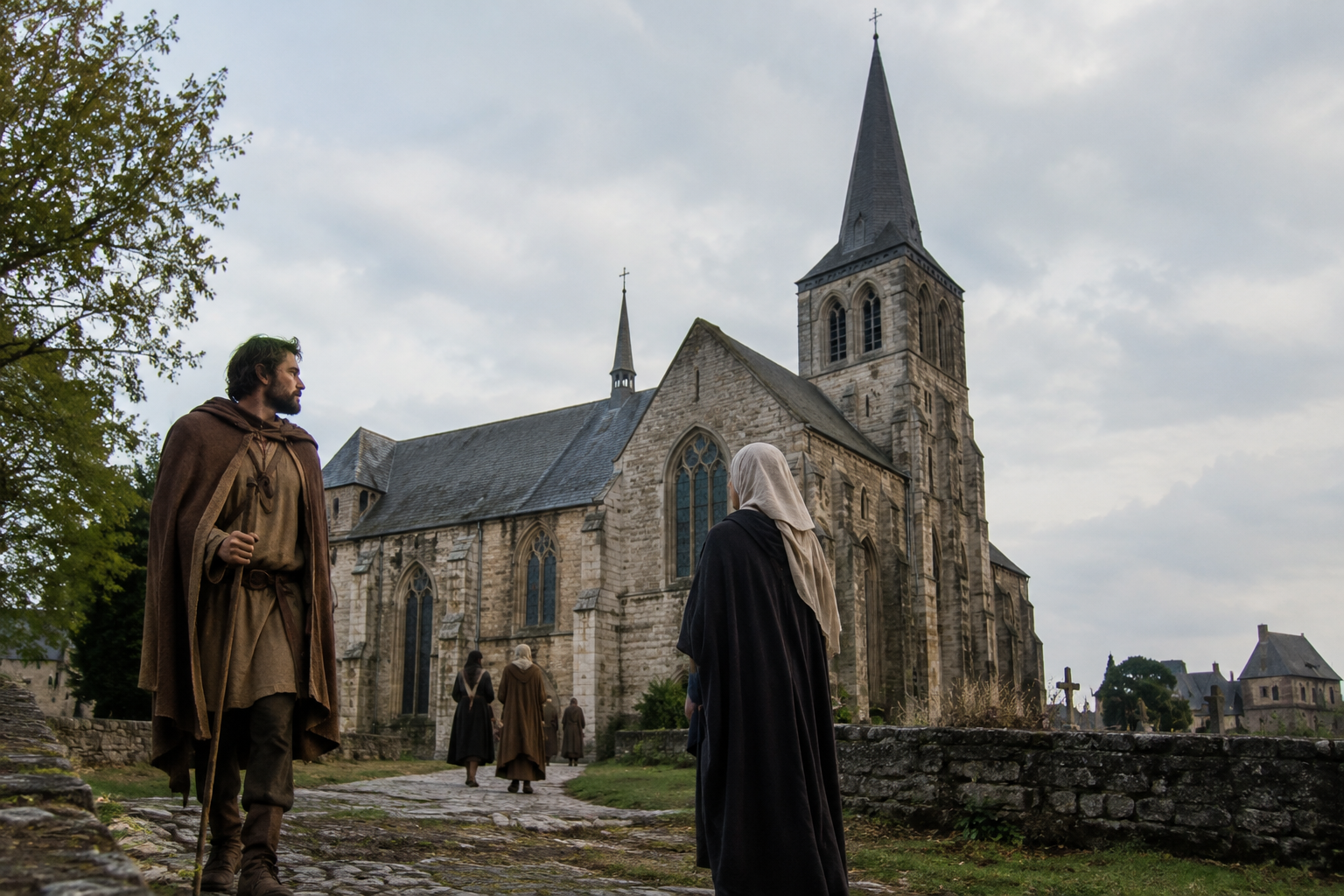
At Sint-Truiden in medieval Belgium, one burial stands out precisely because it does not fit the local pattern. The individual known as ST1186, dated to around AD 900 and recovered from Onze-Lieve-Vrouwekerk, has been described as a "Medieval Belgium Outsider" - a useful reminder that even seemingly settled early medieval towns could contain people whose ancestry was not simply local and uniform. In that one man, assigned here to the very fine-scale Y-DNA branch R1b1a1b1a1a1c2b2a1b1b1a1a, we are looking at a paternal line carried in a place shaped by pilgrimage, trade, lordship, and movement.
That long string of letters and numbers is a very narrow branch within the much broader R1b family, one of the major Y-chromosome lineages in western Eurasia. Y-DNA traces one direct paternal line only - father to son to son - so it does not sum up a person's whole ancestry. But when a lineage like this turns up in a well-dated archaeological context, it can help anchor a paternal branch in a particular historical landscape.
Sint-Truiden was not an isolated village on the edge of nowhere. By the early medieval period it was an important ecclesiastical and urban center in the region that is now Belgium, part of a wider zone where the legacies of Rome, Frankish rule, Christian institutions, and regional mobility all overlapped. A burial from Onze-Lieve-Vrouwekerk therefore matters not because it offers a tidy ethnic label, but because it belongs to a town where different kinds of people could converge.
The label attached to ST1186 is especially revealing. "Outsider" in this sort of context does not mean a stranger dramatically arriving from some far-off saga world; it means that, genetically, this individual differed enough from the local burial population to attract notice. That is an archaeological question as much as a genetic one: how homogeneous were early medieval towns, and how much movement did they absorb?
A study of the Sint-Truiden material, published in Genome Biology, examines urbanization and population structure in this medieval community. Even without forcing more certainty than the evidence allows, ST1186 fits the broader historical picture of Low Countries settlements as places of circulation rather than sealed local enclaves.
The first thing to say about R1b1a1b1a1a1c2b2a1b1b1a1a is that it is not the same thing as the whole of R1b. Broad R1b lineages have a deep and complicated history across Europe, with many branches expanding at different times and in different settings. A medieval man in Belgium carrying this fine-scale subclade should not be turned into proof of one grand migration story all by himself.
Still, the context matters. In the lands between the Rhine, Meuse, and Scheldt, paternal lineages associated with wider R1b families are unsurprising in a broad sense, because this was one of the great contact zones of later prehistoric, Roman, and medieval Europe. What ST1186 offers is not a sweeping origin myth, but a fixed point: by around AD 900, this paternal branch was present in a Christian burial setting in an important town of the medieval Low Countries.
That is valuable for members of the MyTrueAncestry community. Many people meet their haplogroup first as an abstract code. An excavated individual like ST1186 gives it a human setting: churchyard burials, a growing town, and a world tied into wider networks of movement and exchange.
If there is one historical theme that suits this sample, it is connectivity. The Low Countries were repeatedly reshaped by long-term processes: Bell Beaker expansions in prehistory, Roman frontier systems, post-Roman political change, and the growth of medieval towns and churches. No single one of these can be claimed as the direct cause of this exact terminal branch, but together they explain why the region is such a good place to encounter mixed and layered ancestry.
For that deeper background, the lower Rhine-Meuse world has become one of the most intensively studied landscapes in European archaeogenetics. Work on earlier populations in this region has shown both continuity and major turnover at different moments, especially around the Bell Beaker horizon and later demographic reshaping.
That longer regional story makes ST1186 more interesting, not less. He was buried thousands of years after the prehistoric transformations that helped shape western European paternal diversity, yet he lived in a region still defined by movement. Medieval towns did not erase older population history; they layered new mobility on top of it.
It is tempting to read every early medieval genetic outlier through the familiar labels of "Frankish", "Saxon", "Viking", or "local." Real populations were messier than that. Political frontiers shifted, languages spread unevenly, and communities could absorb newcomers over generations without leaving neat textual labels in the cemetery.
That is why a case like ST1186 matters. The burial sits in the age when Latin Christianity, local lordship, and regional trade were reshaping everyday life in northwestern Europe. A genetically distinctive individual in such a setting may represent personal mobility, family movement a generation or two earlier, or the cumulative effect of a town drawing people in from several surrounding regions.
Comparable work elsewhere in northwestern Europe has shown just how complex these supposedly familiar populations could be, particularly where Roman and post-Roman worlds overlapped.
And language history belongs in this discussion too, though carefully. The early medieval Low Countries sat inside a wider zone where Germanic languages had become dominant, but language and Y-DNA are not the same thing. Even so, regional ancient-genomic research has been increasingly useful for understanding how the spread of languages and the movement of people sometimes overlapped and sometimes did not.
There is a tendency, when looking at Y-DNA, to want dynasties, famous names, or heroic founders. But much of the real power of archaeogenetics lies elsewhere: in ordinary burials with secure contexts. ST1186 is useful not because he can be inflated into a king or clan founder, but because he places this paternal line in a documented medieval community.
Onze-Lieve-Vrouwekerk offers precisely the sort of context historians like best: not myth, but setting. A burial tied to a known town and period lets us think about how paternal lineages sat within lived institutions - parish life, ecclesiastical burial, urban growth, and regional mobility. That is richer than a bare map dot.
The most distinctive thing about R1b1a1b1a1a1c2b2a1b1b1a1a, on the evidence currently in view here, is not royal glamour or a dramatic migration tale. It is its appearance in ST1186, a man buried around AD 900 at Sint-Truiden, in a community where genetic research suggests both local structure and meaningful outside connections. For anyone exploring this paternal branch today, that is a sensible historical takeaway: your direct male line belongs to the dense, mobile, deeply layered world of medieval northwestern Europe, where towns and churches gathered together people whose backgrounds were not always the same.

Comments