Haplogroup R1b1a1b1a1a1c2b2a1b1a4b1a1a2

– 5 min read


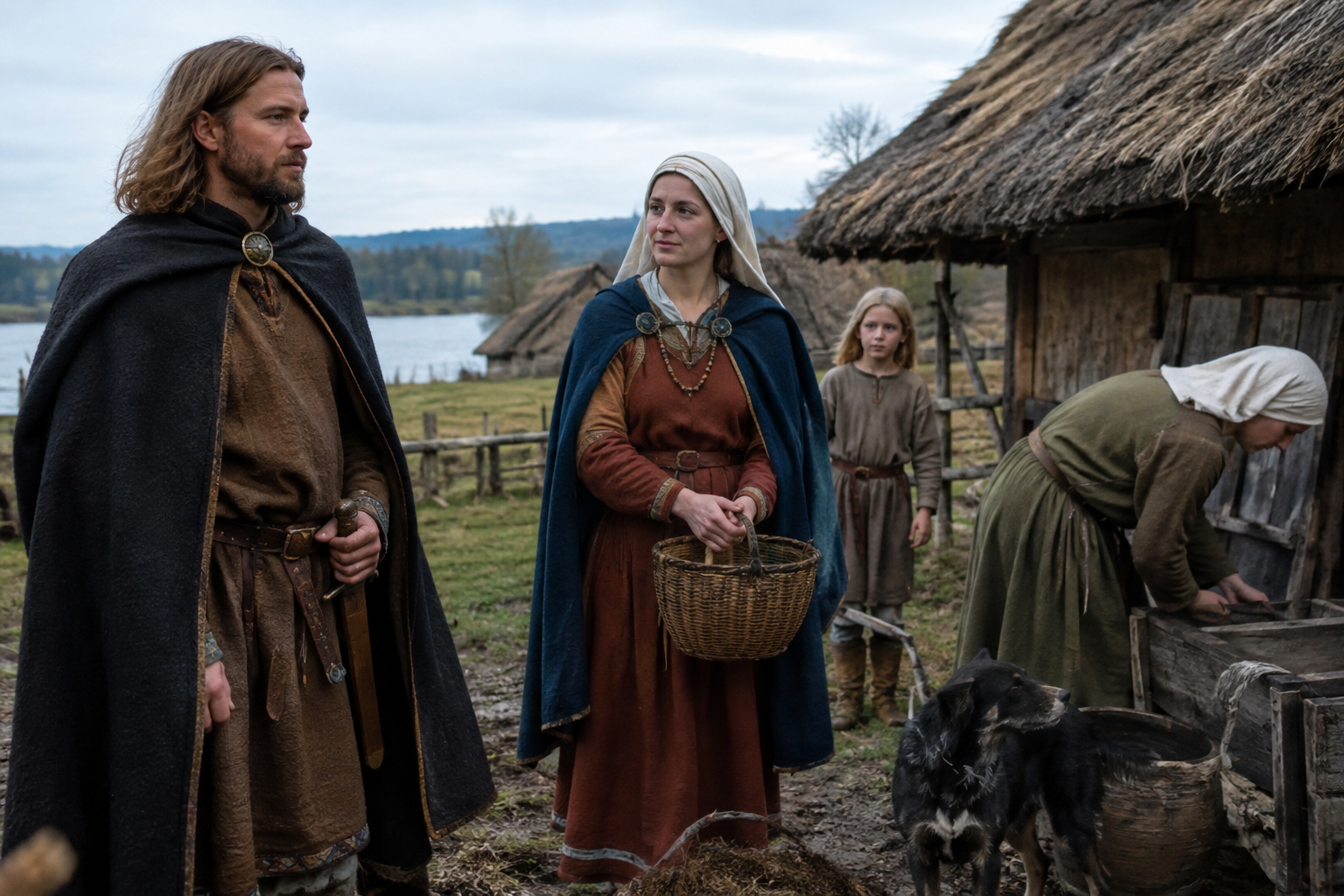
At Altheim in Bavaria, an early medieval burial dated to around AD 500 produced one of those small but telling data points that archaeologists treasure: an ancient male, identified as Alh_130, whose Y-DNA is associated here with the very specific paternal branch R1b1a1b1a1a1c2b2a1b1a4b1a1a2. On its own, that formidable string of letters and numbers does not give us a ready-made saga. But set beside the place and period, it becomes much more interesting. This was the world of the early Merovingian age, when former Roman provinces, local communities, and incoming elites were being folded into new political and social landscapes across western and central Europe.
The fascination of Alh_130 is not that one man can stand for an entire people. He cannot. Y-DNA traces a direct paternal line only, not a person's whole ancestry, language, or identity. Yet a securely placed early medieval individual in Bavaria offers a valuable fixed point. It lets us ask where this paternal line appears in the archaeology of post-Roman Europe, and what kind of historical setting carried it forward.
Altheim sits in a region that, by about AD 500, belonged to a changing frontier zone of power, allegiance, and settlement. Bavaria in this period was not an empty stage waiting for a single migration to explain everything. It was a landscape shaped by the long aftermath of Roman rule, by local continuity, and by the formation of new early medieval communities under emerging aristocratic and regional structures.
That matters for how we read Alh_130. A lineage such as R1b1a1b1a1a1c2b2a1b1a4b1a1a2 is best understood here not as a badge of a neatly bounded tribe, but as evidence that one paternal line was present within this mixed and historically mobile population. Early medieval Bavaria is exactly the kind of setting where genetics and archaeology have to be read together with caution. Burial grounds from this era often show communities that were neither wholly local nor wholly immigrant in any simple sense.
A broader ancient DNA study of Germanic-language expansion has helped underline that point, showing how linguistic and political change did not always map neatly onto one biological profile or one migration event. For readers interested in that wider backdrop, this related piece is a useful companion.
The haplogroup in this article is an extremely fine-grained branch beneath the much larger R1b family, one of the major Y-chromosome lineages in western Eurasia. That broader family has a very long and complicated history stretching far earlier than the Merovingian period. But it would be a mistake to pour all of that immense parent-branch history directly into this narrow subclade. The evidence here is more modest and more useful than that.
What we can say is that a man associated with this branch was living in early medieval Bavaria around AD 500. That places the line in a historically important zone at a historically important moment: the consolidation of post-Roman Europe. It links the branch, at minimum, to a population living amid the making of early medieval kingdoms, the spread of Christian institutions, and the reorganization of older Roman landscapes into new social orders.
What we should not say is that the branch was exclusively "Merovingian," exclusively "Germanic," or tied to a single ethnic narrative. Archaeology has spent decades dismantling those overconfident shortcuts, and ancient DNA has generally reinforced the need for nuance rather than revived old certainties.
The historical importance of Bavaria around AD 500 lies in precisely this mixture of continuity and change. Roman imperial administration had receded, but Roman roads, settlements, agricultural systems, and habits of local life did not simply vanish overnight. Nor were the people buried in the region reducible to a single incoming stream. By the early Merovingian period, communities in southern Germany were products of several centuries of movement, intermarriage, alliance, and adaptation.
That is why Alh_130 matters as evidence rather than emblem. He gives us a paternal lineage embedded in a real archaeological horizon rather than an abstract map of modern frequencies. In public discussions of Y-DNA, there is often a temptation to jump straight from a modern test result to a heroic migration. Ancient individuals pull us back to firmer ground. They show us where a line actually appears, in a dated human context.
Research on post-Roman and early medieval populations across Europe has repeatedly shown that cemetery communities could include people of varied genetic backgrounds living within shared burial traditions and political systems. A related MyTrueAncestry article on the blending of Roman and non-Roman populations along the frontier captures that wider pattern well.
Some readers may wonder whether one sample is enough to build an article around. In one sense, no: one burial cannot define the whole history of a branch. In another sense, absolutely yes. Ancient DNA advances by accumulation, and every securely placed individual helps anchor a lineage in time and space. Alh_130 is useful because he is not a legend, not a family tradition, and not a guess from modern distribution. He is a documented early medieval person from a known region and period.
That kind of anchor matters especially for branches buried deep inside the Y-chromosome tree, where the modern story may be geographically wide but historically blurry. Ancient samples reduce the blur. They tell us that by the beginning of the 6th century, this paternal line was part of the human landscape of Bavaria, a region deeply involved in the remaking of Europe after the western Roman Empire.
There is also a methodological point here. Ancient Y-DNA should not be treated as if every terminal label were equally certain in every publication or database context. Fine-resolution assignments depend on the quality of the ancient DNA and the reporting standards of the study. So the most responsible reading is that Alh_130 is the key ancient association for this branch in an early medieval Bavarian setting, rather than a warrant for grander claims than the evidence can bear.
An ancient DNA study of early European populations is the scientific backdrop for this kind of work, where archaeology and genetics together let researchers place individuals into broader regional histories without collapsing them into simple stereotypes.
For someone exploring this haplogroup today, the strongest historical signal is not a promise of famous descent but a plausible connection to the populations of early medieval western and central Europe. The Altheim evidence points toward a paternal line present in Bavaria during the Merovingian age, in a society shaped by both local roots and wider post-Roman mobility.
That makes this lineage particularly interesting for anyone whose documentary family history later appears in German-speaking lands, the Alpine forelands, or neighboring parts of central and western Europe. It does not prove that every bearer of the branch descends from Bavaria, still less from one ancient man. But it does place the lineage in a concrete historical world: cemeteries, communities, and kin groups living through the formation of medieval Europe.
Readers who want to see how similar questions are being explored elsewhere in early medieval Europe may also find these articles helpful.
And for a broader comparison with Britain in roughly the same long post-Roman era:
Roman and early medieval Britain
The most distinctive thing we can say about R1b1a1b1a1a1c2b2a1b1a4b1a1a2 from the evidence here is simple and valuable: this paternal line is represented by an early medieval man, Alh_130, buried in Bavaria around AD 500, in the unsettled but formative centuries after Rome. That does not hand us an instant tribal label or a royal pedigree. What it does offer is something better: a real historical foothold for a living paternal line in the making of early medieval Europe.
Comments