Haplogroup R1b1a1b1a1a1c2b1b2a

– 5 min read


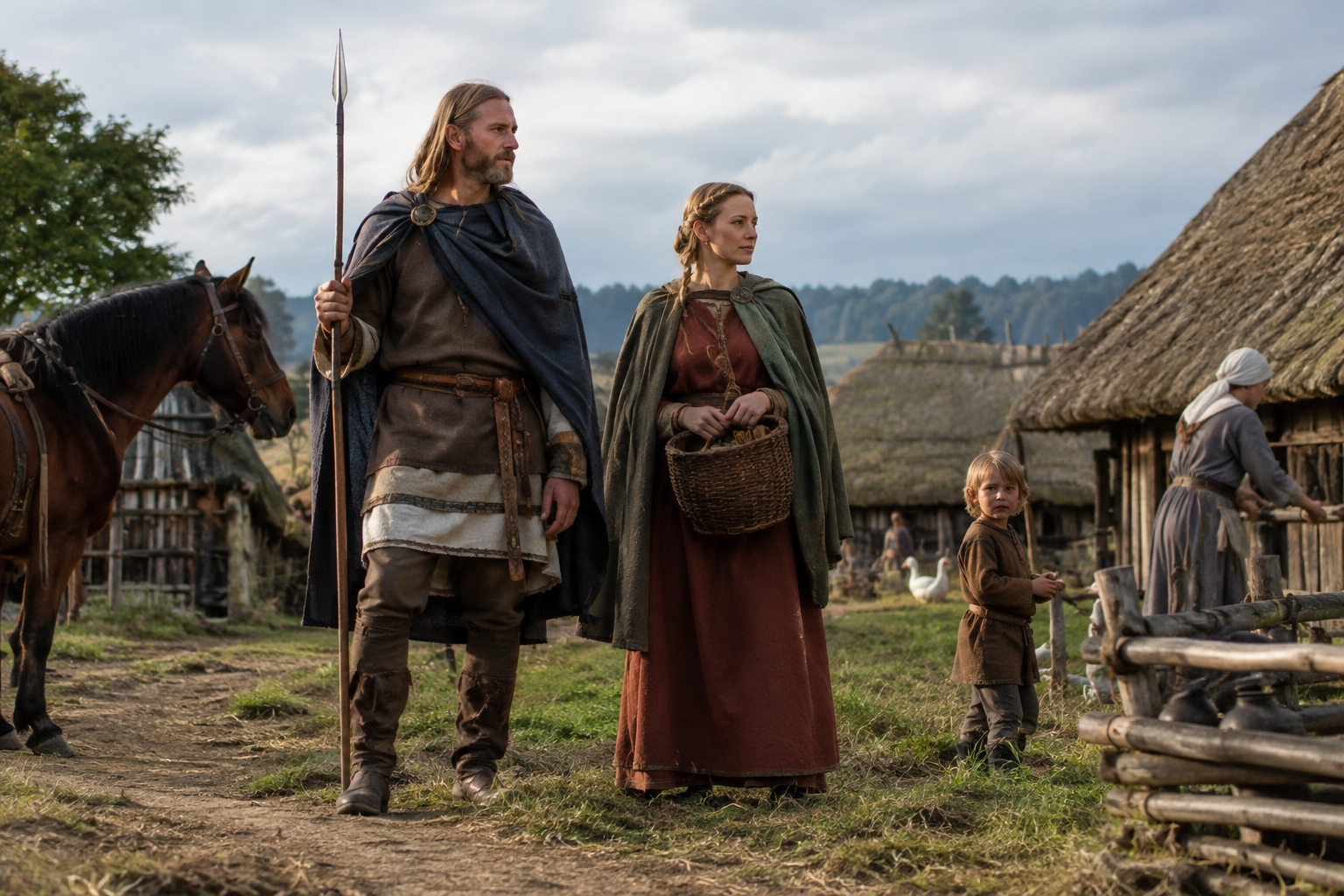
At Altheim in Bavaria, one excavated burial from around AD 600 has become a small but telling signpost in the study of early medieval paternal ancestry. The individual identified as Alh_228, from a Merovingian-period cemetery in southern Germany, has been associated with the Y-DNA branch R1b1a1b1a1a1c2b1b2a. That is a very narrow paternal line, far more specific than the broad and famously widespread parent haplogroup R1b, and its appearance in this setting matters because Merovingian Bavaria sat in a world where local continuity, migration, marriage, and political change were all colliding.
That is the first point worth making clearly. A Y-DNA haplogroup traces one direct paternal line only: father to son to son across generations. It does not sum up the whole ancestry, language, or identity of a person. But in archaeology, even a single paternal line can be revealing when it turns up in a well-dated burial ground, because it helps anchor real men in real landscapes rather than leaving us with abstract maps of genetic labels.
Altheim belongs to the early medieval Bavarian zone under Merovingian influence, a region that was neither a blank slate nor a sealed ethnic box. By the sixth and seventh centuries, Bavaria stood within a post-Roman central European world shaped by former imperial frontiers, new elite networks, Christianization, and movements of people from neighboring regions. A lineage such as R1b1a1b1a1a1c2b1b2a appearing here is therefore interesting not because it instantly identifies a "tribe," but because it sits inside a historical setting where paternal lines could be preserved, introduced, or redistributed through settlement and kinship.
The sample Alh_228 is especially useful because its context is specific: Merovingian-period Bavaria, around AD 600, at Altheim in Germany. Even with sparse published detail at hand, that is enough to place the lineage in a society of village cemeteries, emerging regional lordship, and dense contact across the old Roman frontier belt. Research on early medieval central and western Europe has increasingly shown that these communities were often genetically mixed in ways that do not map neatly onto old textbook labels. A broader article on that theme is worth reading here:
Germanic languages and ancient genomics
It is tempting, when confronted with a long haplogroup string, to treat it as a ready-made history lesson. But the opposite is usually true. The broader R1b family has an enormous prehistoric and historic footprint across Europe, especially western and central Europe, whereas R1b1a1b1a1a1c2b1b2a is a much narrower twig on that great paternal tree. Without a larger cluster of securely published ancient examples from multiple periods, one should not assign this exact subclade a grand migration story of its own.
What can be said more responsibly is that this branch was present in a man buried in Merovingian Bavaria, and that this places it within the demographic world of early medieval south Germany. In other words, the evidence is strongest when kept close to the grave and its region. It becomes weaker the moment one starts pretending that a single burial can stand for all Bavarians, all Germanic speakers, or the full history of the lineage.
An ancient DNA study examining this period of population history has helped push discussion away from old all-or-nothing migration models and toward a more complicated picture of ancestry and mobility in Europe; the relevant research associated with this sample can be found here. The important thing for readers is not to memorize the paper, but to see how ancient genomes let us test whether historical change involved continuity, newcomers, or some blend of the two.
The world of AD 600 in Bavaria was built on the ruins and inheritances of Rome, but it was not simply Roman, nor simply "barbarian." Cemeteries of this period often show communities establishing themselves through burial practice, local memory, and family presence over time. A paternal lineage found in one burial may point to a family line rooted in that community, but it might just as easily belong to someone whose forefathers arrived a few generations earlier through marriage, military service, alliance, or migration.
That is why even a single sample such as Alh_228 is valuable. It reminds us that post-Roman Europe was assembled through households and kin groups as much as through kings and wars. A narrow Y-line in a Merovingian cemetery is not a banner announcing a people; it is a trace of one male descent line living within a larger and changing social world.
Readers interested in how this same broad era produced mixed communities elsewhere in western Europe may find a useful comparison in evidence from Iberia, where seventh-century burials also reveal diversity rather than tidy ethnic boundaries:
There is a slightly old-fashioned habit in public discussions of genetics to value only the spectacular cases: royal mummies, famous warlords, magnificent tombs. But ordinary cemetery burials often do more for history. Alh_228 matters precisely because he was part of a regional population in a formative period, when the social map of central Europe was being remade after the Western Roman Empire.
In that sense, the significance of R1b1a1b1a1a1c2b1b2a here is not prestige but placement. It gives this paternal branch a documented foothold in early medieval Bavaria. For someone carrying the same or a nearby paternal line today, that does not prove descent from this individual or his family. It does, however, show that the branch belonged to the population fabric of Merovingian southern Germany.
Bavaria around AD 600 cannot be understood in isolation. This was part of a broad zone stretching across former Roman and non-Roman territories where ancestry, language, and political identity were being constantly renegotiated. The early medieval record repeatedly shows that local populations did not vanish and get replaced in a single stroke; nor were they static. Instead, communities were recomposed through generations of movement and intermarriage.
That wider pattern helps explain why a narrow paternal branch in Altheim is best read as evidence of participation in a living regional network. It may reflect continuity from earlier central European populations, or integration into new political structures, or both at once. That kind of layered answer is less dramatic than the old migration myths, but much closer to the archaeology.
For a neighboring frontier perspective on exactly this sort of blending between Roman and post-Roman populations, this related piece gives useful context:
Roman-Barbarian blending, 400-700 CE
The most distinctive thing about R1b1a1b1a1a1c2b1b2a in the present evidence is not that it can be tied to a grand dynasty or a legendary migration route, but that it is already visible in a real early medieval burial from Altheim in Bavaria. Alh_228 shows this paternal line, or a line reported in association with it, in the Merovingian world of about AD 600. For anyone researching this branch today, that is a solid and genuinely interesting anchor: a reminder that your direct paternal line belongs to the peopled, local, post-Roman history of central Europe, where family continuity and historical change were tightly interwoven.
Comments