Haplogroup R1b1a1b1a1a

– 6 min read


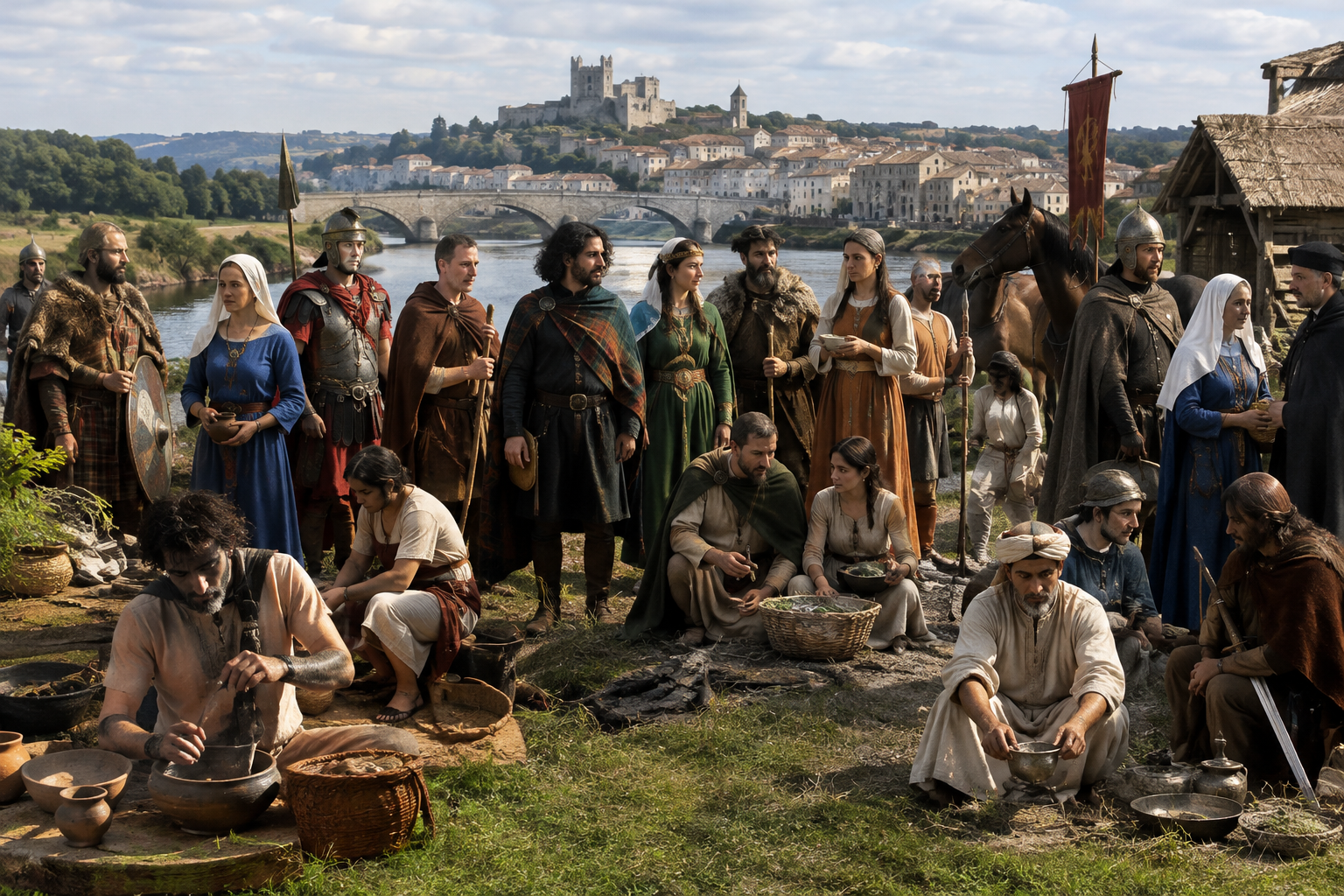
At Rosemarkie Cave on Scotland's Black Isle, a cluster of Pict-era men dated to around AD 541 has become one of the more striking signposts for haplogroup R1b1a1b1a1a. Several individuals from the site - including KD001, KD001_2, KD001_3, KD001_4, KD001_6a, and KD001_6b - are associated with this branch in the sample list. That matters because Rosemarkie is not a vague "Celtic" backdrop but a real early medieval place at the edge of the North Sea world, where archaeology and genetics meet in a stubbornly local story.
That is a useful way to approach this lineage. Y-DNA tracks one direct paternal line only, not the whole ancestry of a person or people. Even so, when the same branch appears in Bronze Age graves, Iron Age burials, Roman frontier communities, Pict-period Scotland, medieval Iberia, and later dynastic Europe, it begins to look less like a single dramatic migration and more like a durable western and central European male lineage that repeatedly turns up inside changing societies.
The Rosemarkie individuals are important precisely because there are several of them. A repeated appearance at one site suggests that R1b1a1b1a1a was not some exotic one-off in northern Britain during the early medieval period. It was present among men living in a region usually discussed through symbol stones, monasteries, and later chronicles, but far less often through surviving paternal lines.
What the evidence does not allow us to do is fold every man from Rosemarkie into a single family tree or declare this "the Pict haplogroup". But the clustering is still informative. It fits a wider picture in which some paternal lines persisted through political change, even where identities, kingdoms, and languages were shifting around them.
Roman & Early Medieval Britain DNA
If Rosemarkie shows this branch in the early medieval north, the deeper time depth comes from Bronze Age and late Copper Age Europe. The sample list places R1b1a1b1a1a in Early Bronze Age France at Saint-Martin-la-Garenne in Yvelines (SMGB54, around 2139 BC) and at Les Pointes et les Grévottes in Aube (BRE445FK, around 2339 BC). It also appears in Bohemia among Corded Ware horizon contexts such as OBR003 from Obříství, STD002 from Stadice, and VLI085 and VLI092 from Vliněves, all around the turn of the 3rd to 2nd millennium BC.
That distribution is revealing. We are not looking at a branch confined to one later nation or language group. Instead, the evidence places it in the broad zone where later Bronze Age societies of western and central Europe took shape: northern France, the Low Countries, Bohemia, southern Germany, and beyond. The same pattern continues with LEU040 and LEU065 from the Unetice-associated site of Leubingen in Thuringia, around 1950 BC, as well as Bronze Age individuals from Wehringen and Alsace.
A major ancient DNA study on Bronze Age Europe helped establish how strongly paternal lineages could structure these communities, even when women and wider ancestry profiles showed more mobility and mixing across regions: https://www.science.org/doi/10.1126/science.aec2634. For R1b1a1b1a1a, the key point is modest but significant: this branch was already embedded in the social landscape of Bronze Age Europe long before the historical Celts, Romans, Picts, or medieval kingdoms appear in written history.
By the Iron Age, the branch appears in settings that many MyTrueAncestry users will instantly recognize: Belgic, Gaulish, and British contexts. There is an Iron Age Suessiones-associated individual from Bucy-le-Long in France (CGG022436, around 330 BC), an elite Celtic burial at Ludwigsburg-Römerhügel in Germany (LWB002_ss and LWB002_ss_b, around 450 BC), and further Gaulish-linked examples such as BES1096B from Bessan and CHF106 from Marne.
In Britain the same lineage appears in individuals labelled Celtic Briton or Late Iron Age, including I7632 from Slonk Hill in Sussex, I19653 from Ham Hill Fort in Somerset, and I20632 from Fin Cop in Derbyshire. That is exactly the sort of evidence that cautions against tidy ethnic stories. A Y-line can persist across different archaeological cultures and political worlds; it does not carry an ethnic passport.
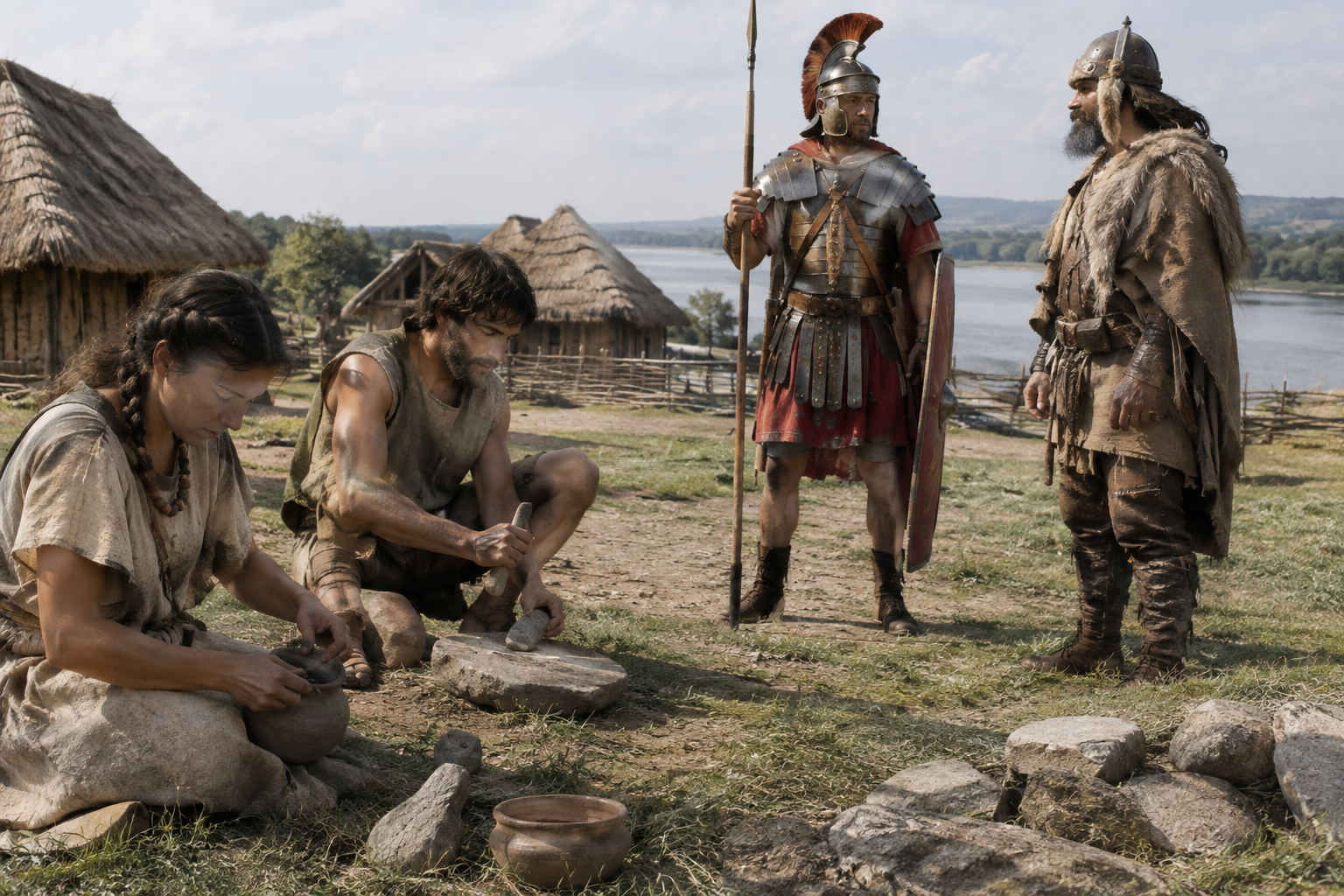
The Roman period adds another layer. I21059 from Tongeren in Gallia Belgica, dated to around AD 35, and CGG107747 from Valkenburg in the Netherlands, dated to about AD 250, place this branch in communities shaped by Roman rule along the northwestern frontier. A study of the Lower Rhine frontier has shown just how mixed such populations could be biologically and socially, with local continuity existing alongside movement through military and civilian networks: https://www.science.org/doi/10.1126/sciadv.abi6941. For this haplogroup, that makes the frontier evidence especially useful. It suggests continuity through empire, not replacement by it.
The post-Roman centuries show R1b1a1b1a1a moving through another set of historical labels. Samples such as DRH046 and DRH017 from Deersheim in Saxony-Anhalt, IND005 from Alt-Inden, Bur6 from Burgweinting, and the Hungarian examples SZL061, SZL073, and MFC006 connect the branch to the mixed societies that emerged after Roman power fractured in the west.
Some of these are associated archaeologically with groups such as Thuringians, Longobards, or Merovingian communities. But again, the sensible reading is not that the haplogroup "belongs" to one migrating people. Rather, it appears among several populations involved in the reorganization of central Europe during the 5th and 6th centuries.
Across the North Sea zone, the branch is also present in early medieval England and adjacent regions: DUN002 in Saxon Lower Saxony, SRS001 in medieval Lower Saxony, S16392 from Anglo-Saxon Yorkshire, and ATP_PSN_944 and ATP_PSN_36 from medieval Cambridgeshire contexts. Add the Danish and Swedish finds - including CGG107467 from Almager, CGG107395 from West Zealand, wes004 from Jämtland, VK217 from Malmö, and VK57 from Gotland - and one gets a lineage well at home in the interconnected northern European world of sailors, farmers, traders, converts, and local elites.
North Sea Migrations to Britain
One of the most interesting features of this sample set is how often the branch appears in Iberia. There are Bronze Age examples such as CLL007 from Cueva de las Lechuzas and VAD004 from Valdescusa in northern Spain, plus ALM057 from El Argar's La Almoloya in Murcia. Later there are Iron Age and classical-period cases like I3323 and I3327 from Ullastret in Girona, MAG001 in Italy's Tyrrhenian orbit, and I8202 from Roman-era Emporion.
Then the medieval evidence arrives in force. Northern Spain contributes ldo040 and ldo046 from Las Gobas, while Portugal provides LP112_13 from Castro de Avelas, LP117_2 from the Christian conquest horizon, LP115_5 from Loulé under the Umayyad Caliphate, and several Santarém individuals from around AD 1300. This is a rather fine reminder that paternal continuity can run through enormous cultural change: Bronze Age chiefdoms, Iberian oppida, Roman towns, Visigothic settings, Islamic al-Andalus, and Christian kingdoms all occupy the same broad landscape at different times.
That is also why Iberia is so useful for readers with this haplogroup. The branch does not appear there as a brief intrusion. It seems, from these scattered but recurrent finds, to have been part of Iberian population history for a very long time.
Roman Hispania's Genetic Legacy
There is one especially eye-catching later appearance: members of the medieval Piast dynasty in Poland. The sample list includes PCA0646, a Piast Masovian dynasty male dated to AD 1298, PCA0621, a Piast dynasty prince dated to AD 1354, and PCA0659, Bolesław III, Duke of Płock, dated to AD 1351. Here at last we are not simply dealing with an archaeological culture or regional burial ground, but with historically named rulers.
Even here, caution is part of the craft. These Piast samples are valuable evidence for the paternal line of particular dynastic individuals, not a magic key to every Piast descendant or every noble family later linked to them. Still, their presence shows something important: R1b1a1b1a1a was not only a prehistoric or village-level lineage. In at least one documented medieval dynasty, it survived into the written political history of Europe.
That matters because dynasties often tempt us into imagining a single noble origin for a haplogroup. The actual evidence here points the other way. This lineage was already widespread centuries and indeed millennia before those Piast burials. The dynasty is one late chapter, not the beginning of the book.
If you belong to haplogroup R1b1a1b1a1a, the strongest pattern in the ancient evidence is not a single tribe, kingdom, or heroic founder. It is continuity across western and central Europe, with especially clear appearances from the Bronze Age onward and repeated finds in Britain, the Low Countries, France, Germany, Iberia, Scandinavia, and medieval Poland. In plain terms, this looks like a long-lived European paternal branch that kept turning up as societies changed around it.
For family historians, that is both humbling and useful. Your direct paternal line may have passed through worlds as different as Unetice cemeteries, Iron Age hillforts, Roman border towns, Pict-period Scotland, medieval Iberian communities, and even a named Polish dynasty. The haplogroup does not tell you which one is "yours" by itself, but it does place your line within a remarkably deep and well-attested historical landscape.
Comments