Haplogroup R1b1a1b1a

– 7 min read


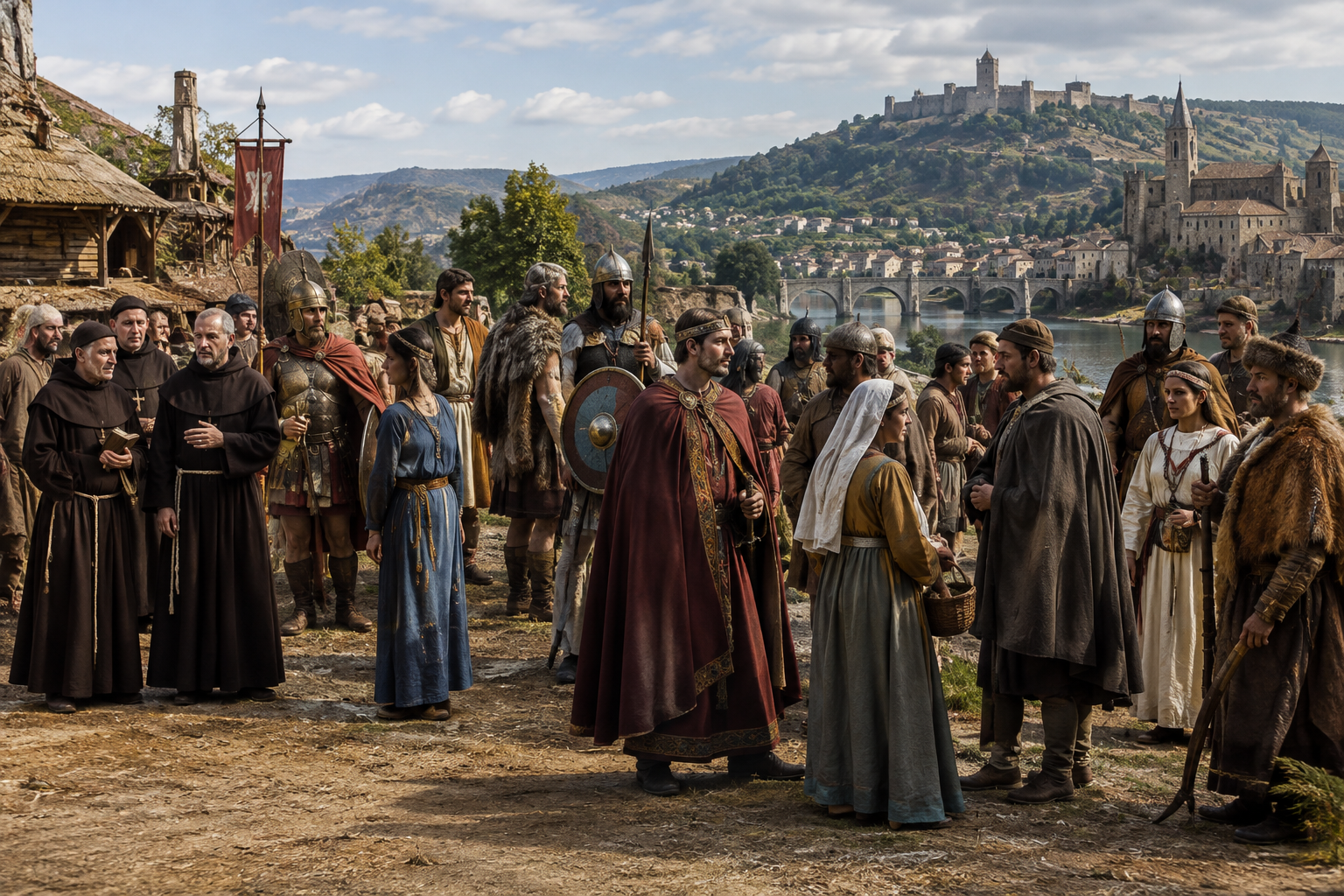
Some Y-chromosome lineages turn up in just one corner of the ancient world. Others seem to behave more like seasoned Mediterranean merchants or restless Bronze Age fighters, appearing in one century in Iberia, then in central Europe, then in the Aegean, and later again in medieval towns and dynastic burials. Haplogroup R1b1a1b1a belongs to that second sort of story.
As always with Y-DNA, a caution comes first. A Y-chromosome haplogroup traces only one direct paternal line: father to father to father. It does not describe all of a person's ancestry, identity, language, or ethnicity. But it can be extraordinarily useful for following how certain male lineages appear, persist, and move through time. In the case of R1b1a1b1a, the supplied ancient DNA points to a lineage present across a striking sweep of European and Mediterranean history, from Bronze Age Portugal and England to Visigothic Spain, Iron Age Hallstatt territory, Byzantine Anatolia, and a Piast dynastic burial in medieval Poland.
R1b1a1b1a sits within the wider R1b family, one of the major Y-chromosome branches found across much of western Eurasia. That broad parent lineage has a deep and complicated history tied to prehistoric population movements, especially in later prehistory. But one of the easiest mistakes in public genetics is to treat a narrower branch as if it automatically carries the entire history of the much larger parent. It does not.
So with R1b1a1b1a, the responsible approach is a modest one. The ancient samples here suggest a paternal line that was established across parts of Europe and the Mediterranean by the Bronze Age, and that continued to appear in quite varied historical settings afterward. That pattern fits a world shaped by mobility: exchange networks, local continuity, warrior movement, dynastic marriage systems, migration-period resettlement, and medieval urban life. It does not let us pin this exact branch to one people, one language, or one kingdom.
The geographical spread is already notable in early material. We see Bronze Age examples in Portugal, Spain, England, the Netherlands, Croatia, Sicily, and the Alpine zone. That is a reminder that by the second millennium BC, paternal lines within the wider R1b world were not confined to a single frontier. They were part of the human background of Atlantic Europe, central Europe, and the Mediterranean alike.
The oldest supplied samples make the point vividly. In western Iberia, I7691 from Bronze Age Monte da Cabida, Evora, Portugal, dated to 1950 BC, places this paternal line in a region that later became a major meeting ground of Atlantic and Mediterranean connections. In northern Spain, EHU001 from Bronze Age El Hundido, Monasterio de Rodilla, dated to 2171 BC, shows the same broad lineage present in another part of prehistoric Iberia.
Across the Channel, Bronze Age England yields more evidence: muw005 from Dorset Monkton Up Wimborne, dated to 1900 BC, and I2464 from Boscombe Airfield, dated to 1680 BC. These are not "English" in any modern national sense, of course, but they do show that this paternal branch had already become part of the population landscape of prehistoric Britain.
Then the map widens further. I26829 from Bronze Age Wervershoof-Zwaagdijk in the Netherlands, dated to 1450 BC, places it in the lower Rhine-Meuse world. AITI_40, listed as North Alpine Bronze Age, dated to 1788 BC, hints at presence in the Alpine corridor. And I18752 from the Pre-Illyrian Bronze Age Cetina Valley in Croatia, dated to 1800 BC, adds an Adriatic dimension.
Perhaps most arresting is I22241, from Hellenic Middle Bronze Age Sicily Motya, dated to 1535 BC. Sicily has always been awkward in the best possible way for simple genetic storytelling. It sits at the crossroads of the central Mediterranean, drawing in people, goods, and ideas from many directions. A lineage like this appearing there in the Bronze Age is precisely what one might expect in a world of seaways rather than borders.
Discover Ancient Italian Islands
By the later Bronze Age and Iron Age, R1b1a1b1a turns up in contexts that feel more recognisably historical. WEZ57, from the Tollense Valley battlefield in Mecklenburg-Vorpommern, dated to 1250 BC, belongs to one of Europe's most dramatic prehistoric conflict sites. Tollense is a sharp reminder that mobility was not always peaceful. Men carrying related paternal lines could meet as allies, rivals, or conscripts in violent confrontations far from any tidy ethnic label.
Central Europe provides several later appearances: I15955 from Late Bronze Age Hostivice-Palouky in central Bohemia, dated to 800 BC; CGG101232 from Iron Age Hallstatt Hallein in Austria, dated to 340 BC; I25507 from Iron Age Vas County, Hungary, dated to 600 BC; I12110 from Iron Age Vekerzug Komarno, Slovakia, dated to 575 BC; and I18531 from Celtic Hungary Gyor-Moson-Sopron, dated to 250 BC. Taken together, they suggest continuity of this paternal line through the shifting cultural worlds of late prehistoric central Europe.
The elite burial DEM3238 from the Royal Tombs of Aigai, Macedonia, Elite Tomb I, dated to 400 BC, adds another layer. One must be careful here: sharing a haplogroup with an elite burial does not make anyone "Macedonian royalty" by DNA. But it does show that paternal lines in this branch could occur in high-status settings as well as ordinary graves, and in the wider Greek world as well as farther north and west.
Later still, the migration-period and early medieval samples show this lineage in communities often discussed through ethnic labels but better understood as mixed and mobile populations. CGG107403, associated with the Danii Tribe in Sjaelland Harlev, Denmark, dated to 375 AD, and OBM008, associated with the Thuringii Tribe in German Obermoellern, dated to 500 AD, place it among northern and central European groups in the late Roman world. S11583 from an Early Anglo Saxon cemetery at West Heslerton, Yorkshire, dated to 550 AD, shows it in early medieval England. And I12032 from Visigothic Early Medieval Spain, Girona Sarria de Ter Pla de lHorta, dated to 488 AD, shows the same broader paternal story in post-Roman Iberia.
Read About Early Medieval Iberia
The medieval samples are particularly useful because they place this lineage not in abstract prehistoric horizons but in towns, churches, convents, and ruling houses. SWG011 from Post Viking Age Hedeby Schleswig Rathausmarkt, Southern Jutland, dated to 1105 AD, belongs to one of northern Europe's great trading centres. Hedeby was a hinge between Scandinavia, the North Sea, the Baltic, and the Continent. A lineage found there belongs to a world of merchants, craftsmen, clerics, and travellers, not simply "Vikings" in horned-helmet shorthand.
In the eastern Mediterranean, I20140 and I20141 from Byzantine Era Stratonikeia Church on the Aegean Coast of Anatolia, dated to 1090 AD and 1100 AD, show the same paternal branch in a Christian Byzantine context. Meanwhile ETR003 from Medieval Siena, Italy, dated to 1073 AD, and LAHPS74 from Medieval Hungary Visegrad Szechenyi utca 25, dated to 1050 AD, place it in two very different medieval societies, both deeply embedded in wider European networks.
The most obviously dynastic sample in the list is PCA0651, identified as a Piast Masovian Dynasty Male, dated to 1298 AD. This is especially interesting because it shows how ancient DNA can intersect with written genealogy. Here we are no longer dealing simply with archaeology but with a lineage inside a named medieval ruling house. Even so, caution is vital: one dynastic male sample can illuminate a paternal line within that branch of the Piasts, but it does not prove sweeping claims about every relative, every allied noble house, or every later family tradition.
One might place alongside it K3per3_GE, a Hungarian Conqueror from Karos III, dated to 900 AD. This sample belongs to the world of the Magyar conquest and early medieval state formation in the Carpathian Basin. Again, the point is not that one haplogroup "belongs" to one people. It is that the paternal line appears in the middle of major political transformations.
In this case, the supplied field for associated noble families and castles is effectively empty. That absence is worth saying plainly rather than papering over with invention. We do have one clearly noble and dynastic connection through the Piast Masovian sample PCA0651, and one elite ancient context at Aigai through DEM3238, but we were not given a documented list of castles, ancestral seats, or specific later noble families tied to this haplogroup.
That matters because castles are seductive evidence. Once a lineage appears in a medieval dynasty, it is tempting to march straight from chromosome to battlement. But castles preserve political memory, not genetic certainty. Without explicit supporting data, it would be irresponsible to claim that any particular fortress, manor, or noble surname stands proven by this haplogroup alone.
Still, the regional settings are suggestive in a broader historical sense. Masovia, Visegrad, Siena, Hedeby, Girona, and Stratonikeia were all places where power, trade, religion, and family strategy overlapped. The men represented by these burials lived in worlds where lordship was material: in churches, courts, ports, market streets, and fortified centres. Ancient DNA cannot replace those histories, but it can add one more thread to them.
Discover the Hungarian Conquest
So what does haplogroup R1b1a1b1a reveal? Above all, it shows that a paternal lineage can be both widespread and historically specific. In the supplied record it appears in Bronze Age Iberia, Britain, the Low Countries, the Alps, the Adriatic, and Sicily; in Iron Age central Europe and Macedonia; in migration-period Denmark, Germany, England, and Visigothic Spain; and in medieval Italy, Hungary, Anatolia, England, Hedeby, and the Piast sphere.
That is not evidence of one unbroken political people. It is evidence of long-term male-line persistence across many changing societies. Archaeology tells us where these men were buried. History tells us what kinds of worlds they inhabited. Y-DNA tells us that, across all those upheavals, some paternal branches endured and resurfaced again and again in new settings.
If R1b1a1b1a appears in your own results, the real excitement is not in claiming a crown, a tribe, or a castle by right of a haplogroup label. It is in seeing how one thin paternal line can connect you, in a very limited but very tangible way, to the Bronze Age dead of Portugal and Dorset, to the battlefield at Tollense, to Visigothic Girona, to Byzantine Anatolia, and to a medieval Piast burial. That is plenty dramatic enough without making the genetics say more than it can.
Upload your DNA to MyTrueAncestry to explore whether your results show links to ancient individuals, archaeological cultures, and historical populations like those discussed here. These matches can offer remarkable clues about the deep past of your ancestry, even when they do not prove direct descent from any specific ruler or noble family.
Comments