Haplogroup R1b1a1b

– 6 min read


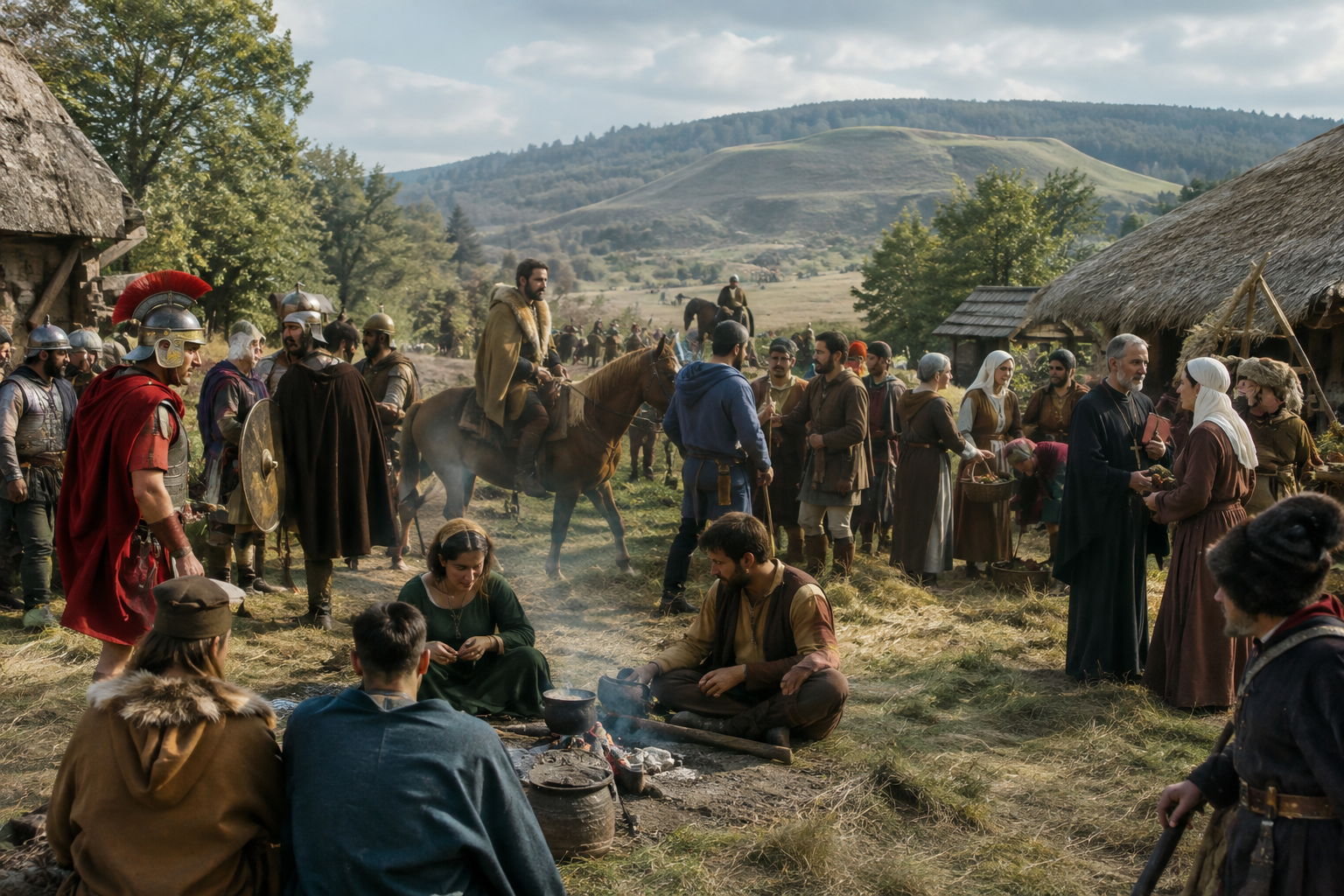
At Magdalenenberg in southern Germany, two men from an elite Celtic burial setting, MBG003 and MBG014, dated to around 530 BC, help anchor an unusually vivid chapter in the history of Y-DNA haplogroup R1b1a1b. That matters because Magdalenenberg is not just any cemetery. It belongs to the early Celtic world of Hallstatt power, status, and monumental burial, the sort of place where archaeology lets us see lineages moving through society rather than floating abstractly on a phylogenetic tree.
R1b1a1b is a paternal lineage, traced through the Y chromosome from father to son. It does not describe a person's whole ancestry, language, or identity. But when the same broad branch appears in steppe-era graves, Iron Age hillfort communities, Roman provincial cemeteries, and medieval towns, it becomes a very useful thread for following long-term male-line continuity and movement across Europe and beyond.
The Magdalenenberg burials place R1b1a1b in a setting associated with the emergence of early Celtic elites north of the Alps. The two individuals, MBG003 and MBG014, come from Villingen-Schwenningen in Baden-Wurttemberg, a region central to Hallstatt-period developments in the 6th century BC. Even without inventing a family tree around them, the pattern is striking: this is a paternal branch turning up in a prominent high-status funerary landscape during the centuries when central European power networks were consolidating.
That is important because the branch does not appear here as an isolated curiosity. It sits within a wider archaeological world that linked fortified centers, long-distance exchange, and burial display across temperate Europe. Another Iron Age example, LAN001 from the elite La Tene context at Langenenslingen Alte Burg in Germany, dated to about 300 BC, suggests that men associated with this broad lineage were present not only in the earlier Hallstatt sphere but also in later Celtic settings.
A recent ancient DNA study on the spread of Celtic-associated populations has helped sharpen discussion of how central European communities contributed to later western and Atlantic-facing populations, even if no single Y-lineage should be treated as "the Celtic haplogroup" on its own. For readers interested in that wider debate, see this research on Central European origins and the spread of Celtic languages.
Celtic language spread and DNA
If Magdalenenberg shows R1b1a1b in an elite Iron Age setting, the deeper time depth lies farther east. Several much earlier samples associated with Yamnaya or closely related Bronze Age steppe contexts are reported in this branch or its immediate reporting range: I3510 from Hajdu-Bihar Puspokladany in Hungary around 2501 BC, I10415 from Crihana-Veche in Moldova around 2573 BC, and 9NP004 from a Middle Bronze Age North Caucasus Yamnaya kurgan around 2800 BC. These are precisely the kinds of contexts that make archaeologists sit up, because they connect paternal history with one of the major demographic expansions of Bronze Age Eurasia.
One should be careful here. The article's haplogroup label is R1b1a1b, and not every one of these ancient men may have been resolved in published work to exactly the same downstream subclade by modern standards. Still, as a broad archaeological pattern, the branch belongs in the long shadow of steppe-linked expansions that reshaped much of Europe in the 3rd millennium BC.
The distribution in later Bronze Age contexts reinforces that point. Samples such as ZIM001 from Russia, RISE47 from Denmark, WEZ40, WEZ53, and WEZ71 from the Tollense battlefield in Germany, and PEB006 and PEB018 from Pottenbrunn in Austria show this paternal line moving through very different Bronze Age worlds: herding zones, river corridors, farming landscapes, and even a major conflict site. What unites them is not one ethnicity or one culture, but repeated presence in the male lines of communities tied into the broad Bronze Age networks of Europe.
Britain is where the evidence becomes particularly dense. Before Rome, the lineage appears in Iron Age and late pre-Roman contexts such as DUX014 from Cambridgeshire around 180 BC, I19207 from Yarnton in Oxfordshire around 300 BC, I20624 and I20625 from Fin Cop in Derbyshire, I16591 from Dibbles Farm in Somerset, and I14552 from Moulsecoomb in Sussex near the turn of the era. This is not a fringe appearance. It looks embedded in local Iron Age male populations across several regions of southern Britain.
Then the Roman period arrives, and the branch is still there. KNF020 from Knobbs Farm, NWC003 from Eddington, ARB002 from the Arbury lead coffin burial, VIC006 from Vicars Farm, and FEN009, FEN011, and FEN013 from Fenstanton all point in the same direction. R1b1a1b was part of the paternal landscape of Roman Britain, including in and around Cambridgeshire, where archaeology often shows a complicated mix of local continuity and incoming influences.
The Durotriges-related burials at Duropolis, Winterborne Kingston in Dorset are especially useful because they sit close to the hinge between late Iron Age Britain and the Roman world. There, WBK33, WBK104, and WBK107 show this branch in a population long associated with the tribal label Durotriges. That does not make R1b1a1b a "Durotrigan marker," but it does show the lineage present within a historically famous regional community in southern Britain.
Roman and early medieval Britain
Research on Roman and early medieval Britain has increasingly emphasized that the island was neither genetically frozen nor wholly replaced. Instead, local lineages, migrants, and regional social histories overlapped in complex ways. The clustering of these British samples fits that picture rather well.
After the Roman world fragmented, R1b1a1b continued to appear in settings shaped by new kingdoms, military followings, and changing towns. In northern Italy, the Lombard-associated burials from Collegno around AD 580 include COL_142, COL_142b, COL_142x, COL_017x, COL_017, and COL_017b. Whether every one of these represents a close paternal relation is another question entirely, but the recurrence of the branch in a Lombard warrior-elite cemetery is notable.
Farther north, KOS010 from Merovingian Flanders, NIEcap12a from a Merovingian noble burial around AD 605, and several Migration-period burials from Saxony-Anhalt, including BRC001x, BRC003x, and BRC060x, place the lineage in the shifting political landscape of post-Roman western and central Europe. These were centuries of confederations, federates, successor states, and localized power. A paternal branch seen here is not telling us who was "Frankish" or "Germanic" in some essential sense. It is showing us male-line persistence across a very unsettled age.
The same pattern carries into towns and churchyards. Medieval examples from Cambridge, Sint-Truiden in Belgium, Denmark, Hungary, Sicily, and Poland suggest that by the High Middle Ages this was a well-established European paternal line, no longer associated with one frontier or one cultural zone. In Cambridge alone, individuals such as ATP_PSN_54, ATP_PSN_86, ATP_PSN_92, ATP_PSN_93, ATP_PSN_128, and ATP_PSN_248 show how ordinary medieval institutions like hospitals and parish grounds can preserve the long afterlife of Bronze and Iron Age paternal histories.
One of the most interesting features of this sample set is that R1b1a1b is not confined to temperate western Europe. It also appears in the Mediterranean and Black Sea zones: UKR131 from a rich Scythian grave near Kharkiv around 400 BC, UKR052 from a Late Scythian burial in Crimea around 75 BC, ASM_S66 from Roman Italy, SGBN26 from medieval Segesta in Sicily, and I7650 from Carthaginian-era Mozia in western Sicily.
These finds do not all mean the same thing. A Scythian nomadic elite burial in the steppe, a Punic-era burial in Sicily, and a Roman-period grave in Italy belong to very different social worlds. But taken together they show how widely distributed this paternal branch had become, and how unwise it is to pin it too narrowly to one later ethnic label. The branch could be carried by men living under Celtic chiefs, Scythian rulers, Roman administration, Lombard military structures, or medieval Christian towns.
That wider mobility is very much in line with ancient DNA work on the North Pontic zone and adjoining regions, where archaeological labels and biological ancestry do not always move in lockstep. Readers following those eastern connections may also want to compare the broader discussion in this related post.
The most distinctive thing about R1b1a1b in this ancient set is not a single royal claim or one famous migration, but its repeated appearance in socially important burials and everyday cemeteries from the Bronze Age onward. It is visible in steppe-linked horizons, early Celtic elites, Iron Age Britain, Roman provincial communities, post-Roman military societies, and medieval towns. For someone researching this paternal line today, that is the useful historical lesson: this branch belongs to a very old and very widely traveled male history, one that repeatedly turns up where archaeologists can watch continuity and change happening at the same time.
Comments