Haplogroup R1b17

– 5 min read


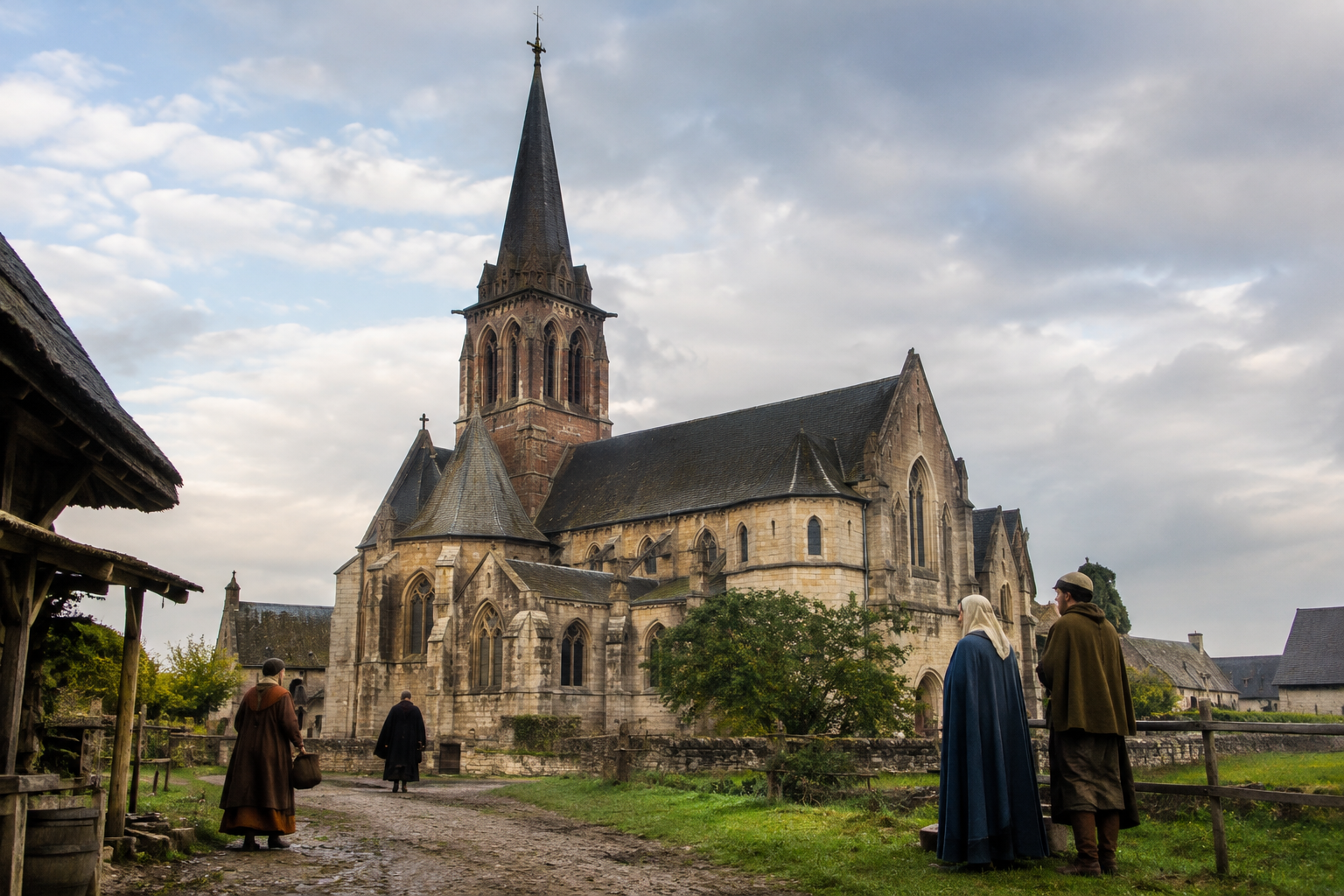
At Sint-Truiden in present-day Belgium, one of the more revealing ancient genomes from the early medieval Low Countries came from an individual labelled ST0727, buried at Onze-Lieve-Vrouwekerk around AD 900. He was classified as an "outsider" in the archaeological-genetic study of the cemetery, which is exactly the sort of label that makes historians sit up a bit straighter. Not because it promises romance or mystery, but because it points to a real question: in a growing medieval town, who counted as local, and who arrived from somewhere else?
That is where the Y-DNA haplogroup R1b17 enters the picture. Y-DNA follows one direct paternal line only, not a person's whole ancestry, but in the right archaeological setting it can still be quite informative. In the case of ST0727, the interest lies less in grand claims about vast migrations than in what one medieval burial can show about movement, settlement, and male-line diversity in an urbanizing corner of northwestern Europe.
Sint-Truiden was not an isolated village cemetery. By around AD 900, this was part of a substantial religious and urban landscape in the Meuse region, tied to the growth of ecclesiastical institutions and the wider transformations of the Carolingian and post-Carolingian world. Cemeteries associated with churches in such towns often preserve a more mixed picture than rural burial grounds, because towns attracted clerics, dependants, traders, craftspeople, and migrants of many kinds.
An ancient DNA study examining these burials, published in Genome Biology, focused on medieval Sint-Truiden as a case study in urbanization and population structure. The broad significance of that work is clear enough even without embroidering the details: early towns were places where local continuity met new arrivals. ST0727 matters because he was not simply another statistically ordinary burial in a churchyard. He formed part of the evidence that medieval towns in the Low Countries could absorb people with distinct backgrounds while still producing an overall impression of regional continuity.
With a haplogroup such as R1b17, caution is not a tedious academic habit; it is the whole point of doing this properly. R1b is a very broad and historically widespread West Eurasian paternal umbrella, and a label like R1b17 is a narrower branch within that much larger family. But a branch name on its own does not automatically tell us a man's language, legal status, or ethnic identity, and it certainly does not turn a burial in Belgium into proof of one neat migration story.
What it does tell us is that a particular paternal lineage was present in this medieval community. When that finding appears in an individual flagged as an outsider, the interesting question becomes contextual rather than deterministic. Was his paternal line newly arrived in the town? Was he himself mobile within the wider Frankish or post-Frankish world? Or was he descended from people who had already been moving around the region for generations? Those are all historical possibilities, but the burial itself does not allow us to choose one with certainty.
Still, the setting matters. Around AD 900, the Low Countries sat within a zone of dense movement, where river routes, monastic networks, lordship, and trade connected communities across what are now Belgium, the Netherlands, Germany, and northern France. A paternal lineage like R1b17 appearing in Sint-Truiden fits neatly into that world of circulation, even if it does not identify a single road taken or a single homeland left behind.
The word "outsider" can mislead modern readers if we let it sound more dramatic than it is. In bioarchaeological work, it usually reflects a measurable distinction from the local burial population, whether genetic, isotopic, or both, rather than a social judgement inscribed on the grave. For ST0727, the point is that he helps reveal the town as a place where newcomers were buried among the dead of an established Christian community.
That matters historically. By the early Middle Ages, churchyard burial was part of belonging, memory, and local identity. A man whose ancestry marked him as less typical for the local population was not left at the margins of the landscape; he was incorporated into it. Medieval towns were not melting pots in the lazy modern sense, but neither were they neat little containers of static ancestry.
It is also worth noticing what we are not told. We do not have, from the evidence supplied here, a documented occupation, a named family, a known place of birth, or a detailed grave inventory for ST0727. So the honest story is not a thinly disguised novel about a wandering warrior or foreign merchant. The honest story is better than that: it is a documented example of mobility embedded in the archaeology of an early medieval town.
Sint-Truiden did not emerge in a vacuum. The lands around the Meuse and Lower Rhine had long been shaped by Roman frontiers, post-Roman political reorganization, and centuries of traffic between inland Europe and the North Sea world. By the time ST0727 was buried, older distinctions between "Roman" and "barbarian" had long since become historically threadbare. Populations had mixed, institutions had changed, and Christian burial grounds had become major anchors of community life.
This is why a single paternal lineage should be read against settlement history rather than against old textbook tribes. R1b17 in medieval Belgium does not mean "Frankish blood" in any simple sense, and it certainly does not prove descent from one named people in the written sources. What it supports is a picture familiar from other archaeogenetic work in northwestern Europe: local populations often show continuity, but that continuity is threaded through with repeated arrivals, marriages, and male-line variation.
The medieval Low Countries are especially good territory for seeing this. River corridors encouraged movement; monasteries and churches gathered dependants and patrons; political borders shifted more quickly than family lines. In such a setting, an "outsider" is less an exception to history than one of its clearest expressions.
Some haplogroup articles can lean on royal pedigrees or clusters of many related burials. This one does something quieter and, in its way, more revealing. ST0727 shows how even a single man with haplogroup R1b17 can illuminate the social history of a place when the archaeology is strong enough. He stands at the meeting point of genetics, burial practice, and urban development.
That is also a useful reminder for anyone tracing paternal ancestry today. The past preserved in Y-DNA is real, but it is rarely tidy. A branch may persist through generations while families move between regions, enter new communities, change languages, and become ordinary locals somewhere else. In medieval Sint-Truiden, R1b17 appears not as a badge of fixed identity but as part of the lived complexity of a town where ancestry and belonging did not always coincide.
Germanic Languages and Genomics
For R1b17, the strongest ancient clue here is not a king or a legend, but ST0727 from Sint-Truiden: a man buried around AD 900 in a church context, yet distinct enough to be recognized as an outsider within the cemetery population. That makes R1b17, in this case, part of a firmly medieval story about mobility in the Low Countries. If you carry this haplogroup, the safest historical lesson is not that your paternal line belonged to one famous people, but that such lines could travel, settle, and become woven into new communities long before modern surnames or national borders existed.

Comments