Haplogroup R1b1

– 5 min read


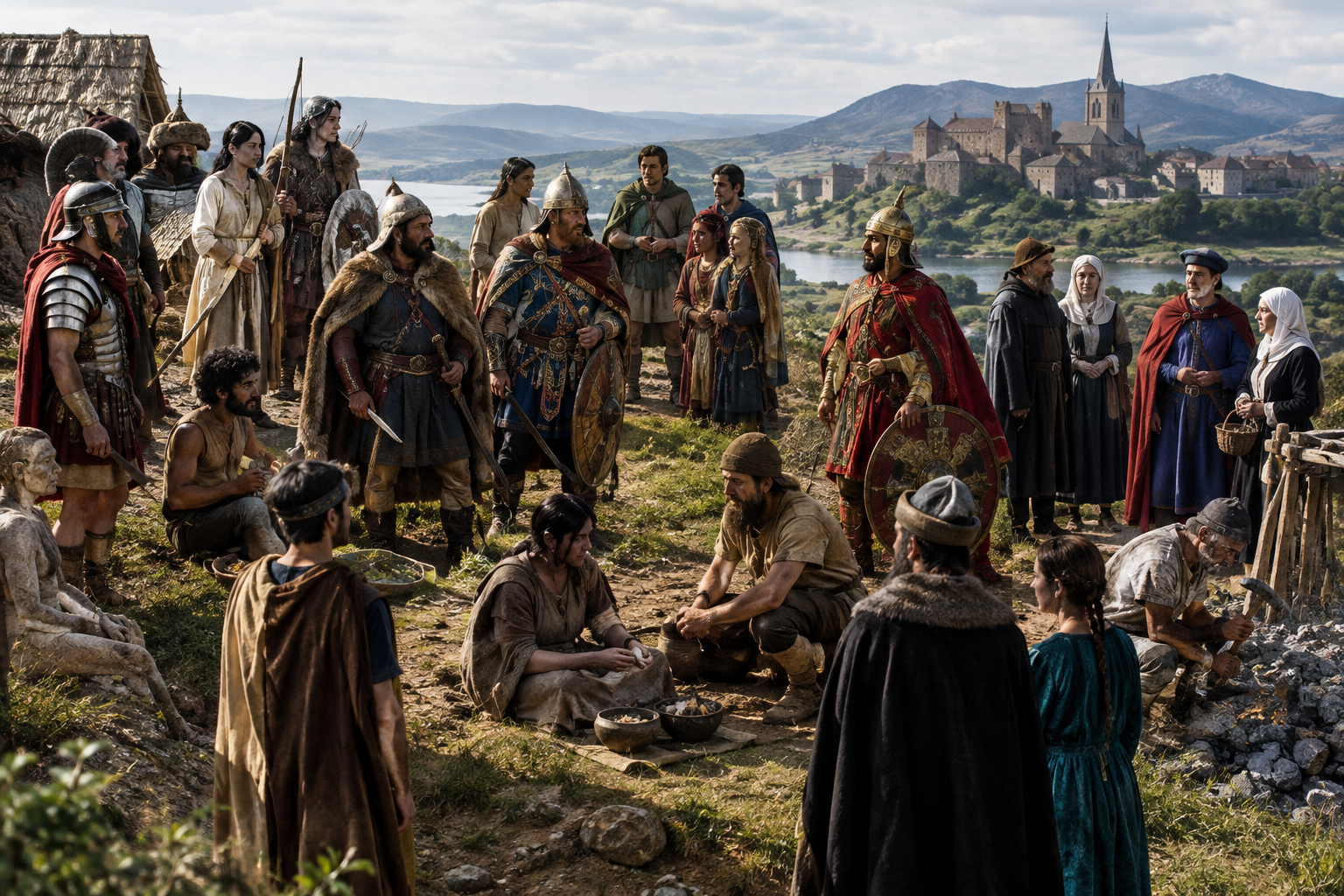
At Collegno, just outside Turin, a cluster of sixth-century burials has become one of the most vivid windows onto the Lombard world in post-Roman Italy. Among the men buried there are several individuals reported within the broad Y-DNA haplogroup R1b1, including COL_143, COL_143b, COL_143x, COL_128, COL_098, and COL_050, all dated to around AD 580. That matters because this is not a lone appearance in an isolated grave: it is a repeated paternal signal turning up in a historically charged setting, at precisely the moment when Italy was being reshaped after the collapse of Roman rule.
R1b1 is a broad paternal branch rather than a neat ethnic badge. Y-DNA follows one direct male line only, so it does not tell us everything about a person's ancestry, language, or identity. But when a lineage like R1b1 appears in samples spread across very different places and periods, it gives us something better than a slogan: a way of tracing how one paternal thread moved through the real social worlds of prehistoric farmers, steppe herders, Roman provincials, migration-period elites, and later medieval townspeople.
The Collegno cemetery has become famous because it captures a society in motion. These were communities living in northern Italy after the Lombard entry into the peninsula, in a landscape where Roman institutions had not vanished so much as fractured and reassembled. The repeated appearance of R1b1-associated males there suggests that this paternal branch formed part of the male population embedded in that changing frontier between late antiquity and the early Middle Ages.
What makes Collegno especially useful is that it is not just "a Lombard site" in the old textbook sense. Archaeology and ancient DNA both point to mixed communities, with people of different backgrounds living together under new political conditions. An ancient DNA study of these burials, published in Nature, helped establish just how varied migration-period cemeteries could be. In that context, R1b1 is not a badge of Lombardness; it is one paternal line present within a mobile, stratified, and entangled society.
The Collegno cluster also warns against a common mistake. Because several men at one site fall under the same broad Y-DNA heading, it is tempting to imagine a single ruling family or a tidy father-to-son sequence. The evidence here is not strong enough for that leap. What it does show is that the R1b1 branch belonged comfortably within the male landscape of early medieval northern Italy, where military identity, household structure, and migration history did not always align.
If Collegno shows R1b1 in a migration-period cemetery, other samples remind us that the branch sits inside a much deeper and more complicated prehistoric story. One striking early appearance is I0410 from Els Trocs in Spain, dated to about 5066 BC. That pushes the conversation back into the Neolithic world of early farming communities in the Pyrenees, long before Celts, Romans, or Germanic kingdoms entered the picture.
Another early sample, Urzi12 from Urziceni in Romania, dated to about 4000 BC, places the lineage within the Copper Age of the lower Danube region. Then there is ERG007, from Ergeninskiy in Russia and dated to about 2500 BC, in a kurgan context belonging to the broad world of Bronze Age steppe societies. These are not mere dots on a map. Together they show that the paternal umbrella containing R1b1 was already present in very different ecological and cultural zones: farming settlements in Iberia, Chalcolithic communities near the Balkans, and burial landscapes of the Eurasian steppe.
That is exactly why one should be cautious with simple origin stories. A branch this broad cannot be reduced to "the farmers" or "the steppe people" or "the western Europeans." The evidence instead suggests long-term circulation across zones that would later become central to European prehistory.
By the Roman period, R1b1-associated samples appear in contexts that are less about prehistory and more about empire. DUX009, from Duxford in Cambridgeshire and dated to around AD 200, places the lineage in Roman Britain. Across the empire's northern and central zones, similar appearances in later centuries turn up in places where the political map was under strain: FVD002 and FVD005 at Fonyod in Pannonia around AD 440, and TGH028 in Hungary around AD 450, described as a Hun-period invader.
These contexts matter because they were not static provincial backwaters. Pannonia, the Danube-Tisza region, and Roman Britain were all places where soldiers, settlers, locals, and newcomers mixed in different proportions over centuries. A genetic study examining Roman and early medieval Britain, published in Molecular Biology and Evolution, has underlined just how varied those populations could be. In that wider setting, R1b1 looks less like a marker of one people and more like a recurring paternal line moving through imperial and post-imperial networks.
The sample I3866 from post-Roman Barcelona, dated to around AD 650, makes the same point from the western Mediterranean side. Iberia after Rome was a place of political succession rather than a clean demographic break. A lineage found there, and also in Britain, Pannonia, and northern Italy, belongs to a Europe of overlapping continuities rather than tidy replacement.
Several Bronze Age samples add another layer. I3484 from Castillejo del Bonete in Iberia, dated to about 2124 BC, and I0257 from Cerdanyola near Barcelona, dated to about 2489 BC, show the branch in prehistoric Iberian settings well before the Roman conquest. I3743, from Seulo in Bronze Age Sardinia and dated to about 2041 BC, brings the lineage into a Nuragic island community, which is historically interesting because Sardinia often preserves local patterns while still participating in wider Mediterranean exchange.
This spread across Iberia and Sardinia is useful precisely because it resists easy storytelling. Islands are not museums, and peninsulas are not sealed containers. Bronze Age maritime contacts, local continuity, and later historical overlays all complicate the picture. The point is not that one R1b1 line "founded" these regions, but that this paternal branch was already embedded in several western Mediterranean populations long before classical historians began naming them.
The later samples are quieter, but in some ways more revealing. In medieval Belgium, ST2073 from Sint-Truiden Groenmarkt around AD 1050 and several ninth- to tenth-century individuals from Onze-Lieve-Vrouwekerk - ST1307, ST1078, ST1241, and ST0415 - show R1b1-associated paternal ancestry in an urbanizing Low Countries setting. This is no longer the world of kurgans or migration-period warbands. It is the world of churches, markets, and local communities taking shape in medieval Europe.
Then, much later, Sk6990 from the Sala Silver Mine in Sweden, dated to around AD 1610, reminds us that the same broad paternal lineage also sits among early modern workers in one of northern Europe's great mining landscapes. By this point, of course, we are very far from any single origin story. What remains is continuity of a paternal branch through radically different kinds of society.
The most distinctive thing about R1b1 in this sample set is not a single homeland or one famous people. It is the branch's repeated appearance in moments of transition: early farming in Iberia, Copper and Bronze Age mobility in eastern Europe and the steppe, post-Roman resettlement in Italy, frontier life in Roman and migration-period provinces, and the growth of medieval towns. For someone researching this paternal line, that is the useful historical lesson. Your Y-DNA may belong to a lineage that appears again and again where communities were mixing, moving, and reorganising themselves - not at the edge of history, but right in the middle of it.






Comments