Haplogroup R1a1a1b2h
– 4 min read


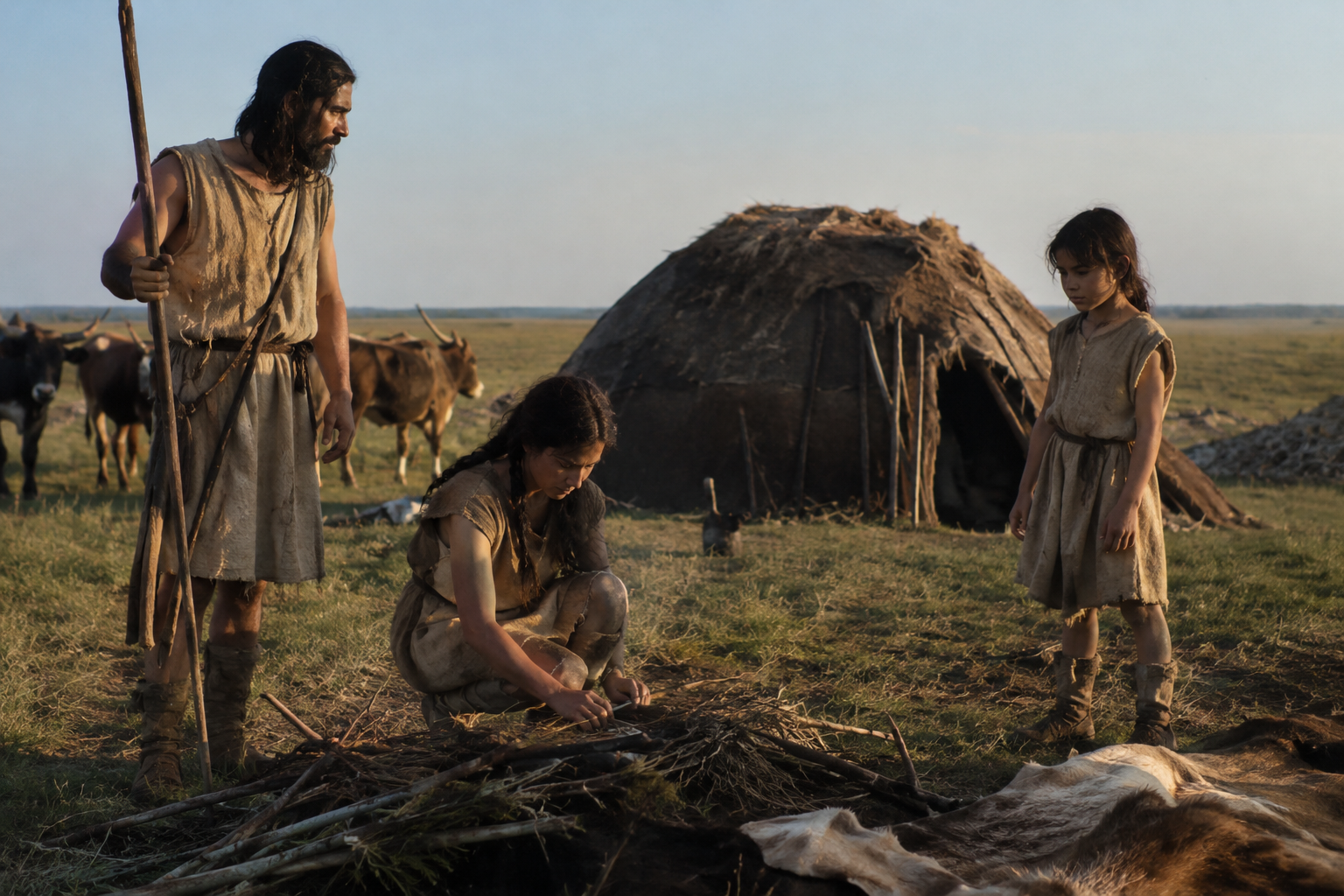
At first glance, kzb002 is just a code attached to a man who lived around 1725 BC in the Trans-Volga forest-steppe. But that setting is exactly what makes him interesting. This was a frontier zone: not a tidy political state, not a single "people" in the modern sense, but a broad meeting ground between steppe herders, river corridors, wooded landscapes, and the mobile communities of the Bronze Age.
The Y-DNA line linked here to R1a1a1b2h belongs to that world. In practical terms, Y-DNA traces one direct paternal line only - father to son to son - so it is not a complete picture of ancestry. Even so, when a lineage turns up in an ancient individual from the Corded Ware horizon of the Trans-Volga region, it places that paternal branch inside one of the great archaeological stories of Bronze Age Eurasia: the spread and reshaping of steppe-derived ancestry across enormous distances.
The label attached to kzb002 identifies him as Trans-Volga Forest Steppes CWC, with "CWC" referring to the Corded Ware cultural horizon. That matters because Corded Ware was not a tiny local culture. It was a vast archaeological phenomenon stretching across much of northern and central Europe, with regional variants and local histories rather than one single uniform population.
In the Trans-Volga setting, the Corded Ware label signals something especially important: this is not western Europe, where Corded Ware is often discussed in relation to the Baltic, Germany, or Poland. This is much farther east, close to the steppe-forest interface, where the paternal lineages associated with wider R1a expansions are highly relevant to the formation of later Bronze Age populations.
A major ancient DNA study of Bronze Age Eurasia, published in Science Advances, helped establish just how entangled these eastern and central zones were. The big lesson from that work is not that one haplogroup equals one tribe, but that the Bronze Age steppe and forest-steppe were full of movement, mixture, and demographic change.
Corded Ware and Bell Beaker burials
The awkward-looking name R1a1a1b2h is a very specific twig on a much larger paternal tree. The important historical caution is simple: the deeper parent branch R1a has a wide prehistoric and historic spread, but that does not mean every narrow descendant branch shares the same exact route, date, or social identity. One should not lazily pour the whole history of R1a into this one terminal label.
Still, the broader context is clear enough. Branches within R1a are strongly associated with many Bronze Age and later populations across the Eurasian steppe, forest-steppe, and parts of central and eastern Europe. A Corded Ware-associated man in the Trans-Volga zone therefore fits a well-known archaeological pattern: paternal lines tied to populations shaped by steppe-related expansions were present across a very wide belt of territory by the early second millennium BC.
That does not make kzb002 a spokesperson for every Corded Ware community, nor does it assign him a language, ethnicity, or political label. Archaeology and genetics are useful precisely when they are kept separate long enough to be compared properly. The value of kzb002 lies in showing that this paternal branch belongs in the eastern Bronze Age conversation, not only in later or more westerly histories.
The forest-steppe can sound like background scenery, but in Eurasian prehistory it is really one of the main stages. It was a contact zone where herding, hunting, travel, exchange, and seasonal movement all had room to operate. Populations here were not isolated museum pieces. They sat in landscapes through which people, animals, ideas, and lineages moved.
That is one reason Corded Ware-related evidence from regions east of the Volga is so valuable. It helps correct an older habit of telling the Bronze Age story as if innovation flowed neatly from one core to one periphery. In reality, eastern regions were not passive margins. They were deeply involved in the processes that shaped later Eurasian populations.
For someone carrying R1a1a1b2h today, this matters because it places a paternal ancestor-line in a zone of interaction rather than in a sealed ethnic box. The ancient evidence points to mobility and regional connectedness. That is often more historically truthful - and more interesting - than trying to pin a modern identity label onto a Bronze Age man.
When people hear "Corded Ware", they often picture central or northern Europe first. But the archaeological horizon was broad, and its eastern expressions are crucial for understanding how steppe-derived ancestry spread and changed. A Trans-Volga individual associated with that horizon is a reminder that the Corded Ware world was never purely western.
This also bears on the long argument over language dispersals. Ancient DNA has not "solved" every linguistic question, and it certainly does not allow us to hear what kzb002 spoke. But the distribution of steppe-related ancestry and R1a-rich paternal lines across Bronze Age Europe and its eastern neighbours has become central to debates about the spread of Indo-European languages. The genetic evidence does not provide a neat dictionary; it does, however, show that the demographic scale of these movements was real.
Ancient genomics and language spread
One ancient sample is never the whole story. Yet single individuals can matter enormously when they are well placed in time and geography. kzb002 sits at a useful intersection: early enough to belong to the Bronze Age reworking of Eurasia, eastern enough to illuminate the forest-steppe corridor, and genetically relevant to a paternal branch that later becomes widely distributed.
That is the real force of the evidence. Not romance, not dynastic fantasy, not a straight line from one grave to a named medieval house - but a documented place for this lineage in a prehistoric world that was already astonishingly connected. The man behind the code kzb002 is valuable because he anchors R1a1a1b2h in an archaeological landscape where movement was normal and where paternal lines like this one were part of much larger population shifts.
How archaeogenetics reads the past
If your paternal line falls under R1a1a1b2h, the strongest point here is not a claim to a famous dynasty or a single named tribe. It is that this lineage has credible roots in the Bronze Age world of the eastern European forest-steppe, where Corded Ware-linked communities formed part of a vast network of migration and mixture. kzb002 gives that history a human foothold: one man, one place, one date range, and a glimpse of how your direct paternal line fits into the making of Eurasia.



Comments