Haplogroup R1a1a1b2a2b2b1

– 5 min read


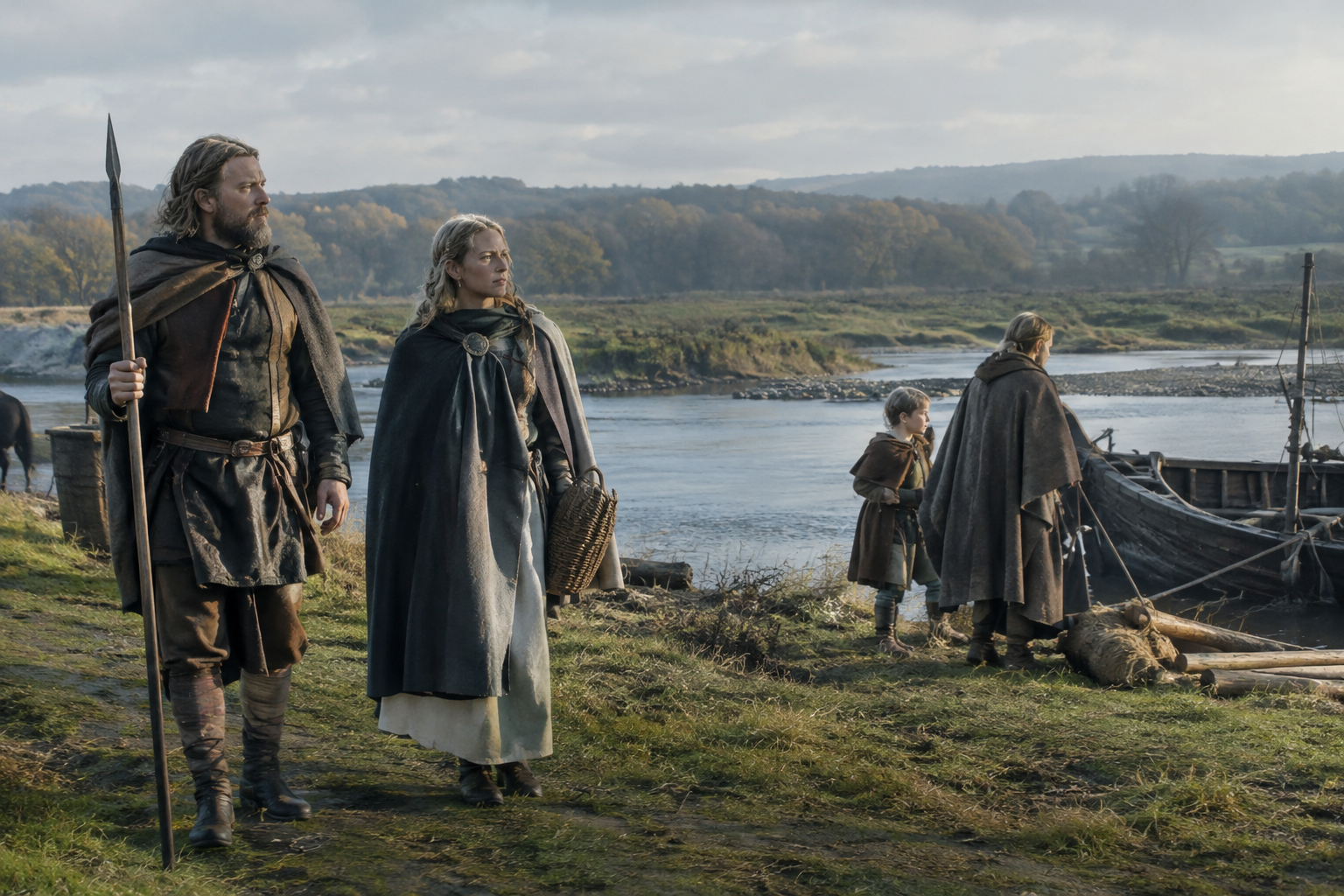
In Saxony-Anhalt, at Bruecken in Migration Period Germany, one ancient male identified as BRC046x and dated to around AD 500 offers a small but telling glimpse into a much larger historical upheaval. This was the age when the old Roman order had fractured, power was being renegotiated across central Europe, and communities in regions east of the Rhine were living through the slow making of the early medieval world.
The Y-DNA line associated here with R1a1a1b2a2b2b1 is especially interesting because it turns up not in some distant steppe setting, but in an early medieval burial from the German heartland. That matters. Y-DNA tracks one direct paternal line only, not a person's whole ancestry, but even a single well-placed sample can show where a branch had reached, and in what sort of historical landscape it was present.
AD 500 is one of those dates that looks neat on paper and is anything but neat on the ground. In central Germany, this was a period of political fragmentation, shifting loyalties, and mobile populations. Regions like Saxony-Anhalt sat within a broad contact zone linking the Elbe, the former Roman frontier, and the routes running east toward the forest-steppe and the Baltic lands.
That makes BRC046x valuable precisely because the sample comes from this turbulent interval. A paternal lineage classified here as R1a1a1b2a2b2b1, or at least reported in association with that branch, places one strand of the wider R1a story inside a Migration Period community in Germany. It is a useful reminder that by the early medieval period, branches of R1a were not confined to one people, one language, or one political identity.
An ancient DNA project connected with these burials is archived at https://www.ebi.ac.uk/ena/browser/view/PRJEB81250. Even without over-claiming details beyond the sample information at hand, the context is enough to place this lineage in a real archaeological setting rather than in the abstract world of modern haplogroup maps.
Germanic languages and genomics
The longer the haplogroup label, the narrower the branch. R1a1a1b2a2b2b1 is therefore not the same thing as the whole of R1a, and it should not be used as shorthand for every ancient movement ever associated with that wider paternal family. The broad parent lineage R1a has a deep and complicated history across Eurasia, but a specific downstream branch must be handled more carefully.
That distinction matters because readers often meet R1a in sweeping narratives about steppe expansions, Indo-European languages, or eastern European population history. Those are big frameworks, sometimes useful, sometimes overused. What this Bruecken sample actually gives us is something more concrete: evidence that a man connected with this narrower paternal line was living in central Germany during the Migration Period.
And that is already historically rich. By this date, central Europe had centuries of prior population mixing behind it: Iron Age communities, Roman frontier interactions, military recruitment, marriage exchange, and population mobility under the pressure of late antique change. A branch like this could have arrived through any number of older demographic processes long before the individual in question was buried.
Modern readers sometimes imagine early medieval central Europe as if every burial ground belonged neatly to a single named people. Archaeology and genetics have steadily made that picture harder to sustain. Burial communities in the centuries around the fall of the Western Roman Empire could be culturally coherent in some ways and biologically diverse in others.
That is why a sample like BRC046x should not be forced into a simplistic label. A Y-chromosome lineage cannot by itself tell us whether this man spoke an early Germanic dialect, identified with a local polity, had paternal forebears from farther east, or belonged to a family long established in the region. What it does show is that this paternal line had become part of the human landscape of Migration Period Germany.
In that sense, the result fits a broader picture emerging from recent archaeogenetics: frontier and post-frontier Europe was full of blended communities. The great interest of these cemeteries lies not in proving a single origin myth, but in showing how people actually lived after centuries of contact and movement.
Roman-barbarian frontier blending
It is worth pausing over the location. Saxony-Anhalt can easily be treated as a middle zone between better-known historical centers, but in late antiquity and the early Middle Ages that "middle" position was the point. The region lay within networks connecting central German river systems, the northern European plain, and the routes leading toward the Slavic-speaking east.
For a branch like R1a1a1b2a2b2b1, this is exactly the sort of setting where one might expect a long and layered history rather than a single dramatic arrival. Central Europe in the fifth and sixth centuries was not a blank map onto which tribes marched in colored arrows. It was a lived landscape of villages, cemeteries, old Roman connections, new power centers, and families carrying lineages that may have been local for generations before they were ever sampled by modern science.
That broader regional complexity also helps explain why one ancient Y-line can matter disproportionately. When evidence is sparse, each securely placed individual becomes a fixed point. BRC046x tells us that this branch, or a very close reported paternal assignment to it, had a foothold in central Germany by around AD 500.
Single samples do not found dynasties on their own, but they do anchor historical possibility. In practical terms, this burial helps place the branch in an early medieval European setting tied to one of the key transition periods in western history: the centuries when Roman provinces gave way to successor societies and local identities hardened, shifted, or merged.
That has implications for how descendants interpret their own paternal ancestry. If you belong to R1a1a1b2a2b2b1, a sample like this does not prove descent from a particular named people or medieval house. What it does offer is a documented example of your branch, or a closely associated reported branch, present in a Migration Period context in Germany. That is far more useful than a vague claim about "ancient warriors" or "tribal origins."
It also sits comfortably beside a wider pattern seen in early medieval Europe, where paternal lines often cut across the tidy ethnic categories found in later chronicles. Genetics keeps pushing us back toward the messier truth: historical populations were built from many threads, and lineages travelled through family history more quietly than legend usually allows.
Diverse early medieval origins
The most distinctive thing about R1a1a1b2a2b2b1 here is not some grand claim of exclusivity, but its appearance in a clearly historical setting: BRC046x, at Bruecken in Saxony-Anhalt, around AD 500. That places this paternal line within the social world of Migration Period central Europe, where communities were neither isolated nor uniform, and where ancestry, culture, and politics rarely lined up neatly. For anyone researching this haplogroup today, that is the real value of the evidence: it grounds a paternal branch in the archaeology of a changing Europe.

Comments