Haplogroup R1a1a1b2a2a3a1
– 5 min read


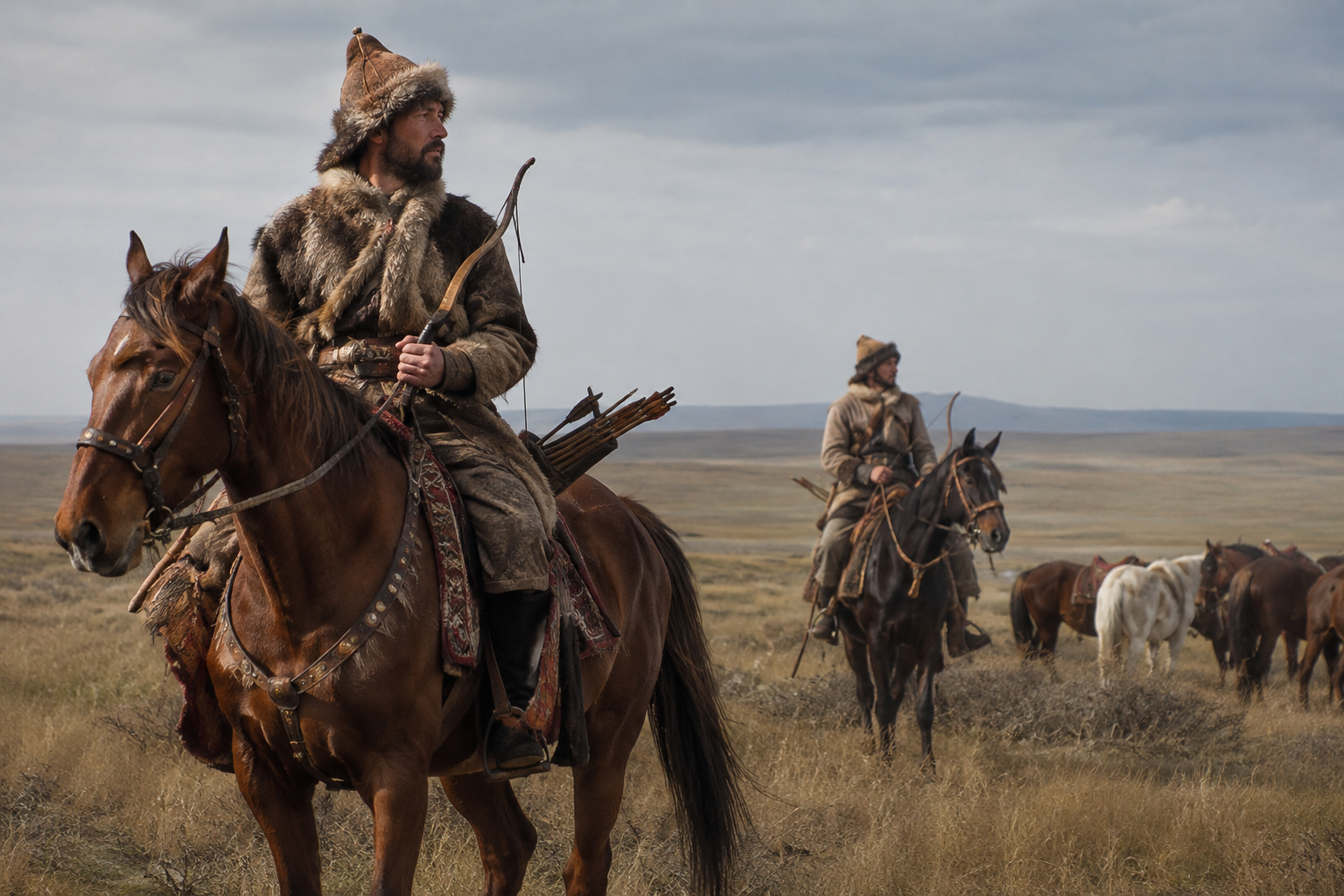
Around AD 220, somewhere in the Sarmatian steppe world, an individual recorded as tem002 carried a paternal line placed here under R1a1a1b2a2a3a1. That may look forbiddingly technical, but the setting is immediately recognisable: the grassland corridor north of the Black and Caspian seas, where mounted societies linked eastern Europe, the Caucasus, Central Asia, and the Roman frontier. When a Y-chromosome branch turns up in that landscape, it matters not because one grave can explain a whole people, but because the steppe was one of history's great engines of movement.
The fascination of tem002 is precisely that mixture of specificity and restraint. We have a date in the Roman imperial period, a Sarmatian attribution, and a direct paternal lineage. What we do not have is a licence to turn one man into the emblem of every Sarmatian, still less to claim a neat straight line from him to any later nation. Y-DNA traces one paternal thread only. But in the steppe, even one thread can tell us a great deal about the wider fabric.
The Sarmatians were not a single tribe frozen in time. Classical writers used the label for Iranian-speaking or Iran-associated nomadic and semi-nomadic groups who dominated large parts of the Pontic-Caspian steppe after the Scythians and before the rise of later confederations. Their history belongs to movement: horse herding, raiding, trade, alliances, and service in armies from the Black Sea to the Danube.
That is why a steppe sample like tem002 is historically richer than it may first appear. A burial from this world sits inside a zone where ancestry, language, and political identity were constantly being negotiated. The Sarmatian horizon was not isolated. It touched Greek colonies on the Black Sea, Roman military systems, Caucasian communities, and the routes running eastward into the deeper Eurasian steppe.
An ancient DNA study of this wider region, published in research on Eurasian steppe populations, helped show just how dynamic these steppe societies were across long spans of time. That matters here because a paternal lineage found in a Sarmatian context belongs to a world of repeated mixture and mobility, not to a sealed ethnic box.
The branch name R1a1a1b2a2a3a1 places tem002 within the wider R1a family, one of the major Y-chromosome lineages seen across much of Eurasia. But the wider family is not the same thing as this exact twig on the tree. It would be careless to pour the entire prehistoric history of R1a straight into this much narrower subclade.
What can safely be said is that lineages within the broader R1a world are frequently associated with steppe-connected populations in later prehistory and antiquity. In the Sarmatian case, that makes historical sense. Steppe societies often show paternal signals that fit long traditions of mobility across eastern Europe and Inner Asia, even while their overall ancestry could be mixed and locally varied.
So if you carry this haplogroup today, the most sensible reading is not "I am Sarmatian" in any simple or exclusive sense. It is that one branch of your direct paternal line belongs to a family of lineages that was present in the steppe zone in the Roman period, in a landscape famous for movement, contact, and re-formation.
There is a temptation, when only one ancient sample is named, to dismiss it as too little. Archaeologically, though, isolated finds can be extremely revealing when they come from a historically strategic zone. The Sarmatian steppe was one of those zones. It was less a border than a conveyor belt: people, animals, technologies, and military styles moved across it with remarkable speed.
That gives tem002 a kind of documentary force. He anchors this branch of the Y-chromosome tree in a recognisable historical setting around AD 220. We are not talking about an abstract map colour or a modern frequency table, but about a man who lived in the age when Rome was dealing with steppe neighbours and when the northern Black Sea world was a patchwork of frontier exchanges.
The great value of such evidence is that it joins genetics back to archaeology. A haplogroup on its own is a label; a haplogroup in a Sarmatian burial context becomes part of a historical argument about how paternal lines circulated in the steppe world.
The steppe north of the Black Sea is one of those regions where modern assumptions collapse rather quickly. It was never simply "European" or "Asian", and certainly not static. Communities there could be locally rooted and highly connected at the same time. Burial customs, material culture, and biological ancestry all show that this was a meeting ground.
That makes Sarmatian-period Y-DNA especially interesting for descendants today. A paternal line from this region might later appear, through entirely separate historical processes, among populations speaking Slavic, Iranian, Turkic, Hungarian, Germanic, or Romance languages. The steppe often worked like that: not as a single-origin story, but as a place where lineages were redistributed again and again.
MyTrueAncestry readers who are drawn to the frontier character of this world may also find it useful to compare steppe evidence with neighbouring cases from the Black Sea littoral and its migration routes. The important point is not that every later appearance of a related lineage must come from one Sarmatian man, but that the region repeatedly served as a staging ground for demographic change.
The Sarmatians are often described as successors to the Scythians, and there is some justice in that, provided we do not make it too tidy. Ancient steppe history is full of overlapping horizons rather than neat handovers. Populations changed, elite identities shifted, and outside observers often applied broad labels to quite varied groups.
Genetics has sharpened this picture by showing both continuity and mixture. Some paternal lineages recur across steppe-linked settings, while whole genomes reveal changing combinations of ancestry over time. That is exactly why a branch like R1a1a1b2a2a3a1 is historically suggestive without being historically sufficient on its own.
In other words, tem002 fits a pattern familiar from steppe archaeology: durable male lines moving through changing political and cultural worlds. The label "Sarmatian" tells us about his archaeological-historical context around AD 220. The haplogroup tells us about one paternal inheritance. The two overlap, but they are not interchangeable.
The most responsible insight from R1a1a1b2a2a3a1 is not a romantic claim of belonging to one ancient tribe. It is something more interesting: your direct paternal line sits within a lineage world that was present in the Sarmatian steppe during the Roman era, in one of Eurasia's most mobile and interconnected regions. Sample tem002 gives that fact a human setting, reminding us that behind every haplogroup code stood a real person living in a recognisable historical landscape.
Comments