Haplogroup R1a1a1b2a2a3a

– 5 min read


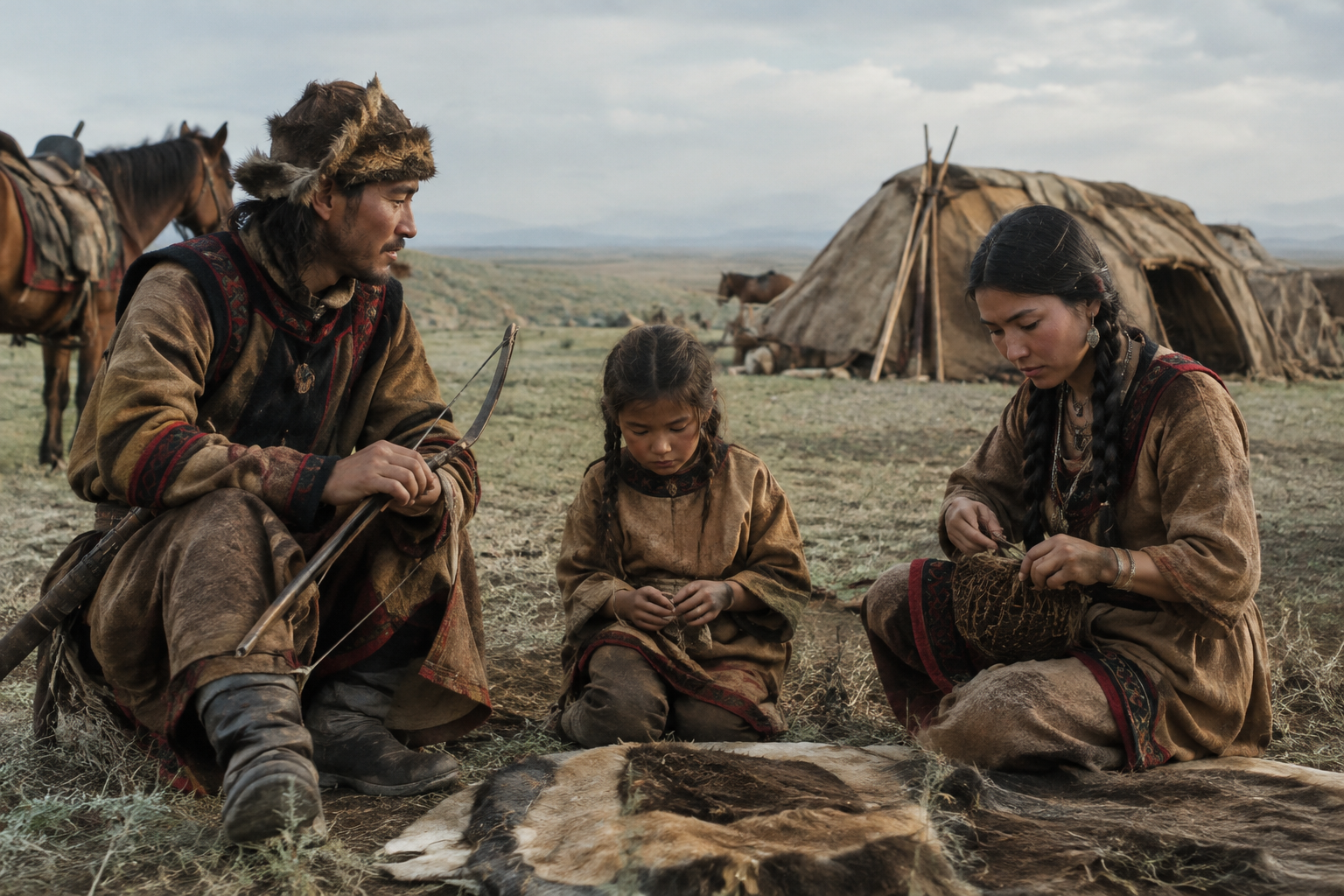
The most tangible clue for haplogroup R1a1a1b2a2a3a in this case is an ancient man identified as I3389x, dated to around 1650 BC and associated with the Andronovo-Karasuk horizon of the Late Bronze Age. Even that short description is enough to place him in one of the most debated landscapes in Eurasian prehistory: the steppe and forest-steppe world stretching across Inner Asia, where archaeologists, linguists, and geneticists have long argued over mobility, metalworking, and the spread of peoples.
That matters because R1a lineages are often discussed in very broad terms, as if every branch told exactly the same story. They do not. The branch named here, R1a1a1b2a2a3a, is a very specific paternal line within the wider R1a family, and this sample gives it a concrete archaeological foothold in a Bronze Age setting linked to major movements across the Eurasian steppe. Y-DNA traces one direct male line only, but when an ancient individual can be placed in a recognisable cultural world, that single line becomes historically vivid.
The label "Andronovo Karasuk Late Bronze Age" deserves a little unpacking. Archaeologists use Andronovo for a broad complex of Bronze Age steppe societies spread across parts of Kazakhstan, southern Siberia, and neighbouring regions during the second millennium BC. Karasuk usually refers to a later Bronze Age horizon in southern Siberia and adjacent areas. When a sample is described with both names together, it points to a transitional or overlapping archaeological context rather than a neat ethnic badge.
That is worth stressing, because culture names are not the same thing as biological descent, language, or political identity. Still, they are extremely useful. They tell us that I3389x belonged to a world of pastoral economies, metal production, and large regional networks linking the western steppe, the Altai, and zones farther south and east. In that setting, a branch such as R1a1a1b2a2a3a is not just an abstract code. It is part of the paternal landscape of Bronze Age Inner Eurasia.
A broad genetic resource associated with ancient Eurasian individuals, including steppe material of this sort, is available through this research data collection. Even without over-claiming details that are not explicitly given here, the placement of I3389x in that Late Bronze Age steppe sphere is the key historical fact.
The wider R1a family is strongly associated in ancient DNA research with Bronze Age and later populations across much of Eurasia, especially in steppe-derived contexts. But that larger picture can easily become misleading if we flatten it. The important point is not that every man carrying R1a belonged to one people or spoke one language. It is that certain steppe environments repeatedly turn up paternal lines from the R1a family, and I3389x belongs squarely in one of those environments.
For readers researching their own paternal ancestry, this is where the evidence becomes both exciting and restrained. A match to R1a1a1b2a2a3a does not mean descent from the Andronovo culture as a whole, still less from one named tribe in later texts. What it does suggest is that your direct male line belongs to a branch with at least one documented presence in the Bronze Age societies of the Inner Eurasian steppe.
That is historically significant because the Late Bronze Age steppe was not a remote backwater. It was a zone of movement and exchange, where technologies, herding systems, and probably languages circulated across extraordinary distances. Paternal lines found there can later appear in very different historical settings, but their archaeological visibility begins with burials like this one.
There is always a temptation to turn steppe ancestry into a simple migration arrow on a map. Real history is messier. By around 1650 BC, steppe-derived populations had already been interacting for centuries with communities to the west, south, and east. Some groups moved long distances; others stayed local while ideas and marriage networks passed through them. A single Y-chromosome lineage cannot by itself distinguish those possibilities.
That said, the Andronovo-related world is one of the major archaeological theatres for discussing how steppe populations expanded and diversified after the earlier Bronze Age. The importance of I3389x lies precisely in being anchored in that later phase. He is not an abstract "Proto-Indo-European" symbol, nor proof of a one-way migration, but a documented male line from the period when steppe societies were well established across a huge zone of northern and central Eurasia.
This wider eastern setting also matters because Bronze Age steppe populations did not stop at the Urals in historical importance. Their contacts stretched toward regions that would later become central to the story of the Altai, the Tianshan corridors, and the frontier between western and eastern Eurasian worlds. In other words, the placement of R1a1a1b2a2a3a here belongs to a frontier of interaction, not to a sealed ethnic box.
With only one listed ancient individual, it would be irresponsible to pretend that we can map the full history of R1a1a1b2a2a3a from this evidence alone. We cannot say that the branch originated at this site, dominated the whole Andronovo sphere, or passed unbroken into any later kingdom or noble house. No such evidence has been supplied here, and serious archaeogenetics is careful about that.
But one well-placed sample can still do real historical work. It shows that this paternal branch had reached, or was present within, a Late Bronze Age population associated with the Andronovo-Karasuk world. That ties the haplogroup to a period of major regional transformations: bronze metallurgy, pastoral adaptation, and the long-distance social links that made the Eurasian steppe such an engine of change.
For a broader look at how ancient genomics is being used to track language spread and steppe-linked population history in later Europe, one useful companion piece is the MyTrueAncestry post on Germanic-language dispersals. It is not about this exact branch, but it shows the sort of larger historical questions that ancient Y-DNA can help illuminate when combined with archaeology.
One of the enduring lessons of ancient DNA is that Inner Eurasia was never merely a corridor between "civilisations." It was a historical world in its own right, with its own settlements, cemeteries, livestock economies, and technological traditions. Haplogroup R1a appears in that world often enough to be important, but each sub-branch needs its own evidence. R1a1a1b2a2a3a enters the picture here not as a vague continental label, but through a specific Late Bronze Age man, I3389x.
That is a modest conclusion, but a useful one. If this is your paternal haplogroup, the evidence presently highlighted here points toward a direct male-line connection with the kind of Bronze Age steppe populations that helped shape the human landscape of northern and central Eurasia. It is not a claim to a throne, a tribe, or a single language. It is something better grounded than that: a documented place for your line in the archaeology of the Late Bronze Age steppe.
Comments