Haplogroup R1a1a1b2

– 5 min read


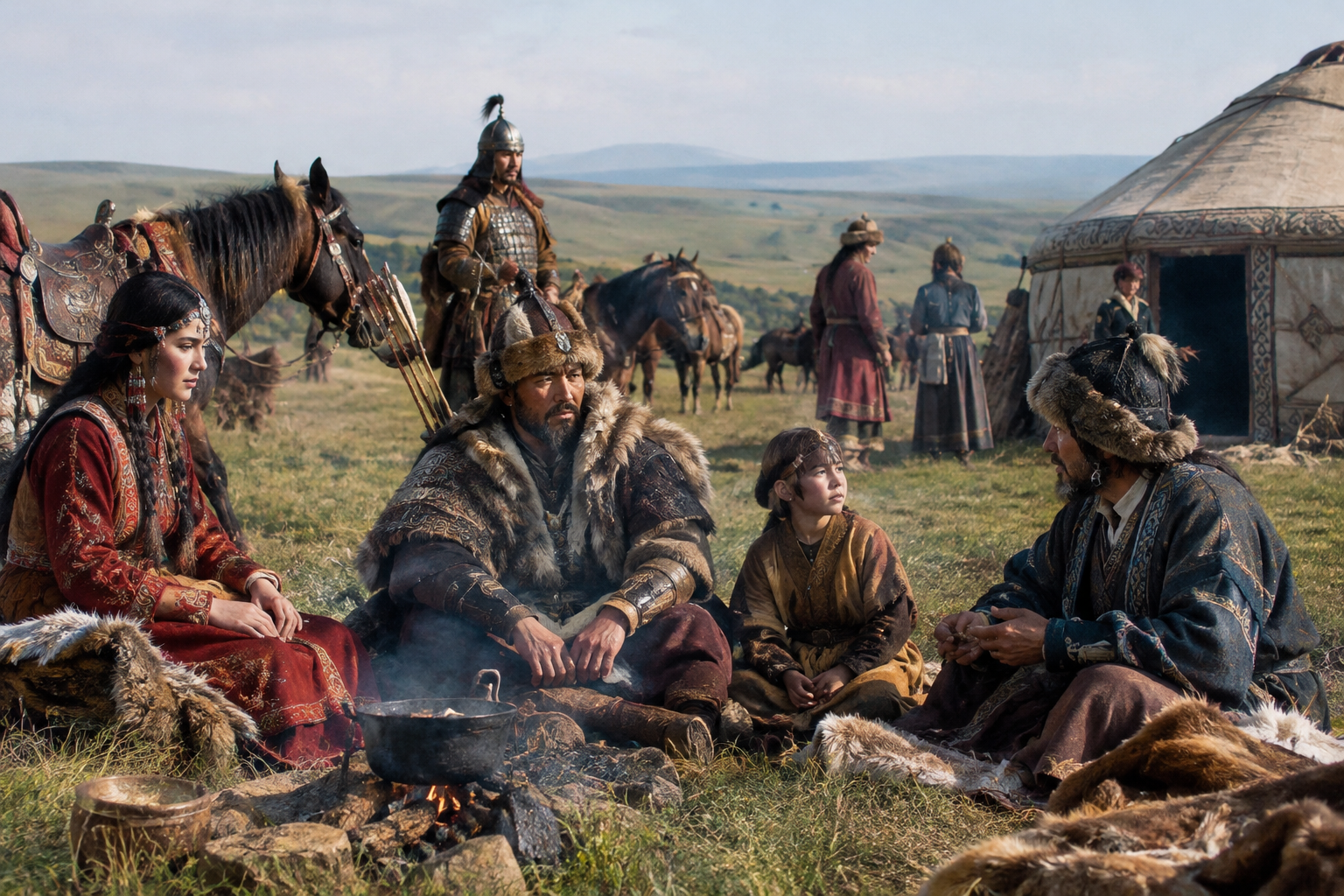
One of the clearest signposts for haplogroup R1a1a1b2 appears far out on the Eurasian steppe, in an elite Saka context at Koktubek in eastern Kazakhstan. The individual KOT003, dated to around 650 BC, belongs to a world of mounted mobility, long-distance exchange, and sharply regional forms of Iron Age prestige. He is not alone. In this branch, the ancient evidence stretches from Bronze Age forests near Moscow to Scythian and Sarmatian burials around the Black Sea and onward into Central and South Asia.
That spread matters because Y-DNA follows one direct paternal line only, not a person's whole ancestry. Even so, a lineage that keeps turning up in Fatyanovo, Srubnaya, Andronovo, Saka, Scythian, and later medieval contexts is telling us something important: R1a1a1b2 sits inside a much wider R1a story, but this particular branch is especially visible in the archaeological corridor linking the eastern European forest-steppe to the Inner Asian steppe.
The oldest samples here are not from famous nomad barrows at all. They come from the Early Bronze Age Fatyanovo horizon in western Russia: HAN002 and HAN004 from Khanevo near Moscow, HAL001 from Khaldeevo in Yaroslavl, and NAU001 and NAU002 from Naumovskoye, dated around 2700-2600 BC. These are important because Fatyanovo belongs to the eastern reaches of the Corded Ware world, where steppe-derived ancestry moved deep into the forest zone.
In other words, the paternal history behind this branch was already established long before the classical age of Scythians and Saka. The Fatyanovo evidence suggests that lineages associated with R1a1a1b2 were present among communities combining steppe ancestry with new local settlement patterns in northeastern Europe. A genetic study of Bronze and Iron Age populations in this broader region helped establish just how consequential these eastward and northward movements were for later Eurasian population history: https://www.science.org/doi/10.1126/science.aar7711.
There is another early northern signal too: RISE189 from Bronze Age Snorthog in Sweden, dated to around 2100 BC. A single Swedish sample should not be exaggerated into a map of mass migration, but it does show that this paternal branch, or at least its reported association, was not confined to one steppe pocket. By the early second millennium BC, related paternal lines were present in both the forest belt of Russia and Scandinavia.
By the Late Bronze Age, the evidence becomes more recognisably steppe-shaped. The sample I0423 from Srubnaya Barinovka in Samara, dated around 1525 BC, sits in a region central to the long history of pastoral societies north of the Caspian. Nearby in time and space are mur003 from the Trans-Volga forest-steppe at Muradym, dated around 1820 BC, and I2163, labelled as a Pontic-Caspian steppe invader, around 1700 BC.
Then come the Andronovo-related samples I11537 and I6047, both around 1300 BC. Here we are in the great belt of Bronze Age societies that linked the western steppe, the Urals, Kazakhstan, and routes toward Central Asia. This is the period when paternal lineages associated with R1a become especially difficult to separate from the wider history of mobility, metallurgy, animal husbandry, and expanding contact zones across the interior of Eurasia.
What makes R1a1a1b2 so interesting in this context is not just age, but recurrence. It keeps resurfacing in places that were not identical cultures, yet shared open connections across the steppe. That pattern fits the archaeology rather well: not a single tribe marching from A to B, but generations of related male lines moving through overlapping Bronze Age networks.
The most striking cluster for this haplogroup belongs to the Iron Age steppe. KOT003 from elite Saka Koktubek in eastern Kazakhstan is one example. TAL003, from a high-ranking Saka-Scythian grave at Taldy and also dated around 650 BC, strengthens the impression that this branch had a real presence among steppe elites in central Kazakhstan. KSH001 and KSH003 from Karashoky I, assigned to the Tasmolinskaya horizon and dated around 600 BC, add more local depth rather than a single glamorous outlier.
This is where archaeology helps keep us honest. "Saka" and "Scythian" are broad historical labels covering multiple groups across vast territory. The Y-DNA evidence does not mean every Saka or Scythian man carried this lineage. But the repeated appearance of R1a1a1b2 in high-status and regional Iron Age steppe contexts does suggest that some paternal lines within this branch were well established among the eastern Iranian-speaking nomadic worlds of the first millennium BC.
The western steppe tells a related, though not identical, story. UKR095 from the Scythian forest-steppe near Kharkiv in Ukraine, dated around 389 BC, and MJ34 from the western Scythian Black Sea zone, around 290 BC, show this branch on the other side of the steppe arc. So does BSB001, a Sarmatian burial from Bisoba mound 3, around 450 BC. A recent ancient DNA study focusing on mobility in Ukraine and the North Pontic zone is especially relevant for understanding how these regions worked as meeting grounds rather than fixed ethnic blocks: https://www.researchgate.net/publication/380994383_North_Pontic_crossroads_Mobility_in_Ukraine_from_the_Bronze_Age_to_the_early_modern_period.
It is worth pausing here. The evidence does not point to a neat east-versus-west split. Instead, R1a1a1b2 appears in both Kazakhstan and the North Pontic region, exactly where archaeology already sees mobile confederations, trade routes, and shifting political worlds.
This haplogroup also turns up beyond the classic steppe heartland. DA382, dated around 800 BC and labelled "Median Dynasty" from Turkmenistan, places the branch in an Iranian-connected setting south of the steppe proper. I6893 from Saidu Sharif Buddhist Monastery, around 400 BC, and later medieval samples I2959 and I2960 from a Ghaznavid mosque, around AD 1120, show the same paternal thread persisting in regions shaped by Iranian, Central Asian, and South Asian interactions.
ALN002 from the Alai Nura burial, around AD 300, and I6946 from Skeleton Lake, around AD 830, add to that broad southern and eastern footprint. These are not all the same society, religion, or language community, and it would be quite wrong to flatten them into one people. But taken together, they show that the paternal branch associated with R1a1a1b2 was still circulating along the routes that connected steppe herders, oasis settlements, mountain corridors, and medieval states.
For anyone with this haplogroup today, that is perhaps the most revealing point. The branch does not belong to one modern nation or one ancient empire. Its ancient appearances suggest a long history in the interaction zone between eastern Europe, the Eurasian steppe, and Central Asia.
One later sample, GHD003 from post-Roman Pannonia at Arrabona-Gyirmot in Barbaricum Hungary, dated around AD 550, is especially suggestive. By then the old Roman frontiers had become busy contact zones full of newcomers, local survivors, and mixed communities. A paternal branch with earlier roots in the steppe showing up in that world is hardly surprising; in fact, it fits the historical moment rather well.
UKR123, from Iron Age to Chernyakhiv-period Poltava and dated around AD 229, provides another useful reminder that the northern Black Sea and adjacent forest-steppe were repeatedly reworked by new political constellations. These were the centuries when Goths, Sarmatian groups, local agricultural populations, and later Hunnic-era powers all touched the same landscapes. A lineage like R1a1a1b2 could persist through such changes without belonging exclusively to any one named people.
The ancient trail of R1a1a1b2 is not a tidy family tree leading to one throne, one tribe, or one heroic migration. It is more interesting than that. The best evidence places this paternal line repeatedly in the great corridor from Bronze Age Fatyanovo and Volga-steppe populations to Iron Age Saka, Scythian, and Sarmatian worlds, with later survivals in Central and South Asia and on the post-Roman frontier. If this is your haplogroup, the strongest supported picture is of a paternal ancestry tied, over many centuries, to the broad steppe and forest-steppe networks that connected Europe and Asia.

Comments