Haplogroup R1a1a1b1a3a1b3e5

– 5 min read


One of the awkward truths of Y-DNA is that sometimes the branch name is impressively precise while the ancient trail behind it is still frustratingly incomplete. That is the case with R1a1a1b1a3a1b3e5: a very specific paternal subclade nested inside the much larger R1a family, but here without a supplied roster of excavated ancient men securely assigned to that exact terminal branch. In other words, we are not dealing with a neat royal skeleton, a named warrior, or a single showpiece grave. We are dealing with a narrower question: what kind of past does a branch like this most plausibly belong to, and what can archaeology already say about the wider world in which such paternal lines spread?
That wider world is not a blank one. R1a in general appears again and again across the archaeology of Eurasia, especially in societies touched by Bronze Age steppe expansions and in later populations of Central, Eastern, and Northern Europe. But the exact subclade here, R1a1a1b1a3a1b3e5, should not be casually projected backwards onto every ancient R1a burial. A Y-chromosome line traces one direct paternal thread only, not a whole ancestry, language, or identity. So the sensible way to approach this branch is through the best-documented archaeological settings in which related R1a paternal histories mattered most.
If you are sitting somewhere deep inside R1a, the broadest historical backdrop usually lies in the great demographic changes that moved out of the Eurasian steppe during the 3rd millennium BC. Ancient DNA has shown that these movements were not literary legend or Victorian guesswork but measurable population events, visible in both genome-wide ancestry and Y-chromosome turnover. In many parts of Europe, paternal lines associated with steppe-derived groups became unusually prominent, especially in contexts linked to Corded Ware and related horizons.
That does not mean every later R1a branch was born in the same place or carried unchanged into every region. Quite the opposite: once a broad lineage spreads, it fragments. New subclades form, some becoming locally common, others remaining rare, and each taking on its own more recent history. A branch such as R1a1a1b1a3a1b3e5 is therefore best imagined not as a timeless label, but as a later twig on a very old tree.
How ancient DNA changed history
Some of the strongest archaeological context for R1a comes from the North Pontic region and adjoining steppe, where prehistoric and early historic mobility was intense. This is the country of herders, river corridors, burial mounds, and repeated cultural reorganisation. It is also one of the places where ancient DNA has been especially important, because material culture alone cannot tell us how much continuity or replacement stood behind those changes.
Research on the North Pontic region has shown long-term shifts in ancestry and population structure rather than a single, simple migration. That matters for a branch like R1a1a1b1a3a1b3e5 because later paternal lineages in Europe often emerge from precisely this sort of layered history: not one tribe marching cleanly westward, but centuries of movement, intermarriage, local founder effects, and political change. The branch in your results is therefore part of a story that is archaeological before it is genealogical.
That same caution applies to the old temptation to turn genetics straight into ethnicity. A man buried in a steppe-associated zone may carry R1a, but that alone does not make him "Scythian," "Sarmatian," "Slavic," or anything else named in later texts. The useful historical point is narrower and better: many of the paternal lines that later became important in Central and Eastern Europe were shaped in exactly these interaction zones between forest, steppe, and frontier settlement.
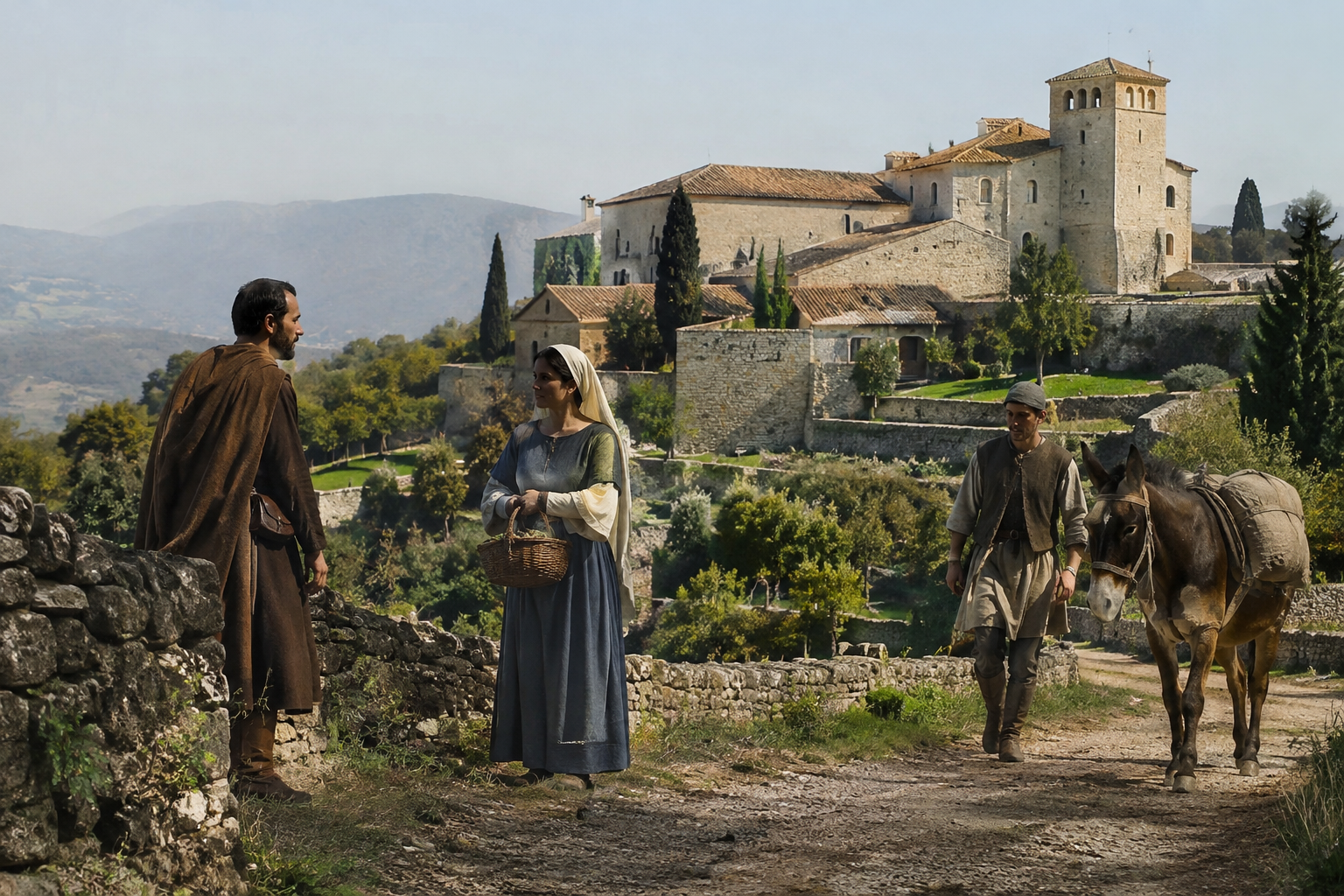
By the early medieval period, the world had changed completely from the Bronze Age, but paternal lines had not vanished with old cultures. They had been folded into new kingdoms, new speech communities, and new religious landscapes. This is one of the reasons Y-DNA can be both revealing and maddening. The chromosome may preserve a very old line of descent, while the men carrying it live in recognisably medieval settings: Christian cemeteries, frontier communities, trading towns, and post-Roman villages.
Ancient DNA studies from places such as the Rhineland and the German frontier have shown that early medieval populations were often mixed in ways older nationalist histories would not have expected. Roman, local, and incoming ancestries could coexist within the same region and sometimes within the same burial ground. For a narrow branch under R1a, that is a useful reminder that paternal descent does not map neatly onto cultural labels such as Frank, Saxon, Goth, or Slav. A direct male line can survive huge historical changes while everything around it - language, law, political allegiance, burial custom - shifts.
That is particularly relevant for anyone whose closest historical paper trail lies in medieval or early modern Europe. Your branch may feel "ethnic" because surnames and family memory tend to be local. But the paternal line itself may have been local in one region for a thousand years after arriving from somewhere quite different in prehistory.
One reason branches like R1a1a1b1a3a1b3e5 generate so much interest is that R1a as a whole is common in regions later associated with Slavic and some Baltic populations, while also appearing in areas shaped by Germanic-speaking groups. That has led, more than once, to overconfident historical claims. Genetics has not validated the idea that one haplogroup equals one people.
What it does show is that language spreads in several ways. Sometimes populations move in large numbers. Sometimes elites expand. Sometimes neighbouring groups adopt new speech without dramatic genetic replacement. That is why archaeogenomic work on the spread of Germanic languages has been so useful: it asks not whether one lineage "is Germanic," but how populations, mobility, and cultural change interacted in the first place. A subclade like R1a1a1b1a3a1b3e5 may today turn up among men with very different national identities, yet their shared paternal origin may lie much further back than those identities themselves.
For the family historian, that can be unexpectedly liberating. The lineage is real, but the modern story attached to it may be only the latest chapter.
With no securely documented ancient samples supplied here for R1a1a1b1a3a1b3e5 itself, the honest conclusion is a modest one. This branch belongs to a paternal family whose deeper roots sit within the broad R1a history of Eurasian steppe expansion and later European population formation. What makes it interesting is not a fabricated single ancestor, but the way a very narrow modern lineage preserves one thread through those much larger archaeological transformations.
If this is your haplogroup, the best next question is not "which famous dynasty did I come from?" but "where does this branch cluster, and when do its nearest matches begin to share traceable ancestry?" That is where Y-DNA is strongest: connecting your direct paternal line to real population history, one careful step at a time.
Comments