Haplogroup Q1b1a1a1i1a1b

– 5 min read


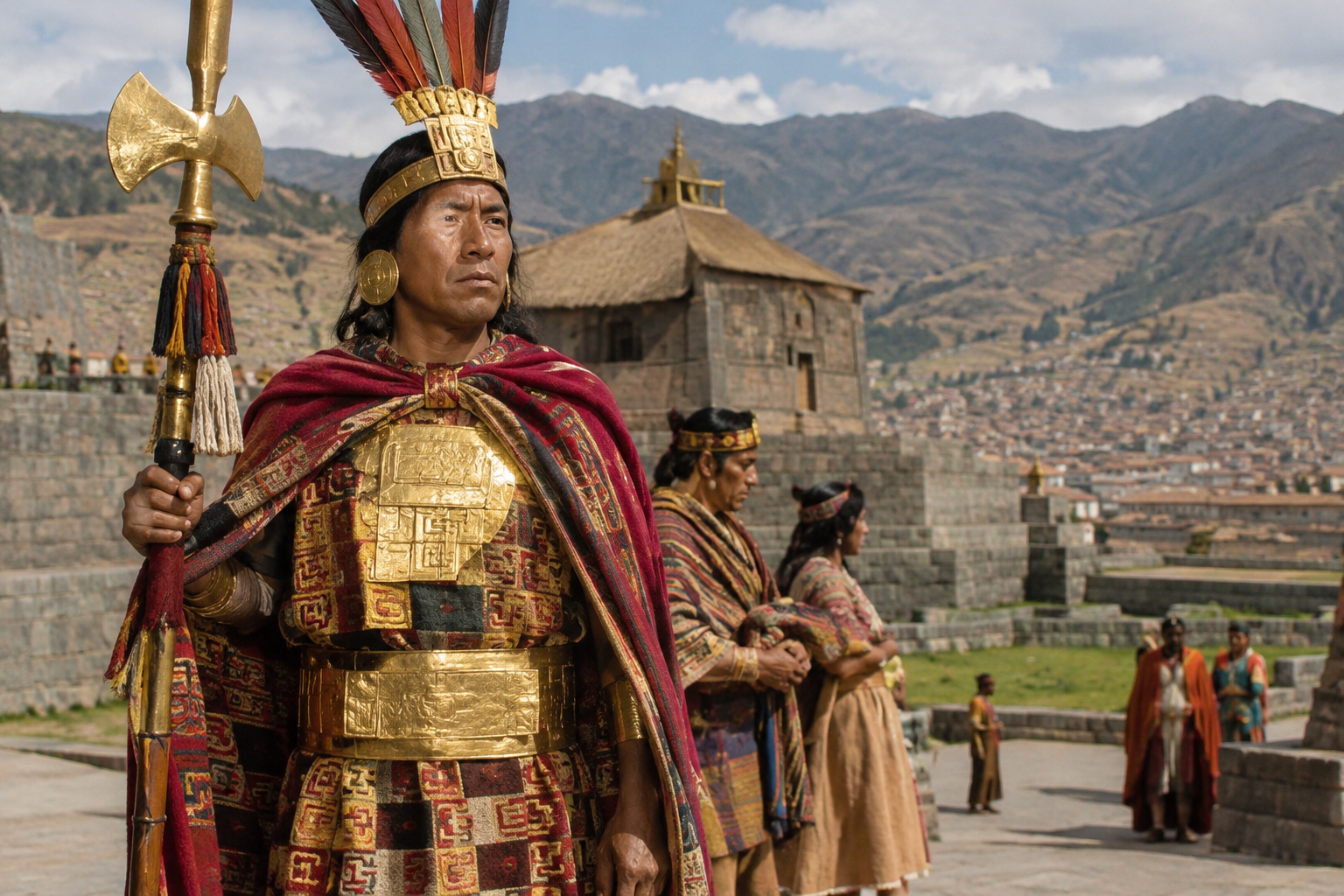
In Cusco, at the site of Qotakalli, one late pre-Hispanic man has become unexpectedly important for the history of a very old paternal line. He is recorded as sample QKI-21-1, dated to about AD 1425, in the heartland of the Inca world. For the haplogroup Q1b1a1a1i1a1b, that matters because it places this branch squarely inside the political and ceremonial landscape of the Andes just before the Spanish conquest.
There is something rather bracing about evidence like this. Not a legendary founder, not a romanticized emperor, but a real excavated individual from Cusco City. Y-DNA follows one direct paternal line only, not the whole ancestry of a person or people, yet even that narrow line can illuminate where male lineages were present at crucial historical moments. In this case, Q1b1a1a1i1a1b appears in an Inca-period context at the imperial center itself.
Qotakalli is not merely a point on a map. It belongs to the wider archaeological world of Cusco, the city that became the political and sacred core of the Inca state. By the early fifteenth century, when QKI-21-1 lived, Cusco was already expanding into the capital of a fast-growing empire whose influence reached far beyond the highlands of southern Peru.
The significance of QKI-21-1 is therefore quite specific. This is not just an ancient American Y-chromosome in a broad sense, but a paternal lineage found in an urban Inca-period setting associated with the imperial heartland. That does not mean every bearer of this branch was Inca nobility, nor that one man can stand for all of Cusco. It does mean that Q1b1a1a1i1a1b was present within one of the most historically consequential cities in the pre-Columbian Andes.
A wider ancient DNA study of the region, published in Science Advances, has helped sharpen this kind of picture by examining population history in Peru across different places and periods. The important point here is not to over-claim from one lineage, but to place it in a real archaeological setting: late pre-contact Cusco, during the age of Inca power.
Ancient DNA from Chincha, Peru
The first thing to say is that Q1b1a1a1i1a1b is a very narrow branch within the wider Y-DNA haplogroup Q. Haplogroup Q is one of the major paternal lineages associated with the peopling of the Americas, but that broad statement should not be carelessly transferred to every tiny downstream branch. A deep subclade like this tells a more local and more recent story within that larger paternal framework.
That is why a sample such as QKI-21-1 is useful. It anchors the branch in time and place. Rather than talking vaguely about "Native American ancestry," we can point to one documented man from Inca-period Cusco whose direct paternal line is associated with this specific subclade.
There is also a historical lesson here. Empires such as the Inca did not erase older local lineages; they gathered, reorganized, and ruled over populations that already had long regional histories. A paternal branch found in Cusco in about AD 1425 may reflect local continuity, movement into the city from nearby regions, or the concentration of many Andean communities in an imperial capital. The haplogroup alone cannot choose between those possibilities, but archaeology helps us frame them properly.
By the fifteenth century, the Andes were anything but isolated. Roads, labor obligations, resettlement policies, exchange networks, and ritual landscapes all tied distant communities together. Cusco was the greatest expression of that integration. So when a paternal lineage appears there, the question is not simply "where did it begin?" but also "how did imperial life gather men and families into the city?"
That matters especially for interpreting Q1b1a1a1i1a1b. A branch found in imperial Cusco might represent a line established in the region long before Inca expansion, or one drawn into the capital through the political machinery of the state. Inca rule famously moved people as well as goods. Ancient DNA gives us a way to test that history, one burial at a time, even when the evidence remains fragmentary.
Recent work on Andean populations has repeatedly shown that pre-Columbian Peru was genetically structured, historically dynamic, and full of regional continuities that survived major political change. That larger pattern makes QKI-21-1 especially interesting: not because he solves the whole puzzle, but because he fixes this paternal line inside a society we can place historically with confidence.
Indigenous Andeans and adaptation
Readers sometimes assume that one ancient sample is too little to matter. But archaeology is full of cases where a single securely dated individual changes the map of what can be said. QKI-21-1 does exactly that for Q1b1a1a1i1a1b. He demonstrates that this paternal branch had reached, or was already established in, Cusco during the late pre-Hispanic period.
That is a small claim, but a sturdy one. It is sturdier, in fact, than grander stories that try to leap from a haplogroup straight into ethnic labels, dynastic fantasies, or modern identity politics. We do not need to pretend that one man represents all Inca subjects. It is enough to recognize that his lineage belonged to the human landscape of the imperial Andes.
There is also a methodological point worth making. Ancient Y-DNA becomes most useful when combined with context: date, place, settlement history, and regional comparison. Without that, haplogroups drift into abstraction. With it, even a single record like QKI-21-1 becomes historical evidence rather than just a string of letters and numbers.
Cusco in the fifteenth century was not a village of one descent group. It was a capital, a ritual center, and an administrative engine. People arrived there through kinship, service, power, pilgrimage, and obligation. That makes the city exactly the sort of place where ancient DNA can reveal how broad political structures were built out of many local paternal and maternal lines.
For Q1b1a1a1i1a1b, the Cusco evidence suggests not an abstract prehistoric survival but a lineage still active in a living historical world on the eve of colonial disruption. The Spanish invasion would transform the demography and social organization of the Andes with extraordinary violence and speed. A pre-conquest sample from Cusco therefore captures a paternal line before that rupture.
Pre-Columbian Andean biohistory
If you belong to Q1b1a1a1i1a1b, the most solid historical takeaway is not a promise of royal descent or a tidy migration tale. It is that your direct paternal line is associated here with a documented man from Inca-period Cusco, sample QKI-21-1, around AD 1425. That places the branch within the late pre-Columbian Andes at one of the most important urban centers in the Americas.
In other words, this haplogroup is not floating in the deep past without context. It appears in a real city, at a decisive historical moment, in the world of the Inca before conquest remade everything. That is already a remarkable inheritance for one paternal line to carry.
Comments