Haplogroup Q1b1a

– 4 min read


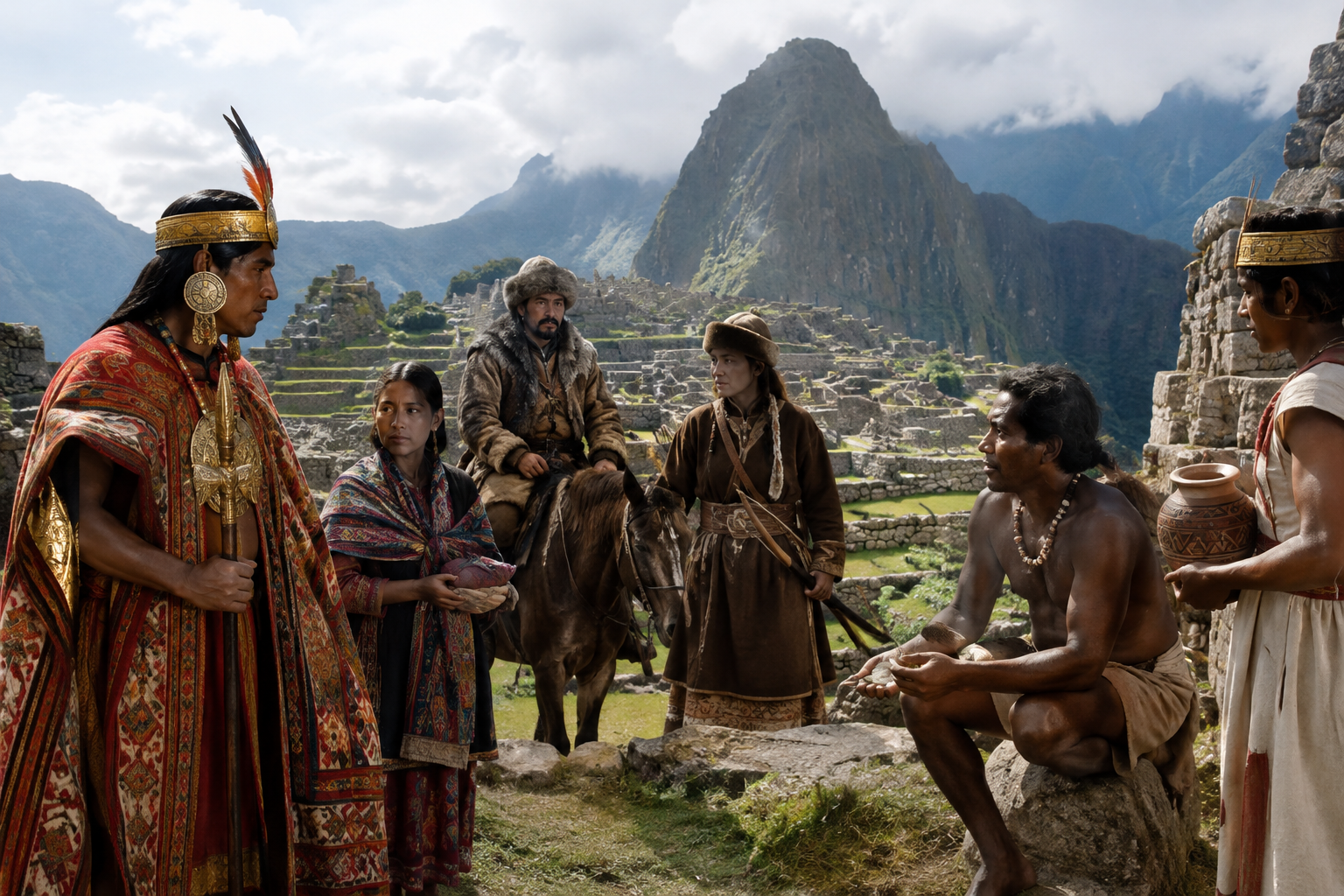
At Sacsahuaman above Cusco, and at Machu Picchu high in the Andes, archaeologists and geneticists are dealing not with legend but with named ancient individuals. Two men dated to around AD 1500, SHN-212 from Sacsahuaman and MP53a from Machu Picchu, are associated here with Y-DNA haplogroup Q1b1a. That is immediately interesting, because it places this paternal line in the heartland of the Inca world at the moment just before Spanish conquest transformed the Andes forever.
Q1b1a is a Y-chromosome branch, so it follows one direct paternal line only: father to son to son. It does not describe the whole ancestry, language, or identity of a person. But when the same branch appears in very different archaeological settings, it gives us a narrow, rather stubborn thread to follow through history. In this case that thread runs from the Andes and the Caribbean back across Inner Asia, appearing in contexts as different as an Inca imperial center, a Bahamian cave burial, an Iron Age Scythian grave in Kazakhstan, and a Late Bronze Age site in Mongolia.
The strongest opening evidence for this haplogroup comes from the late pre-Hispanic Andes. SHN-212 is recorded from Sacsahuaman, the monumental complex overlooking Cusco, and MP53a from Machu Picchu, both around AD 1500. These are not just random dots on a map. They belong to places central to Inca political and ceremonial life, and that gives Q1b1a a secure foothold in one of the best-known Indigenous states of the Americas.
That does not mean Q1b1a was an "Inca haplogroup" in any exclusive sense. Empires gather people. The Inca state drew in communities from across the Andes through alliance, labor obligations, resettlement, and pilgrimage. Still, the presence of this paternal line in two major Inca-era settings tells us that Q1b1a was part of the male population living within that imperial world, not merely a remote or peripheral survival.
A genetic study of ancient Andean populations has helped sharpen this broader picture of continuity and movement in the region, even if individual Y-line assignments must always be handled carefully at sample level: research on ancient Andean DNA has shown how much local population history matters when we move from imperial history down to real communities and families.
A very different appearance of Q1b1a comes from Preachers Cave in the Bahamas, where sample PCV003 is dated to about AD 1137. Here the setting is pre-Columbian Caribbean, not the high Andes. That matters because it reminds us that this paternal branch was not confined to one famous civilization or one ecological zone. It belonged to the wider human history of the Indigenous Americas.
The Bahamas have become especially important for ancient DNA because preservation conditions are often difficult, so every successfully analyzed individual carries unusual weight. A man from Preachers Cave associated with Q1b1a suggests that this branch formed part of the paternal diversity of Caribbean communities before European contact. It is a useful corrective to older historical habits of treating island populations as marginal appendages to mainland history. They had their own lineages, their own local continuities, and their own mobility networks.
Research on ancient Caribbean remains has steadily improved that picture, especially where preservation once seemed too poor for confident recovery. For readers interested in how these island populations are being reconstructed from difficult evidence, the wider context is well worth exploring.
Long before the Inca and long before PCV003 in the Bahamas, the same haplogroup label appears in sample BRE027 from Berel in East Kazakhstan, dated around 300 BC and described as Scythian. Berel belongs to the wider Pazyryk horizon of the Iron Age steppe, a world of elite burials, horse-centered mobility, and striking long-distance cultural links across Inner Asia.
Now, one must be careful here. The appearance of Q1b1a in a Scythian-context burial does not mean that later American carriers of Q1b1a can be straightforwardly tied to Scythians, nor that Scythian identity can be reduced to a single paternal line. Steppe populations were mixed and mobile, and archaeological cultures are not the same thing as Y-DNA branches. But BRE027 does show that this paternal lineage, or a lineage classified close to it, was present in Inner Asia in the first millennium BC.
That is historically important because haplogroup Q as a broader family is deeply associated with northern Eurasia and the peopling of the Americas. A branch such as Q1b1a appearing in both Inner Asian and Indigenous American contexts fits that larger background, though the precise route and branching history for this exact subclade cannot be reconstructed from a handful of samples alone.
The record reaches still further back with ARS018 from Arbulag Soum in Mongolia, dated to about 1060 BC in the Late Bronze Age. This is perhaps the most revealing sample for the deep background of the article, because it places Q1b1a, or an associated reported classification, in the eastern steppe centuries before the Scythian period represented by Berel.
The Late Bronze Age Mongolian steppe was not an empty prelude to later nomad empires. It was already a zone of herding, exchange, shifting populations, and regional interaction on a large scale. A reported Q1b1a presence there suggests that the paternal history behind later Inner Asian and American distributions was already being shaped in this broad northern Eurasian arena.
That wider steppe setting has been transformed by archaeogenetics over the last few years. A major ancient DNA study of the region, published on the genetic history of the Mongolian steppe, helped establish just how dynamic these populations were across millennia. Even where one cannot claim a neat one-to-one story for a single branch, the general lesson is clear enough: steppe history was made through repeated mixtures, expansions, and local survivals rather than by one simple migration.
What makes Q1b1a distinctive in this set of evidence is not sheer quantity but range. In the material discussed here, it appears in Late Bronze Age Mongolia, Iron Age Kazakhstan, pre-Columbian Bahamas, and the Inca Andes. That is an unusually broad historical spread, and it suits what we know of the wider haplogroup Q family: a northern Eurasian paternal background with important branches in the Indigenous Americas.
For someone researching a present-day Q1b1a line, the most responsible conclusion is also the most interesting one. This is a paternal branch with a credible deep history on both sides of the Pacific world shown by ancient DNA, and with especially meaningful appearances in pre-Columbian American contexts. It does not pin your ancestry to one empire, one tribe, or one famous individual. But it does place your direct male line inside a very old story of northern Eurasian depth and Indigenous American continuity.
Comments