Haplogroup Q1a2a1a

– 5 min read


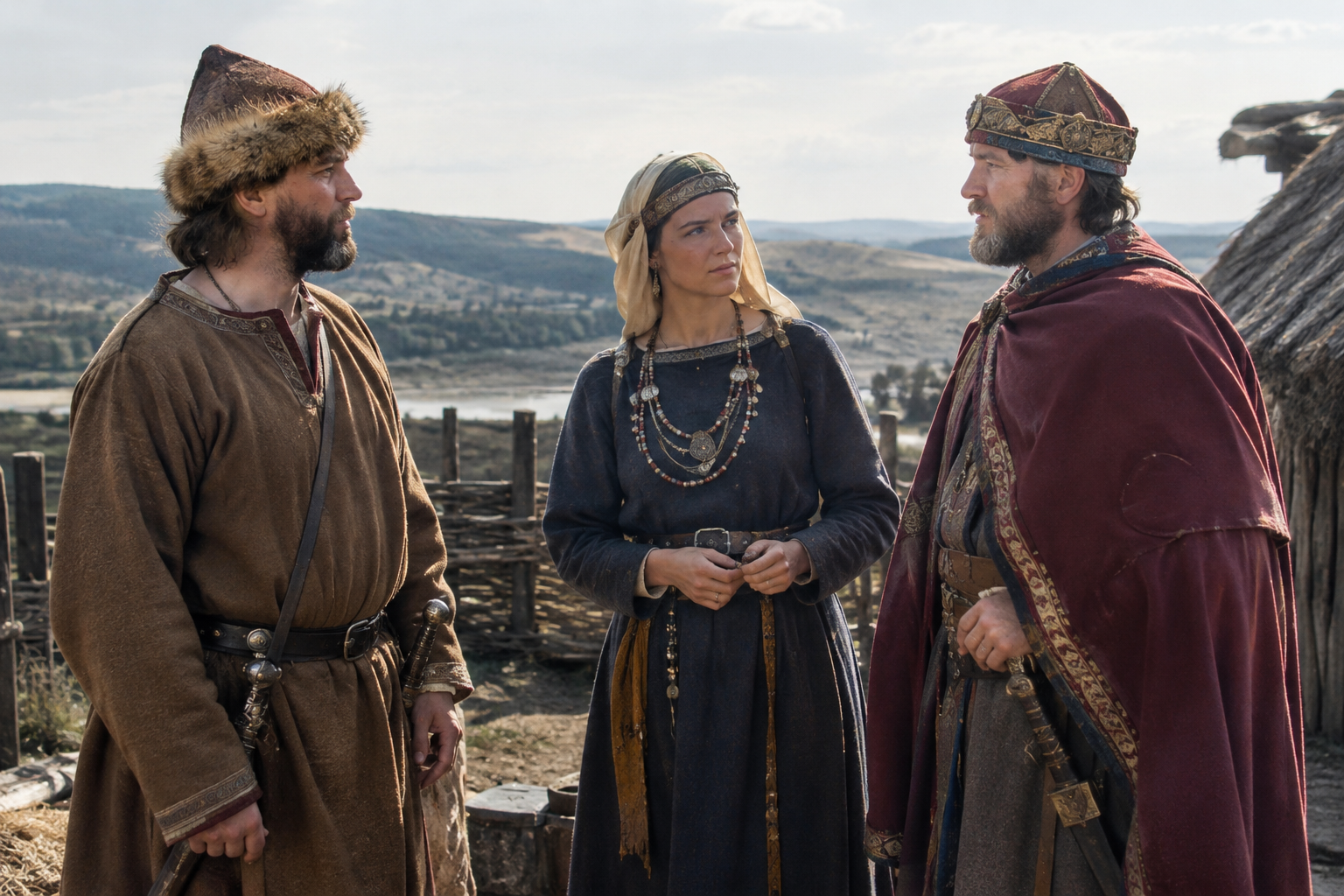
At Arkus-Homokbanya in Hungary, two men from the Late Avar period stand out for a very specific reason. Sample ARK-6, dated around AD 750, and sample ARK-36, dated around AD 800, are both associated here with the Y-DNA haplogroup Q1a2a1a. That is immediately interesting because the Avar world in the Carpathian Basin was never a simple, uniform population. It was a frontier society, a political federation, and a place where steppe lineages, local Europeans, and later newcomers could all meet in the same cemetery record.
A little later, another man linked to the same branch appears farther south in medieval Bulgaria: I2525 from Veliko Tarnovo Samovodene, dated to about AD 949. Three samples are not a dynasty, and they are certainly not an entire people. But taken together, they make Q1a2a1a visible in a very particular historical zone: the eastern and southeastern fringes of medieval Europe, where steppe connections remained active long after Roman power had faded.
Y-DNA follows one narrow line of descent: father to son, back through time. That makes haplogroups useful for tracking paternal ancestry, but not for reducing a whole person, cemetery, or culture to one label. In this case, the important point is that Q1a2a1a is a specific branch within the wider haplogroup Q, a lineage with deep roots across northern Eurasia and a long history in Inner Asia as well as in the Americas through other branches.
That wider background matters, but it should not be carelessly pasted onto every subclade. For this article, the real evidence is much narrower. What we can say is that men associated with Q1a2a1a appear here in early medieval contexts tied to the old steppe corridor into the Carpathian Basin and the Balkans. That alone makes the branch historically evocative: it turns up not in an abstract map, but in places shaped by Avar and post-Avar mobility.
An ancient DNA study of the Avar-period Carpathian Basin helped show just how varied these communities could be, with some groups carrying stronger eastern connections than others. That broader regional framework is central to understanding why a haplogroup like Q1a2a1a can appear in Hungary during the eighth century without needing any melodramatic story attached to a single grave. See the research context here: https://www.science.org/doi/10.1126/science.abm4247.
The strongest pattern in this small set of evidence comes from Arkus-Homokbanya, because it gives us two men, ARK-6 and ARK-36, in the same Late Avar setting. The Avar Khaganate had already endured major political shocks by this time, including pressure from the Franks and internal fragmentation. Yet cemeteries from the Late Avar period show that communities remained rooted in the Carpathian Basin while still preserving traces of their diverse origins.
That is exactly where a paternal lineage like Q1a2a1a becomes historically useful. One sample could always be dismissed as an isolated arrival. Two men from the same site, across roughly half a century, suggest something more durable: not necessarily close kin, and certainly not a ruling house, but a local paternal presence surviving within a settled Late Avar population.
The key point is that the Avar label is political and archaeological, not a genetic essence. Avar-period cemeteries can contain lineages that reflect steppe ancestry, local European ancestry, or mixtures of both. Q1a2a1a fits neatly into that larger lesson. It reminds us that the Avar world was assembled from people, not stereotypes.
For readers tracing a modern Q1a2a1a line, the temptation is to leap straight from a medieval grave in Hungary to a named migrating tribe. History is not so obliging. Still, the placement of these two Arkus-Homokbanya men is meaningful because the Avar period sits within a long chain of steppe-linked movements into Europe, involving Huns, Avars, Bulgars, and later Magyar-associated populations, all interacting with older inhabitants of the basin.
What a lineage like this may preserve is not a neat ethnic badge, but a memory of those movements. In the Carpathian Basin, paternal lines with eastern associations can survive inside communities that were by then culturally mixed and locally established. That is often how real history works: not as a single migration event frozen in time, but as generations of settlement, marriage, alliance, and adaptation.
The third sample, I2525 from Veliko Tarnovo Samovodene, dated around AD 949, shifts the picture south into medieval Bulgaria. By the tenth century, this was a region shaped by the First Bulgarian Empire, Slavic-speaking populations, older Balkan communities, and the lingering heritage of steppe-origin elites. A Q1a2a1a-associated paternal line here is therefore not out of place; if anything, it suits the historical landscape rather well.
What makes Samovodene valuable is not that it proves continuity from the Avars in any simple genealogical sense. It is valuable because it shows the same branch, or at least the same reported haplogroup assignment, appearing again in a neighboring region where steppe and Balkan histories had also been deeply entangled. In other words, Q1a2a1a is not appearing in one isolated pocket. It is visible in more than one early medieval society along the old corridor between the Pontic steppe, the lower Danube, and the Carpathian Basin.
Research on early medieval populations in and around Bulgaria has repeatedly emphasized mixed origins rather than tidy ethnic packages. That broader pattern is relevant here. The men buried in these landscapes belonged to political communities shaped by conquest and migration, but also by ordinary local continuity.
If we step back from the individual graves, the most striking thing about Q1a2a1a in this evidence is geographical rather than numerical. Hungary and northern Bulgaria were both zones of transmission: armies moved through them, empires claimed them, and communities re-formed within them. The paternal signal we see here belongs to that world of movement and resettlement.
That does not mean every man with this lineage rode west from Inner Asia, nor that all such men shared one recent common historical identity. But it does suggest that Q1a2a1a had a place in the male lineages circulating through early medieval eastern Europe, especially in societies marked by steppe influence. Another study relevant to this broader regional backdrop examined post-Roman and Migration-period populations in the area and helps frame how varied these communities could be: https://www.sciencedirect.com/science/article/pii/S0960982222007321#app2.
That is one reason ancient DNA has changed the historical conversation. Older narratives often imagined sharply bounded peoples arriving fully formed. The genetic evidence keeps nudging us back toward a messier and more plausible picture: federations, mixed households, absorbed newcomers, local survivors, and paternal lines that outlasted the political names attached to them.
On present evidence, Q1a2a1a has a historically suggestive foothold in the early medieval Carpathian Basin and the Balkans, especially in settings touched by steppe-connected populations. The memorable detail is not grandeur or dynasty, but recurrence: two Late Avar men at Arkus-Homokbanya and a later medieval man at Samovodene together hint that this paternal line was part of the human fabric of that frontier world. For someone researching this haplogroup today, that is the useful takeaway. Your direct paternal line may connect, not to a single named people, but to the long and complicated zone where eastern steppe history met medieval Europe.

Comments