Haplogroup O2a2b1a2a1a

– 6 min read


Some Y-chromosome lineages announce themselves in royal tombs or steppe war graves. Haplogroup O2a2b1a2a1a tells a rather different story. Its importance, at least from the evidence supplied here, lies in the remarkable depth of its presence in China: from Late Neolithic men at Baligang in Henan Province around 3000 BC to a Late Ming Dynasty individual from Guangxi in south China around 1600 AD. That is a span of more than four millennia, and it offers a vivid reminder that the most historically important paternal lineages are not always the ones attached to a single conquest or dynasty, but the ones that help map long continuities across settled landscapes.
Y-DNA haplogroups trace one very specific line of ancestry: the direct paternal line, from father to son to son again. They do not describe a person's whole ancestry, culture, language, or identity. Still, when ancient DNA repeatedly turns up the same paternal branch in different times and places, it gives us a precious tool for reconstructing how male lineages endured, spread, and changed alongside farming communities, regional societies, and later states.
Haplogroup O is one of the major Y-chromosome lineages of East and Southeast Asia, and branches within O have long been important in studies of East Asian population history. A highly specific subclade such as O2a2b1a2a1a should be handled with care. We should not simply pour the entire deep history of haplogroup O, or even of broader O2 branches, into this narrow label as if all levels of the tree were interchangeable. What we can say more safely is that this lineage belongs within a paternal framework strongly associated with East Asian population history, and that the ancient samples supplied here place it in northern and southern China across a very long timespan.
That matters because ancient Y-DNA helps us move beyond broad modern distributions and into real historical settings. Instead of abstract frequency maps, we get named archaeological sites, dates, and human remains. In this case, the evidence points toward a lineage present in the world of late Neolithic communities in the Central Plains and still present, many centuries later, in Ming-period south China.
Explore East Asian Y-DNA Migrations
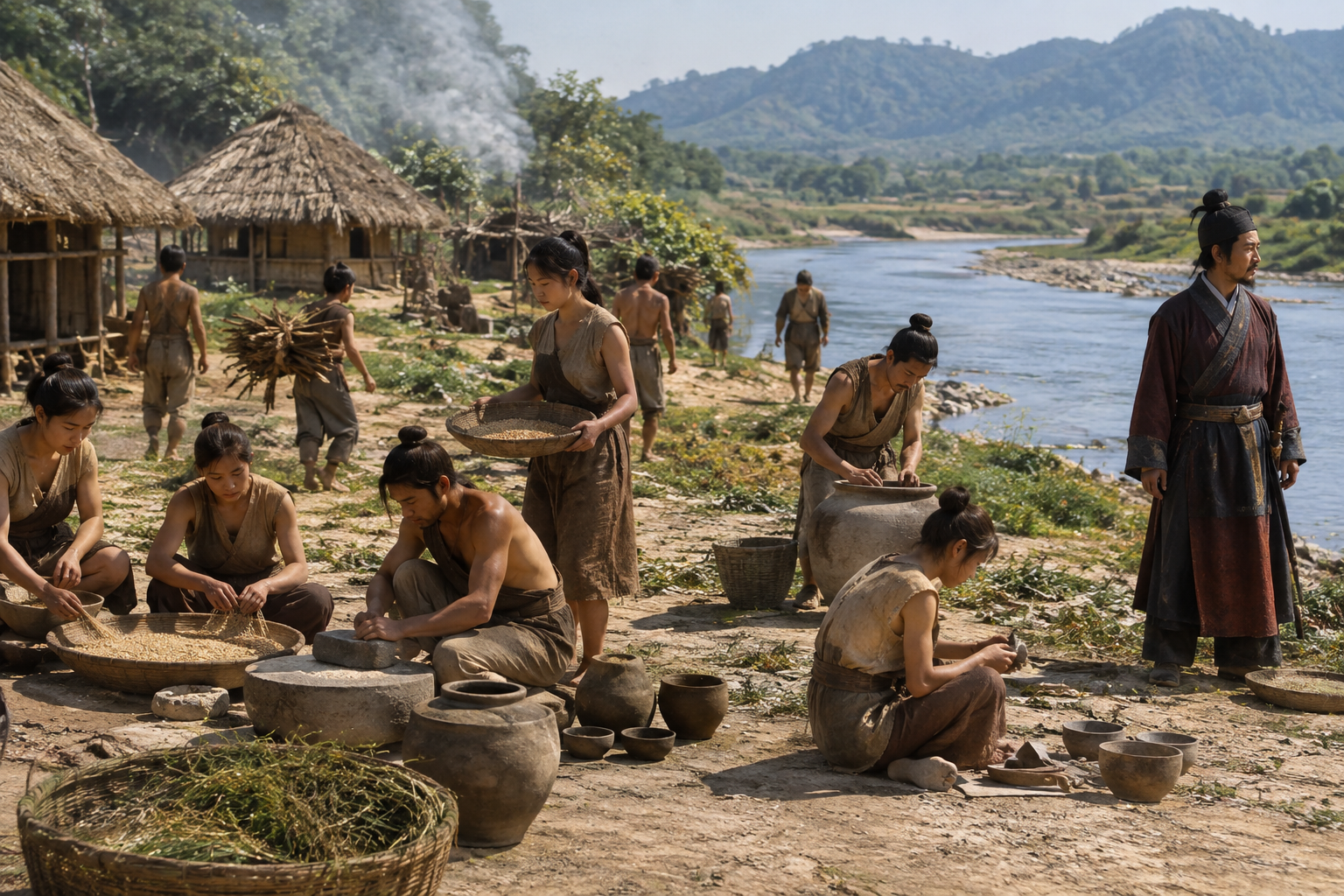
The most striking concentration of evidence comes from Late Neolithic China Baligang Tuan River Henan Province Year:3000 BC. Not just one man, but a substantial cluster of individuals from this setting appears in the supplied data: BLG-M13-20, BLG-M167, BLG-M174, BLG-M224-3, BLG-M231, BLG-M76-2, BLG_M13-12, BLG_M13-25, BLG_M13-30, BLG_M13-4, BLG_M13-44, BLG_M13-51, BLG_M13-68, BLG_M13-7, BLG_M13-77, BLG_M13-8, BLG_M13-88, and BLG_M13-89.
That concentration is historically suggestive. Baligang, in Henan, lies in a region central to the development of early farming societies in northern China. The Tuan River setting places these men in a landscape of cultivation, settlement, kinship, and local community life. When so many individuals from one Late Neolithic context are associated with the haplogroup under discussion, it hints at more than an isolated arrival. It suggests that closely related paternal lines, or at least the same narrow branch of a paternal lineage, had become well established in that local population.
Of course, caution is needed. Shared Y-DNA does not mean all these men were close relatives, nor does it prove a single family tomb. But it does make the site especially valuable for understanding how paternal structure worked in Neolithic China. A cluster like this can reflect founder effects, lineage persistence, or the importance of local male descent groups within settled communities.
And there is something rather arresting about the scale of it. We are not looking at one famous grave; we are looking at a pattern. In historical terms, that can be far more revealing. It is often the repeated ordinary burial, not the sensational elite one, that tells us how populations were actually composed.
Read 6,000 Years of Yellow River DNA
The later anchor point in the dataset is Ancient Individual:Late Ming Dynasty South China Guangxi Baitaishan Year:1600 AD ID:NBT_1-1. Here the setting is wholly different. We are no longer in the Late Neolithic world of village farming along the Tuan River, but in the early modern era, in Guangxi, deep in south China, during the closing centuries of the Ming Dynasty.
This does not prove that NBT_1-1 descended directly from any particular man at Baligang. That would be far too strong a claim. But taken together, the Baligang cluster and the Guangxi sample show something historically important: this paternal branch was present in multiple regions of China across an enormous span of time. That raises questions about demographic continuity, internal migration, and the ways lineages spread through long-settled agrarian societies.
One possibility, broadly speaking, is that lineages within this part of haplogroup O participated in the long peopling and re-peopling of different Chinese regions as populations expanded, mixed, and reorganized over thousands of years. Another possibility is that the branch remained more regionally structured for long periods and only later became more widely distributed through state formation, resettlement, frontier development, or ordinary family migration. The supplied evidence does not let us choose neatly between those scenarios, but it does show why ancient DNA matters: it grounds such questions in real places and dates.
The shift from Henan to Guangxi is especially evocative because it spans not just time but geography. Henan belongs to the historical heartland of many early Chinese developments; Guangxi sits in the more southerly, culturally varied landscapes of later imperial China. A paternal lineage appearing in both contexts reminds us that the history of China was made not only by courts and capitals, but by the movement and persistence of countless households.
Explore Southwest China Ancient DNA
The supplied samples give us a powerful but limited form of evidence. They show that a paternal lineage identified as O2a2b1a2a1a or closely associated with it appears in a Late Neolithic Henan context and again in Late Ming Guangxi. That is already significant. It helps place the lineage in the archaeological record rather than only in modern testing databases.
But the limits are just as important. A shared haplogroup is not proof of shared ethnicity, shared language, or membership in one enduring clan across 4,600 years. Nor does it tell us that these men thought of themselves as part of a single people. Y-DNA records one line only. Each of these individuals also had countless other ancestors whose stories are not captured by the paternal label alone.
Still, the paternal line can be unusually revealing when many samples point in the same direction. The Baligang material suggests local depth in the Neolithic Central Plains. The Guangxi sample suggests later geographical breadth. Put together, they help sketch a lineage that belonged not to a passing episode but to the long demographic making of China.
Readers interested in later Chinese kinship patterns may also find it useful to compare this with work on historical family structure in imperial China, where genetics can illuminate how descent, marriage, and burial practice intersected with written records.
See DNA in a Tang Dynasty Clan
In this case, the supplied field for associated noble families and castles appears to be empty. That absence is worth stating plainly rather than papering over with guesswork. There is therefore no responsible basis here for attaching haplogroup O2a2b1a2a1a to a named dynasty, aristocratic house, clan seat, or castle.
And in truth, that is not a weakness. It is a useful reminder of how archaeogenetics and documentary genealogy work differently. Written genealogies often begin with elites: men important enough to appear in chronicles, land grants, or lineage books. Ancient DNA often begins elsewhere, with excavated communities, burial grounds, and unnamed individuals. The two kinds of evidence can sometimes meet; sometimes they do not. Here, the story remains grounded above all in archaeology.
That does not make it any less historical. Quite the reverse. These Baligang men and the Ming-period individual NBT_1-1 belong to the human background out of which later lineages, local identities, and regional societies emerged. Before castles and noble pedigrees there were farmers, settlements, inheritance patterns, and male lines that either endured or vanished. Haplogroup studies help us see some of that deeper scaffolding.
What makes O2a2b1a2a1a fascinating is not the claim that it belonged to some single famous conqueror. It is the opposite. The evidence supplied here shows a paternal branch embedded in the long history of Chinese populations, visible in a dense Late Neolithic sample set from Henan and still present in south China during the Ming era. That kind of continuity, however partial and cautious our interpretation must be, is exactly what makes ancient DNA so valuable.
It lets us ask big historical questions with unusual precision. How stable were paternal lineages in early farming communities? How far did some branches spread across the great north-south span of China? Which male lines stayed locally important for millennia, and which expanded into new regions? Every ancient sample adds a little more shape to those questions.
For MyTrueAncestry users, that is part of the excitement. A Y-DNA result is not a complete biography, and it is certainly not a shortcut to claiming descent from a dynasty or a famous house. But it can connect your paternal line to ancient populations, real archaeological sites, and long patterns of continuity that no paper family tree could ever reach.
If you want to explore whether your DNA shows links to ancient individuals such as those from Baligang or later historical populations, MyTrueAncestry can offer a remarkable new perspective. These matches do not necessarily prove direct descent, but they can place your ancestry within the wider human story revealed by archaeology and ancient DNA.
Comments