Haplogroup N1a1a1a1a1a1a6
– 5 min read


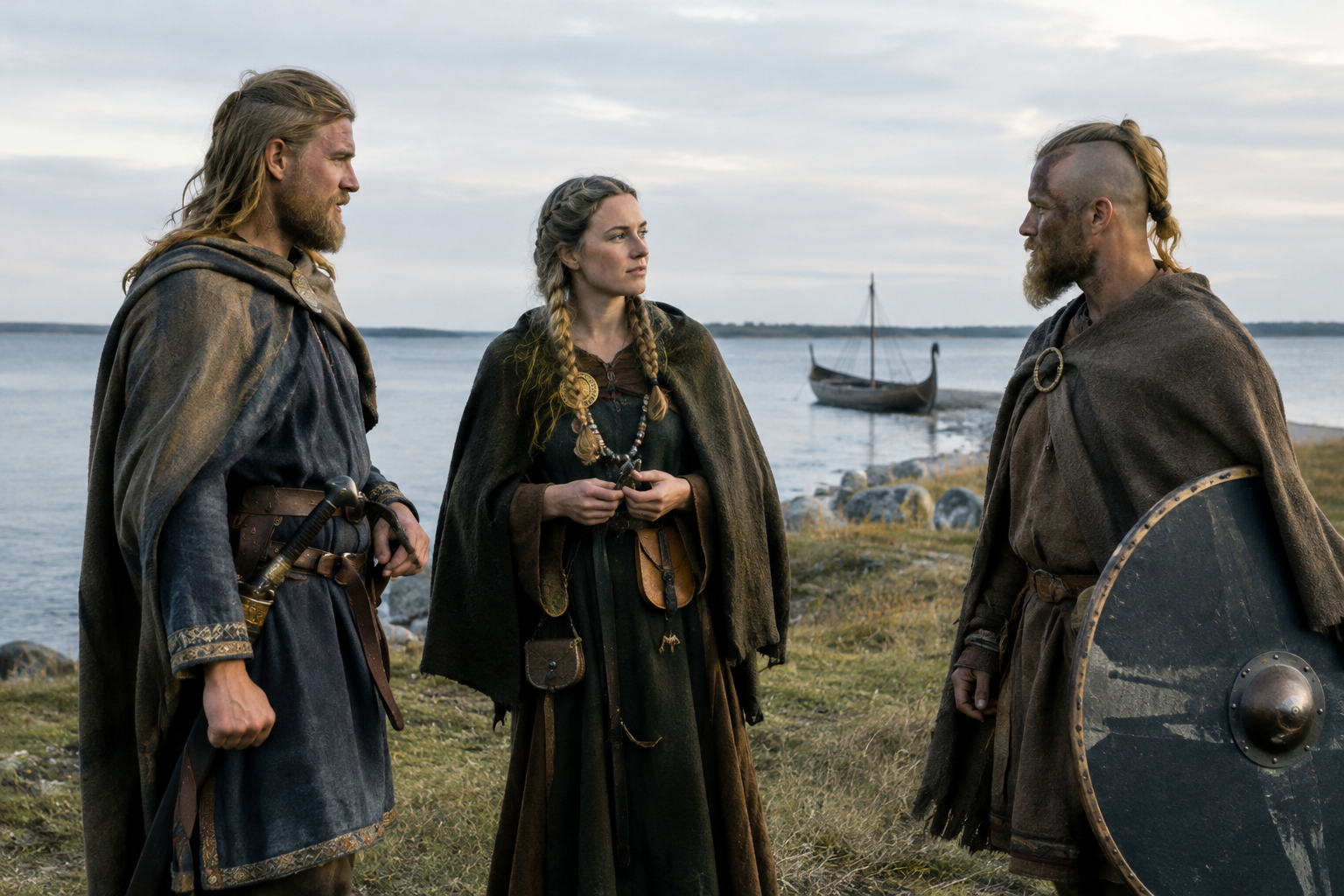
At Varnhem in Skara, in western Sweden, one Viking Age man dated to about AD 1050 was identified as sample VK399. On paper that may look like a dry laboratory label, but it is exactly the sort of clue that changes how we picture the north. VK399 is associated here with Y-DNA haplogroup N1a1a1a1a1a1a6, a very specific paternal line found not in some remote prehistory alone, but among people living in the Scandinavian world at the end of the Viking Age.
That matters because Y-DNA follows one direct male line only: father to son, and so on. It does not describe a person's whole ancestry, language, or identity. But when the same narrow paternal branch appears in more than one archaeological setting, it gives us something precious: not a legend, but a pattern. In this case, the pattern runs through Viking Age and late Iron Age sites around the Baltic, including Sweden and Saaremaa in present-day Estonia.
VK399 from Viking Age Skara Varnhem is the clearest starting point because the setting is historically rich even when the genetic note is brief. Varnhem is one of those places where early medieval Scandinavian history becomes tangible: a religious and political landscape in western Sweden, active at a moment when older Viking Age networks overlapped with expanding Christianity and new forms of kingship.
To place a man from this world on the branch N1a1a1a1a1a1a6 is a reminder that Scandinavian society was not made from a single paternal stock. The old popular picture of "the Viking" as genetically uniform has been steadily dismantled by archaeology and ancient DNA alike. Instead, we find mobility, mixture, and regional variation, especially around the Baltic Sea where trade, raiding, marriage, migration, and military service all pulled men into contact.
An ancient DNA study examining Viking Age populations, available at https://www.biorxiv.org/content/10.1101/703405v1, helped establish just how broad and complex that world was. Even without forcing every detail onto one individual, VK399 fits that larger archaeological picture: Scandinavian communities included paternal lines with deeper northern and northeastern Eurasian associations as well as lines more common farther south and west in Europe.
The most intriguing comparison is sample VK481, dated to about AD 725 from the Vendel Age site of Salme II-IV on Saaremaa. Salme has become famous because it sits at the intersection of archaeology, violence, and seaborne movement in the eastern Baltic. This is not the end of the Viking world; it is one of the places where that world was being made.
Here the presence of a man associated with N1a1a1a1a1a1a6 is especially interesting because Saaremaa was no provincial backwater. It was part of a maritime zone linking eastern Sweden, the islands of the Baltic, coastal Estonia, and wider routes beyond. A paternal lineage appearing both at Salme in the eighth century and in Sweden later on suggests that this branch belonged to the real human traffic of the Baltic, not to some isolated pocket outside it.
That does not mean VK481 and VK399 were close relatives, nor that one site directly founded the other. What it does mean is that this branch had a place within the social world of the northern seaways. The eastern Baltic was not merely visited by Scandinavians; it was one of the arenas in which identities, alliances, and communities were formed.
Baltic connections in the north
A third sample sharpens the pattern. VK533, from Viking Age Oland in Sweden and dated to about AD 950, places the same haplogroup in another island setting at the heart of Baltic exchange. Oland was no quiet margin. Like Gotland and Saaremaa, it belonged to a busy maritime environment where ships, goods, people, and ideas moved with regularity.
When a narrow Y-line such as N1a1a1a1a1a1a6 turns up in both mainland-linked western Sweden and island or eastern-Baltic contexts, it becomes harder to dismiss as a one-off anomaly. We are looking instead at a paternal branch that had entered, and remained within, the Scandinavian-Baltic sphere by the eighth to eleventh centuries. The spread of these samples across time is modest, but it is meaningful: Salme around AD 725, Oland around AD 950, and Varnhem around AD 1050.
Chronologically, that sequence also spans an important transformation. The Vendel Age world of elite mobility and war-bands shades into the classic Viking Age, and then into the more settled Christian kingdoms of the eleventh century. A paternal line surviving across that arc suggests continuity through change. Men bearing this branch were present in the north before the Viking Age reached its fullest expression and were still there as the old order was giving way.
The exact branch name matters. N1a1a1a1a1a1a6 is not the same thing as the whole of haplogroup N, which is a very broad paternal family spread across northern Eurasia and found today in a number of Uralic-speaking, Baltic, Slavic, and Scandinavian populations. One of the most common mistakes in popular writing is to take the deep history of the parent haplogroup and paste it straight onto a very narrow subclade. That is not good enough.
What can be said more carefully is this: the branch represented by these samples sits within a wider paternal family that has long been important in the north and northeast of Europe. Its appearance in Viking Age and late Iron Age Baltic settings fits what we know from other ancient DNA work, namely that northern Europe was shaped not by a single migration or a single people, but by repeated movements and mixtures over a very long period.
That is why these Swedish and Saaremaa finds are so useful. They do not simply tell us that haplogroup N existed somewhere in northern Eurasia; that was never much in doubt. They show a much narrower paternal line already embedded in historically recognizable communities around the Baltic during the early medieval centuries.
Medieval Finland and archaeogenetics
If there is one wider historical lesson here, it is that the Baltic was a contact zone of astonishing density. Sweden, the eastern Baltic islands, coastal Finland, and lands farther east were connected by far more than occasional voyages. People moved for trade, fosterage, warfare, settlement, and service. Paternal lines could spread through all of these processes without carrying a single neat ethnic label along with them.
That is particularly worth stressing for a haplogroup like N1a1a1a1a1a1a6, because modern readers are often tempted to assign such branches too quickly to one modern nation or one ancient people. The archaeology pushes the other way. Salme, Oland, and Varnhem belong to related but distinct settings: an eastern Baltic martial context, an island in the middle of exchange routes, and a major Swedish early medieval landscape. The common thread is not a simplistic identity claim. It is participation in the connected northern world.
Other MyTrueAncestry discussions of northern populations, including work on Finland and wider northern Eurasia, help show that these patterns sit within a larger story of regional interaction rather than ethnic purity. Ancient DNA keeps returning us to the same conclusion: real past populations were messy, local, and mobile all at once.
For someone researching a present-day paternal line, N1a1a1a1a1a1a6 is interesting not because it points to a single famous ancestor, but because it appears in several genuine early medieval Baltic-Scandinavian contexts. The strongest supported insight is continuity of this narrow branch within the northern world from at least the Vendel Age into the late Viking Age. That does not make every bearer a Viking in the narrow popular sense, but it does place the lineage in the orbit of the seaways, islands, and evolving kingdoms of the Baltic north.




Comments